Disclaimer: Information found on CryptoreNews is those of writers quoted. It does not represent the opinions of CryptoreNews on whether to sell, buy or hold any investments. You are advised to conduct your own research before making any investment decisions. Use provided information at your own risk.
CryptoreNews covers fintech, blockchain and Bitcoin bringing you the latest crypto news and analyses on the future of money.


Concerns regarding the perceived centralization of Ethereum (ETH) staking pools may soon be addressed by a new staking framework designed to enhance private key security while minimizing validator downtime and slashing penalties.
In an exclusive interview with Cointelegraph, Alon Muroch, founder of SSV.network, explained how the platform’s distributed validator technology (DVT), developed in collaboration with the Ethereum Foundation, will contribute to the decentralization of ETH staking pools and validators.
SSV.network launched its public mainnet on September 14, with over 10 decentralized applications for staking deploying their platforms on the network. DVT is intended to decentralize the existing landscape of staking providers, which is currently dominated by a few ETH staking pools that hold a substantial portion of ETH locked in the ETH2 staking contract.
Related: SSV launches $50M ecosystem fund to support ETH staking tech
According to Muroch, the technology represents a method of validator security that distributes key management and signing duties among multiple parties, thereby reducing single points of failure and enhancing validator resilience.
This technology divides a private key used to secure a validator among a cluster of computers. This approach boosts security and permits some nodes within a validator cluster to go offline, which also diminishes single points of failure in the network and strengthens validator sets.
“By splitting keyshares among a diverse array of nodes in a cluster, validators become significantly more decentralized. Staking pools utilizing DVT can either decentralize their own infrastructure or delegate it to SSV.network node operators.”
Related Posts
Data from blockchain analytics firm Nansen indicates that Lido Finance represents 32% of ETH locked in the Beacon Chain deposit contract. ETH staking pools provided by Coinbase (8%) and Binance (4%) also hold a considerable share of staked ETH.
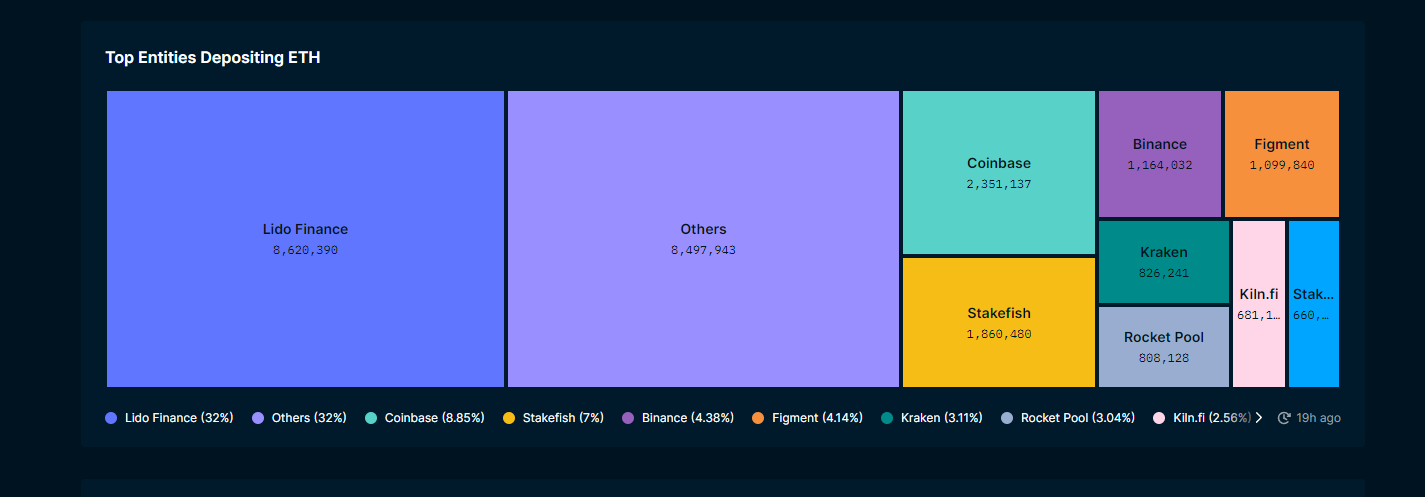 An overview of the largest ETH staking entities. Source: Nansen ETH2 Deposit Contract.
As SSV noted in a statement celebrating the mainnet launch, centralized exchanges such as Coinbase, Binance, and Kraken control approximately 18% of the total staked ETH, while liquid staking pools like Lido, RocketPool, Stader, and Stakewise account for over 36% of the overall market share.
Liquid staking pools gained immense popularity leading up to Ethereum’s highly anticipated Shanghai upgrade in July 2023. This event enabled Ethereum users to withdraw staked ETH from the Beacon contract for the first time.
SSV aims to provide an alternative to liquid and centralized staking pools, which it characterizes as “fundamentally centralized and custodial.” Muroch further stated that SSV can significantly enhance validator private key security and optimize rewards through high performance and a fault-tolerant configuration that prevents slashing penalties for offline validators.
SSV.network made headlines in January 2023 when it launched a $50 million ecosystem fund to support other projects utilizing DVT. This technology was previously recognized as a crucial element of Ethereum’s scaling roadmap outlined by co-founder Vitalik Buterin in December 2021.
Magazine: Are DAOs overhyped and unworkable? Lessons from the front lines
