Disclaimer: Information found on CryptoreNews is those of writers quoted. It does not represent the opinions of CryptoreNews on whether to sell, buy or hold any investments. You are advised to conduct your own research before making any investment decisions. Use provided information at your own risk.
CryptoreNews covers fintech, blockchain and Bitcoin bringing you the latest crypto news and analyses on the future of money.


The increase in Ethereum staking following significant network upgrades, namely the Merge and Shanghai, has resulted in heightened centralization and diminished staking yields, according to a recent report from JPMorgan.
Analysts at JPMorgan, led by senior managing director Nikolaos Panigirtzoglou, released a new investor note on Oct. 5, cautioning about the dangers associated with Ethereum’s increasing centralization.
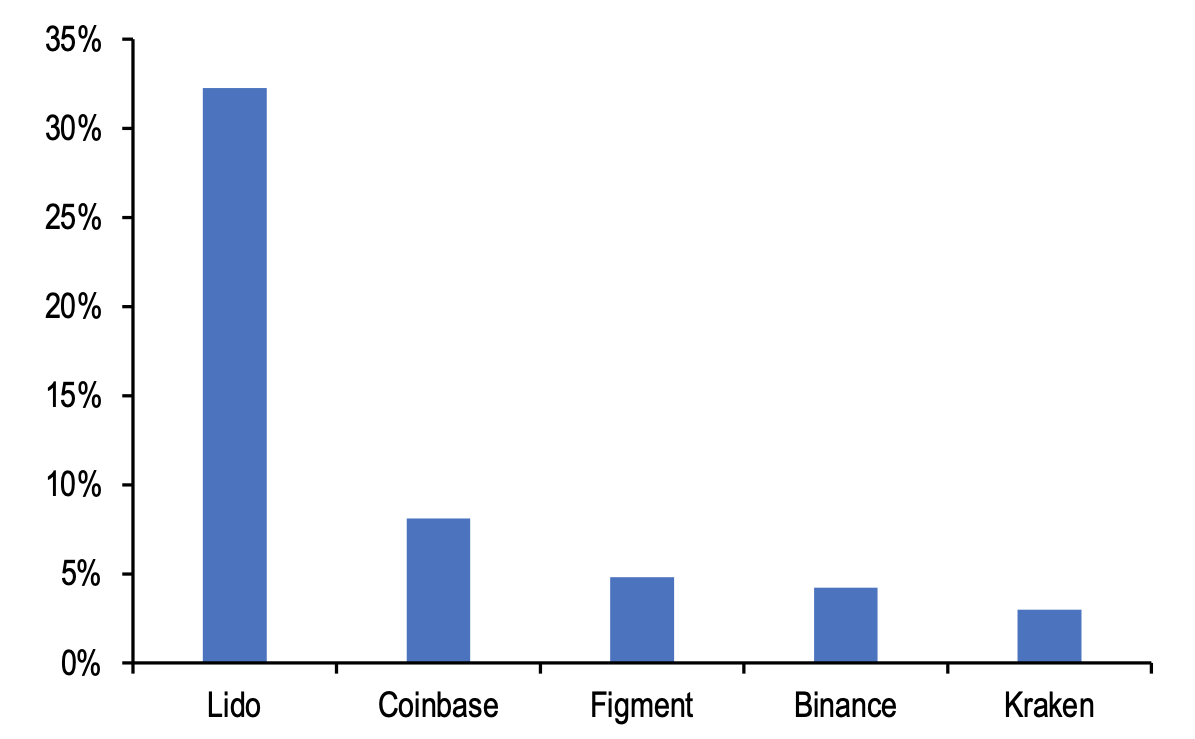 Market share of top five liquid staking providers. Source: JPMorgan
The report highlighted that the top five liquid staking providers—Lido, Coinbase, Figment, Binance, and Kraken—collectively control over 50% of staking on the Ethereum network, with Lido alone representing nearly one-third of that share.
The analysts pointed out that the crypto community has viewed the decentralized liquid staking platform Lido as a preferable option compared to centralized staking platforms linked to exchanges like Coinbase or Binance. However, in practice, “even decentralized liquid staking platforms involve a high degree of centralization,” the report stated, noting that a single Lido node operator manages more than 7,000 validator sets, equating to 230,000 ETH.
These node operators are chosen by Lido’s decentralized autonomous organization (DAO), which is governed by a limited number of wallet addresses, “rendering Lido’s platform relatively centralized in its decision-making,” the analysts explained. The report referenced an instance where Lido’s DAO dismissed a proposal to limit the staking share to 22% of Ethereum’s total staking to mitigate centralization.
“Lido didn’t engage in the initiatives as its DAO overwhelmingly rejected the proposal with 99% against,” JPMorgan analysts noted, adding:
Related Posts
“It goes without saying that centralization by any entity or protocol poses risks to the Ethereum network, as a concentrated number of liquidity providers or node operators could function as a single point of failure or become targets for attacks or collude to form an oligopoly […]”
In addition to increased centralization, post-Merge Ethereum is also linked to a general decline in staking yields, JPMorgan observed. The standard block rewards have fallen from 4.3% prior to the Shanghai upgrade to 3.5% at present, the analysts indicated. The overall staking yield has decreased from 7.3% before the Shanghai upgrade to approximately 5.5% currently, the report noted.
Related: Time to ‘pull the brakes’ on Ethereum and rotate back to Bitcoin: K33 report
JPMorgan analysts are not the only observers of Ethereum who have recognized a notable rise in centralization of the network following the Merge upgrade. Implemented on Sept. 15, 2022, the Merge has been regarded as a significant barrier to Ethereum’s decentralization and a primary factor in the reduction of yields.
you are the yield pic.twitter.com/ONJT6QmDch
— Pledditor (@Pledditor) October 5, 2023
Ethereum co-founder Vitalik Buterin has acknowledged that node centralization is one of Ethereum’s key challenges. In September 2023, he stated that discovering an ideal solution to address this issue may require another 20 years.
Magazine: Blockchain detectives — Mt. Gox collapse saw birth of Chainalysis
