Disclaimer: Information found on CryptoreNews is those of writers quoted. It does not represent the opinions of CryptoreNews on whether to sell, buy or hold any investments. You are advised to conduct your own research before making any investment decisions. Use provided information at your own risk.
CryptoreNews covers fintech, blockchain and Bitcoin bringing you the latest crypto news and analyses on the future of money.

Hacken reports that 85% of cryptocurrency rug pulls in the third quarter lacked audit disclosures.

Investors can relatively easily identify cryptocurrency rug pulls, as most of these scams typically exhibit clear and recognizable characteristics, as indicated by a recent report.
On October 25, blockchain security auditor Hacken published its latest security insights report, which aims to identify trends in Q3 crypto hacks and assess how the impacted projects managed their security measures.
The report focused particularly on rug pulls, a form of exit scam that occurs when a team inflates their project’s token value before abruptly withdrawing liquidity. Hacken noted that crypto rug pulls constituted the largest share of exploits in the crypto space, representing over 65% of all hacks in Q3 2023.
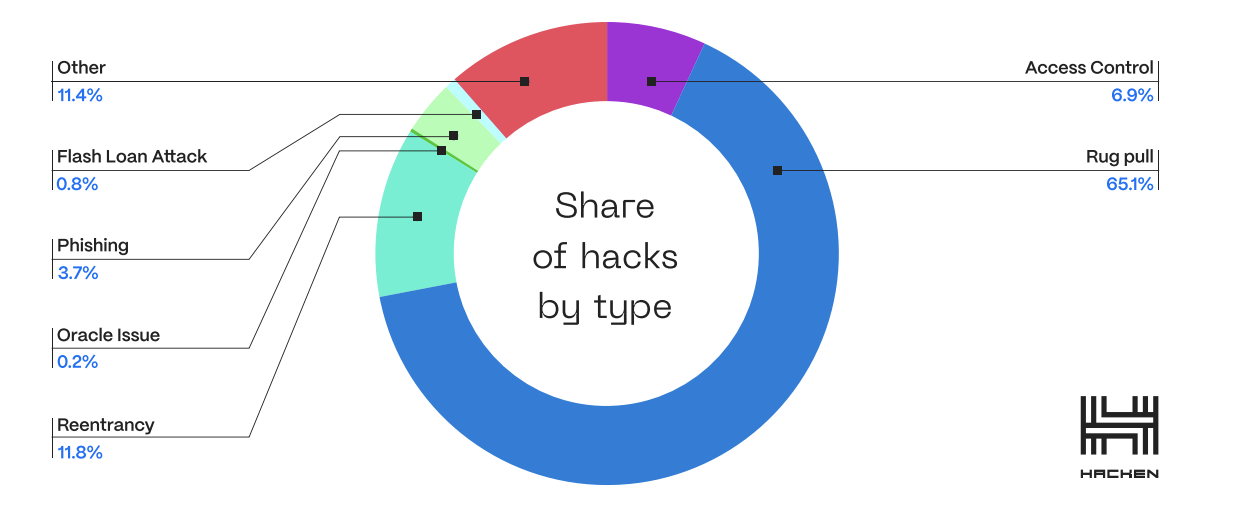 Cryptocurrency hacks by type in Q3 2023. Source: Hacken
The prevalence of rug pulls in the market can be attributed to the ease of creating such schemes. The report highlights that “serial scammers utilize token factories that demonstrate similar behavior to generate fraudulent tokens on a large scale.”
Despite their widespread occurrence, cryptocurrency rug pulls are described as “one of the easiest scams to prevent,” according to Hacken, which offered several recommendations based on its observations from Q3.
One of the most important methods for evaluating a project is to verify the presence of an independent third-party audit, as stated by Hacken. Among the 78 rug pulls analyzed in Q3, only 12 indicated that they had undergone “any kind of audit.”
Related Posts
However, even when a crypto project provides an audit, users must remain cautious and thoroughly review them, since an audit by itself does not always ensure protection against scams, Hacken pointed out, remarking:
“The project can undergo an audit and have an audit report, but with a poor score. Yet, users overlook this and consider the mere fact that the project was audited as sufficient.”
According to Hacken co-founder and CEO Dyma Budorin, investors frequently disregard warning signs such as the lack of audits and other concerns due to factors like the fear of missing out (FOMO). The industry has witnessed success stories with memecoins like Pepe (PEPE) and Shiba Inu (SHIB), where an initial investment of $100 out of curiosity resulted in substantial profits, leading individuals to hope for similar outcomes, the executive noted.
Related: Rug pull feared as Safereum devs reportedly unlock and dump native token
“This aspiration for significant returns in a short period often leads individuals to ignore warning signs and hastily engage in investments,” Budorin stated, adding:
“Scammers are well aware of this, and they are very adept at imitating successful projects. […] Scammers often reference thriving projects, heightening the FOMO surrounding the next big opportunity.”
Hacken’s CEO also emphasized that the investment process in cryptocurrency is a “no-brainer for many users,” requiring “only a few clicks.” According to the executive, this simplicity can also contribute to impulsive decision-making.
Magazine: Blockchain detectives — Mt. Gox collapse saw birth of Chainalysis
