Disclaimer: Information found on CryptoreNews is those of writers quoted. It does not represent the opinions of CryptoreNews on whether to sell, buy or hold any investments. You are advised to conduct your own research before making any investment decisions. Use provided information at your own risk.
CryptoreNews covers fintech, blockchain and Bitcoin bringing you the latest crypto news and analyses on the future of money.

Game analysis: Immutable’s Guild of Guardians provides mobile dungeon exploration experiences.

From October 9 to 20, Immutable welcomed playtesters to experience an early version of its forthcoming mobile game, Guild of Guardians.
Guild of Guardians was initially revealed in 2021. Its utility token, Guild of Guardians Gems (GOG), became available for purchase in December 2021, generating over $5.3 million for the game’s development. Furthermore, more than 800,000 individuals signed up for the token sale, which Immutable described as an “oversubscription” of 82 times compared to the anticipated demand. The game is being developed by Mineloader, the same studio behind the Final Fantasy VII remake and Final Fantasy XIV: Endwalker. The game is being published by Immutable, the creator of Gods Unchained.
As per the game’s roadmap, it is anticipated to enter open beta in the fourth quarter of 2023. The documentation for Guild of Guardians indicates that it will be a free-to-play and play-to-earn mobile game. Players will not be required to make any purchases to start playing and earning nonfungible tokens (NFTs) or game tokens. To support further development post-launch, Immutable plans to offer “seasonal content” that includes limited edition NFTs, such as “heroes, pets, guilds, and energy boosters.” They will also impose a percentage fee on secondary sales of certain in-game items.
 Guild of Guardians demo opening screen. Source: Guild of Guardians demo
The play-to-earn feature of Guild of Guardians will focus on crafting equipment and summoning heroes. As players advance through dungeons, they will earn crafting materials that can be used to mint NFTs representing gear. Additionally, players can collect “common” heroes that can be combined to create higher rarity versions and minted on the blockchain. Guild of Guardians NFTs are minted on the Immutable X network, while the GOG token operates on Ethereum.
Since the fundraising event, information regarding the game’s development has been limited. However, Immutable invited media representatives to playtest the game from October 9 to 20, and this writer was among those invited.
An Android and iOS mobile game
Guild of Guardians is exclusively designed for mobile devices. It can be played on smartphones or tablets and is available on both iOS and Android platforms. Currently, there is no option to play it on a PC or console, and the development team does not seem to have plans for a PC version in the near future, if at all. The game controls are tailored for mobile gameplay, with battles primarily automated and minimal real-time control during combat.
Related: What is Gods Unchained, and how to play it.
The Guild of Guardians documentation highlights that mobile games are more accessible than other types of video games. The global number of smartphone owners significantly surpasses that of PC owners, which is why the decision was made to develop Guild of Guardians solely as a mobile game with touch-screen controls.
A dungeon-crawling adventure
Guild of Guardians embodies a traditional “dungeon-crawl” game. The core gameplay involves navigating through various dungeons, battling monsters, and opening treasure chests for loot. Players can select which dungeon to explore by clicking on it from an in-game world map.
Upon selecting a dungeon, the player’s party of heroes enters the first room, typically filled with monsters to defeat. After clearing each room, players can choose the next room to explore. Different rooms present varying enemy strengths and rewards, and players are provided with these metrics to aid in their decision-making. Some rooms contain treasure chests, healing items, or other boosts that may assist the party in progressing.
Once a player has navigated through all choices and vanquished all monsters, the dungeon concludes. In this scenario, the main menu reappears, and any heroes who perished during the dungeon are revived. If all party members are defeated before completing the dungeon, the player fails but retains the items acquired during their partial progress.
New dungeons unlock as previous ones are completed. Completing all dungeons grants access to a new “infinite” mode, which reportedly allows players to traverse endlessly generated dungeons for additional loot. Unfortunately, I did not reach a point to test the infinite mode.
Related Posts
Automated battles
The game features predominantly automated battles. To initiate a battle, players click a “fight” button and observe the combat unfold. They have the option to manually activate characters’ ultimate abilities, introducing some interaction during battles. Alternatively, they can opt for automatic activation of these abilities, resulting in a completely passive experience.
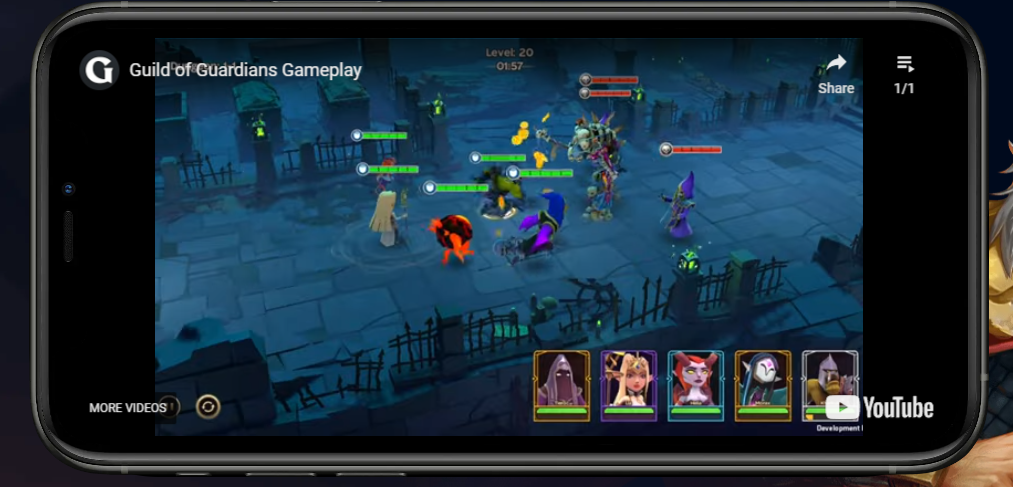 Battle from an earlier build of Guild of Guardians. Source: Guild of Guardians
The challenge in winning battles stems from decisions made prior to combat. Before entering a dungeon, players select which heroes to include in their party. Each hero possesses unique abilities, with some serving as tanks or healers, while others focus on dealing damage. To achieve success, players must assemble a party of characters whose abilities complement one another. Additionally, players can position characters in various formations within the party before battles commence. Tanks should be placed at the front, while ranged damage dealers and healers should be positioned at the back. Players also influence their chances of victory by selecting appropriate gear for their characters.
I found the battles to be fairly balanced in terms of difficulty. My party easily dispatched numerous small enemy groups, while certain bosses proved to be quite formidable. I appreciated that heroes are automatically revived after a dungeon failure.
Collecting heroes and crafting
Two primary objectives in Guild of Guardians are to collect heroes and craft equipment. To acquire a new hero, players must obtain a “summon,” which allows them to roll for a randomly selected hero. There appears to be a diverse array of heroes available, each featuring distinct artwork, ultimate abilities, and stats.
Some “summons” can be earned as rewards for exploring dungeons, while others are provided as login bonuses. Players receive two heroes during the tutorial: one tank and one healer.
I found the hero-collecting system to be a rewarding mechanic. The heroes exhibited considerable variety in terms of stats and abilities, making the acquisition of a new hero feel meaningful.
To craft gear, players need to gather crafting materials within dungeons. I managed to craft a single item during my playtest sessions but could not gain further experience beyond that. The game’s documentation indicates that gear items vary in rarity, with rarer items requiring more uncommon materials for crafting. Different crafted gear pieces offer unique buffs; some items belong to sets that provide greater bonuses if a character wears multiple pieces from the same set, according to the documentation.
Related: Game review: Axie Infinity currently rules the Pay-to-Win-to-Earn roost
In conclusion
The Guild of Guardians demo I experienced was an early iteration of the game. The public release is likely to feature additional content and functionalities. Thus far, the game’s development appears to be progressing positively. The battles present challenges, and players must make a variety of strategic decisions to succeed. This is not a typical play-to-earn game characterized by mindless grinding for cryptocurrency. The gameplay is engaging and demands considerable thought from players. Fans of turn-based RPGs may find Guild of Guardians appealing, as it satisfies their desire for strategic challenges.
Conversely, players seeking Diablo-style real-time action may wish to overlook Guild of Guardians upon its release. The battles are predominantly automated, resulting in no test of reflexes in this particular dungeon-crawler.
The views, thoughts, and opinions expressed here are solely those of the author and do not necessarily reflect or represent the views and opinions of Cointelegraph.
