Disclaimer: Information found on CryptoreNews is those of writers quoted. It does not represent the opinions of CryptoreNews on whether to sell, buy or hold any investments. You are advised to conduct your own research before making any investment decisions. Use provided information at your own risk.
CryptoreNews covers fintech, blockchain and Bitcoin bringing you the latest crypto news and analyses on the future of money.


The price of Ether (ETH) saw a 7% drop from Oct. 6 to Oct. 12, reaching a seven-month low of $1,520. Although there was a minor recovery to $1,550 on Oct. 13, it seems that investor confidence and interest in Ethereum are diminishing, as suggested by various indicators.
Some may contend that this trend signifies a wider disinterest in cryptocurrencies, as evidenced by Google searches for "Ethereum" hitting a three-year low. Additionally, Ethereum has lagged behind the overall altcoin market capitalization by 15% since July.
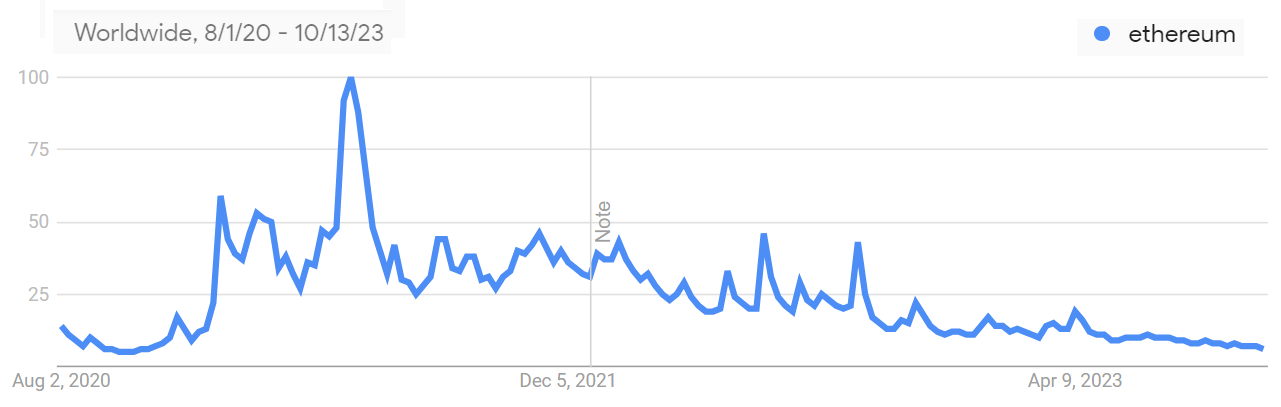 Ethereum” keyword search, globally. Source: Google Trends
Notably, this price fluctuation coincided with Ethereum’s average 7-day transaction fees dropping to $1.80, the lowest in the past year. For context, just two months prior, these fees were over $4.70, a price considered high even for initiating and concluding batched layer-2 transactions.
Regulatory uncertainty and declining staking yield contribute to ETH’s price drop
A key event that influenced Ether’s price was the comments made by Cardano founder Charles Hoskinson regarding U.S. Securities and Exchange Commission director William Hinman’s 2018 classification of Ether as a non-security asset. Hoskinson, also an Ethereum co-founder, claimed on Oct. 8 that some form of "favoritism" affected the regulator’s decision.
Interest in Ethereum staking has also diminished among investors involved in the network validation process, as the yield fell from 4.3% to 3.6% in just two months. This shift occurred alongside an increase in ETH supply due to decreased activity in the burn mechanism, reversing the previous scarcity trend.
On Oct. 12, regulatory concerns heightened after the Autorité de Contrôle Prudentiel et de Résolution (ACPR), a branch of the French Central Bank, pointed out the "paradoxical high degree of concentration" risk in decentralized finance (DeFi). The ACPR report recommended the establishment of specific regulations governing smart contract certification and governance to safeguard users.
Derivatives data and declining TVL indicate bearish control
Examining derivatives metrics offers insight into how professional Ether traders are positioned following the price correction. Typically, ETH monthly futures trade at a 5 to 10% annualized premium to account for delayed trade settlement, a practice not exclusive to the crypto markets.
Related Posts
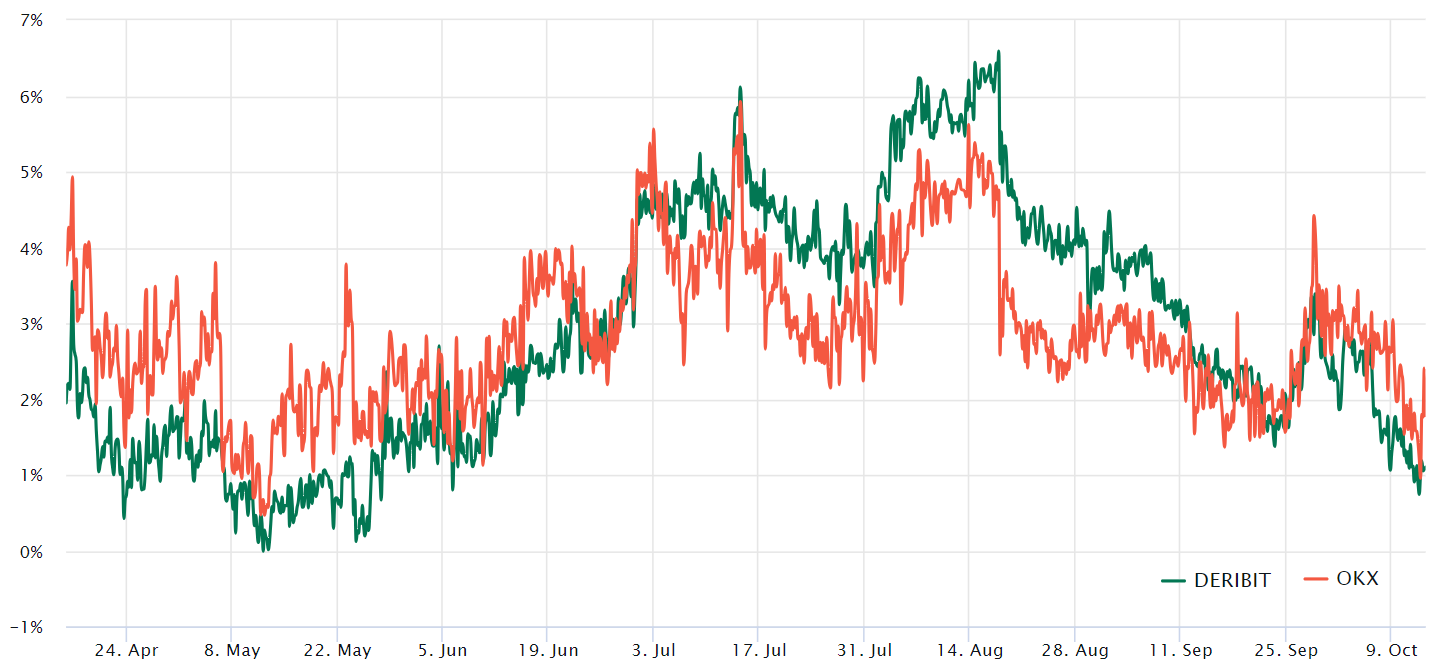 ETH 2-month futures premium vs. spot market. Source: Laevitas.ch
The premium for Ether futures reached its lowest level in five months on Oct. 12, indicating a lack of demand for leveraged long positions. Notably, even the 8.5% Ether price increase between Sept. 27 and Oct. 1 could not elevate ETH futures above the 5% neutral threshold.
The total value locked (TVL) in Ethereum decreased from 13.3 million ETH to 12.5 million ETH over the past two months, reflecting reduced demand. This trend signifies waning confidence in the DeFi sector and fewer advantages compared to the 5% yield provided by traditional finance in U.S. dollars.
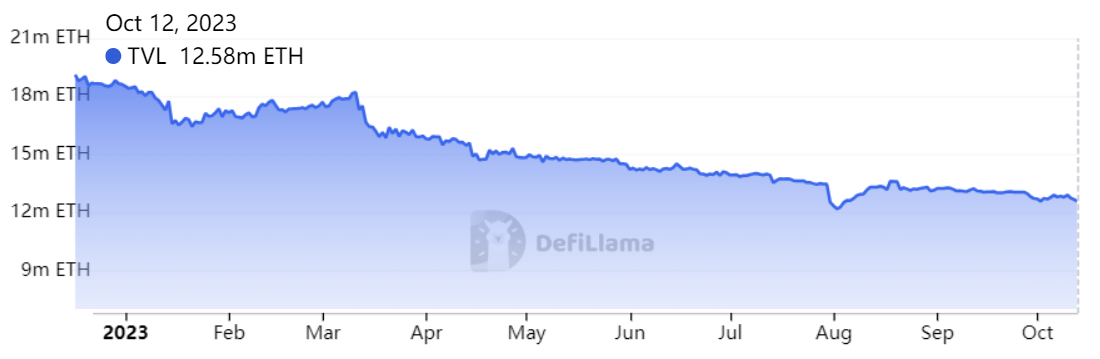 Ethereum network TVL ex-native staking. Source: DefiLlama
To evaluate the importance of this TVL decline, one should consider metrics related to decentralized application (DApps) usage. Certain DApps, such as DEX exchanges and NFT marketplaces, are not financially intensive, making the deposited value less significant.
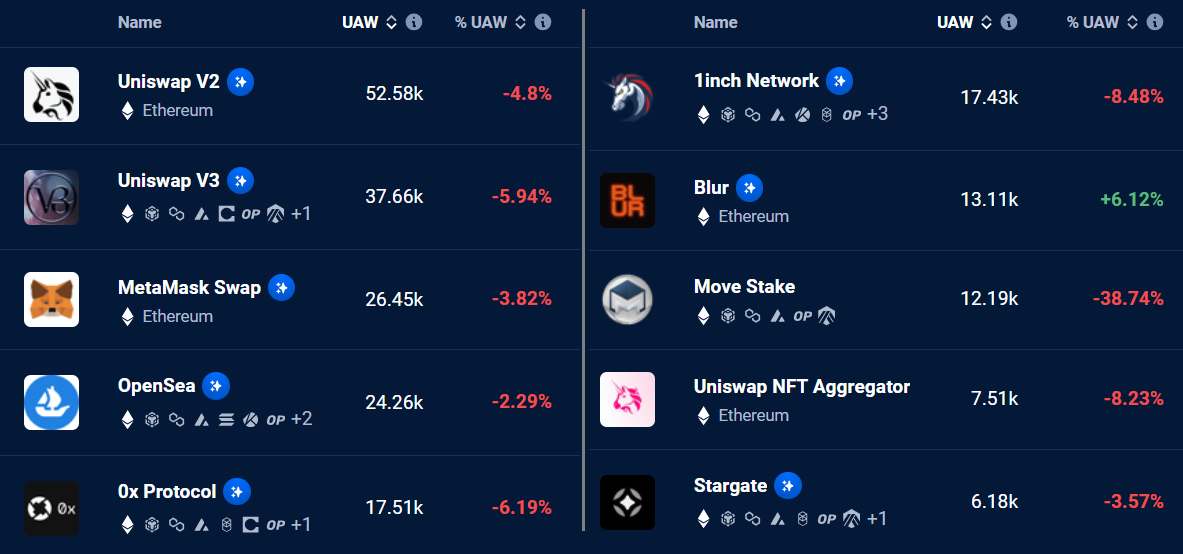 Ethereum top DApps 7-day active addresses. Source: DappRadar
Unfortunately for Ethereum, the decrease in TVL is accompanied by diminishing activity across most ecosystem DApps, including the leading DEX, Uniswap, and the largest NFT marketplace, OpenSea. The reduced demand is also apparent in the gaming sector, with Stargate reporting only 6,180 active accounts on the network.
While regulatory concerns may not be directly linked to Ether’s classification as a commodity, they could negatively impact the DApps industry. Furthermore, there is no guarantee that key components of the ecosystem, such as Consensys and the Ethereum Foundation, will remain unaffected by potential regulatory actions, especially in the U.S.
Given the declining demand for leveraged long positions, falling staking yields, regulatory uncertainties, and a broader lack of interest, as reflected in Google Trends, the probability of Ether dropping below $1,500 remains relatively high.
This article is for informational purposes only and is not intended to be and should not be construed as legal or investment advice. The views, thoughts, and opinions expressed here are solely those of the author and do not necessarily reflect or represent the views and opinions of Cointelegraph.
