Disclaimer: Information found on CryptoreNews is those of writers quoted. It does not represent the opinions of CryptoreNews on whether to sell, buy or hold any investments. You are advised to conduct your own research before making any investment decisions. Use provided information at your own risk.
CryptoreNews covers fintech, blockchain and Bitcoin bringing you the latest crypto news and analyses on the future of money.


The significant Merge upgrade from September 2022 — which signified Ethereum’s shift from proof-of-work (PoW) to proof-of-stake (PoS) — led to a notable decrease in adherence to the standards established by the Office of Foreign Assets Control (OFAC).
Ethereum blocks that comply with OFAC regulations censor specific transactions, which adversely affects the neutrality of the Ethereum ecosystem. In early August 2022, OFAC imposed sanctions on Tornado Cash and various Ether (ETH) addresses linked to it due to its capability to obscure and anonymize transactions.
Prior to the Merge upgrade, Ethereum’s compliance with OFAC surged dramatically as entities like cryptocurrency exchanges chose to operate censoring MEV-Boost relays on their validators. The roster of leading censorship offenders includes well-known platforms such as Binance, Celsius Network, Bitfinex, Ledger Live, Huobi (HTX), and Coinbase, as reported by MEV Watch data.
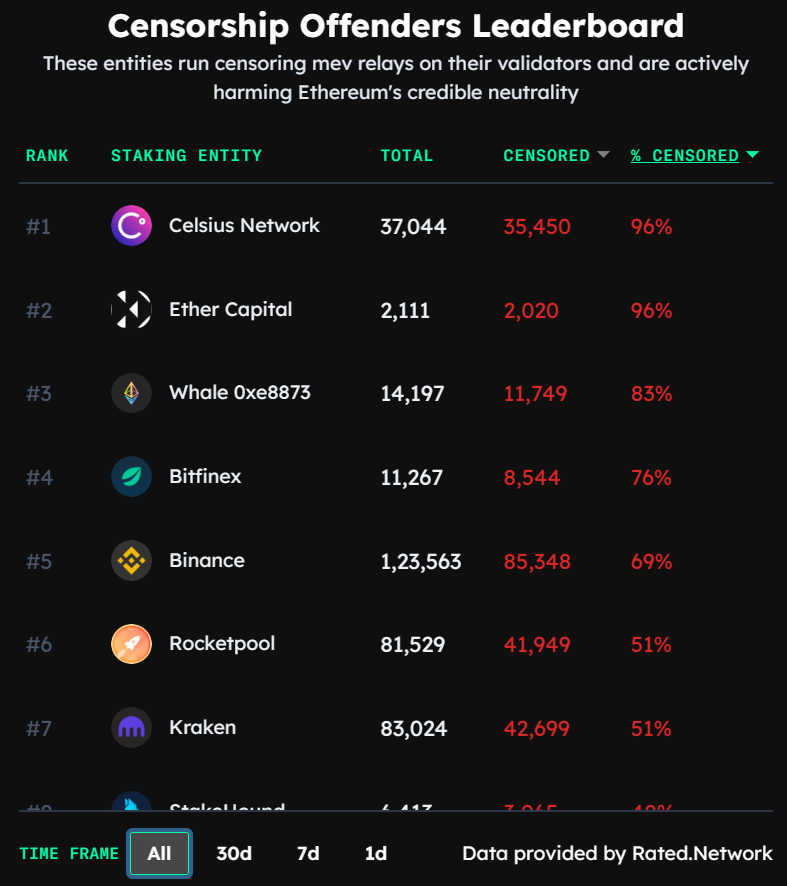 List of entities operating censoring MEV relays on their validators are actively undermining Ethereum’s credible neutrality. Source: MEV Watch
Nonetheless, the overall OFAC compliance of Ethereum blocks has experienced a substantial decline. In November 2022, 78% of the total Ethereum blocks were in accordance with OFAC regulations. As of today, September 27, Ethereum’s OFAC compliance has fallen to 30%, marking a total decrease of 57%.
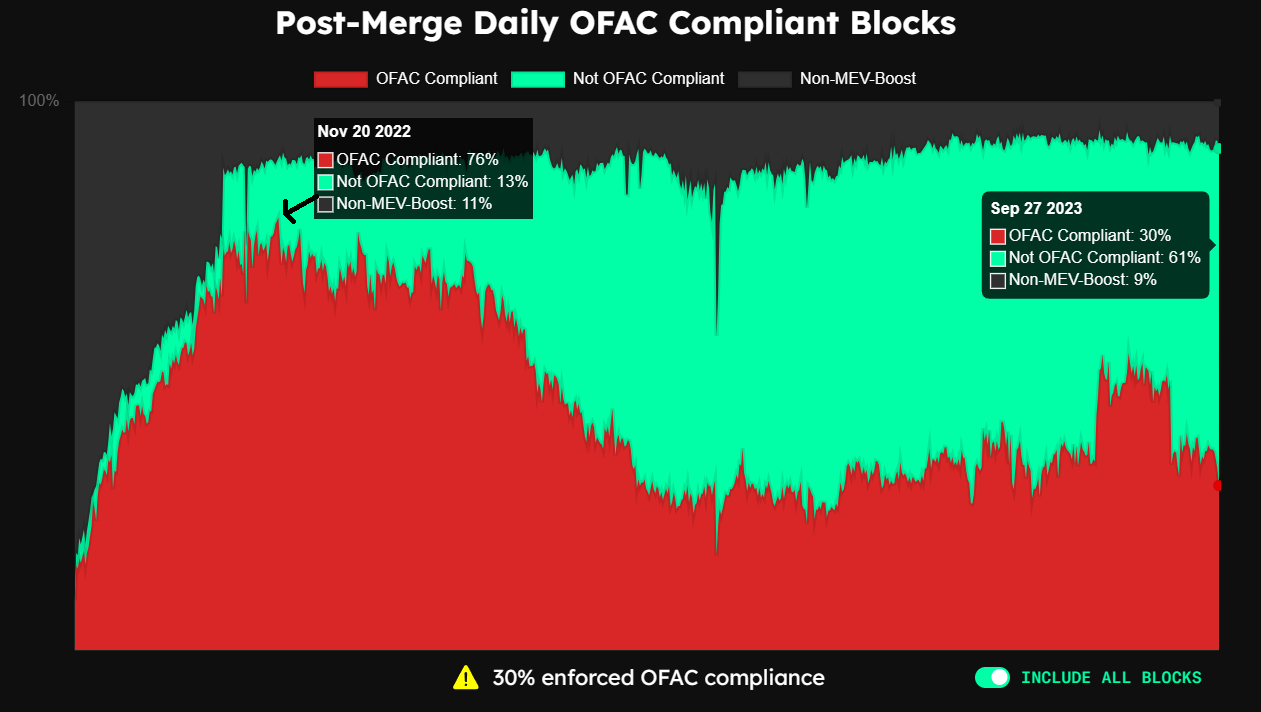 Post-Merge daily OFAC-compliant Ethereum blocks. Source: MEV Watch
To counter OFAC compliance, operators must utilize relays that do not impose censorship based on OFAC compliance criteria. There are seven primary MEV-boost relays that are most frequently employed: Flashbots, BloXroute Max Profit, BloXroute Ethical, BloXroute Regulated, BlockNative, Manifold, and Eden. However, not all systems comply with OFAC regulations, according to MEV Watch:
Related Posts
“Of the 7 available major relays only 3 do not censor according to OFAC compliance requirements.”
It is also crucial to recognize that not every block created by OFAC-compliant relays is censoring; however, all blocks produced by OFAC-compliant relays will censor when non-compliant transactions are sent to the network.
While OFAC regulations mainly focus on organizations based in the United States, validators located outside the U.S. should contemplate operating non-censoring relays for the network’s benefit.
Related: US Treasury sanctions Ethereum wallet tied to cartel over ‘illicit fentanyl trafficking’
In light of Ethereum’s diminished OFAC compliance, Grayscale opted to relinquish all rights to PoW Ethereum tokens (ETHPoW). However, this decision was linked to a lack of market liquidity. According to an official statement:
“As such, it is not possible to exercise the rights to acquire and sell the ETHPoW tokens, and on behalf of the record date shareholders, Grayscale is abandoning the rights to these assets.”
Conversely, some cryptocurrency investment firms, such as ETC Group, have sought to introduce dedicated EthereumPoW exchange-traded products (ETPs).
Magazine: ‘AI has killed the industry’: EasyTranslate boss on adapting to change
