Disclaimer: Information found on CryptoreNews is those of writers quoted. It does not represent the opinions of CryptoreNews on whether to sell, buy or hold any investments. You are advised to conduct your own research before making any investment decisions. Use provided information at your own risk.
CryptoreNews covers fintech, blockchain and Bitcoin bringing you the latest crypto news and analyses on the future of money.


Circle, the issuer of stablecoins, has revealed that it has commenced the minting of USD Coin (USDC) directly on the Ethereum layer-2 scaling solution, Polygon.
Users and developers can now access USDC without the need to bridge the stablecoin from Ethereum to an alternative blockchain. Circle Mint and Circle’s developer application programming interfaces (APIs) now accommodate Polygon-based USDC, leveraging the scaling advantages of Polygon.
1/ It’s official. #ItsStillStableSeptember and $USDC is now available natively on @0xPolygon PoS mainnet!
Discover the advantages of native USDC and how to transition from bridged USDC.e https://t.co/KcK55sT4KH pic.twitter.com/Gm6HjR62KW— Circle (@circle) October 10, 2023
As per Circle’s announcement, businesses and developers will have the opportunity to create decentralized applications utilizing USDC on Polygon. This new feature is expected to facilitate near-instant, low-cost transactions for a variety of applications, including payments, remittances, trading, borrowing, and lending.
Prior to Circle’s introduction of its native Polygon USDC, users of the protocol were required to utilize bridged USDC (USDC.e) from the Ethereum blockchain. Unlike the new offering, this token is not issued by Circle and will not be redeemable at a 1:1 ratio for United States dollars.
Related Posts
Related: Circle launches USDC stablecoin on Polkadot Asset Hub
Previously, Circle had enabled deposits and withdrawals for USDC.e on Polygon through Circle Mint and its APIs. The issuer intends to cease this service starting Nov. 10, cautioning users who try to send USDC.e to Circle Mint accounts that their assets may become unrecoverable after this date.
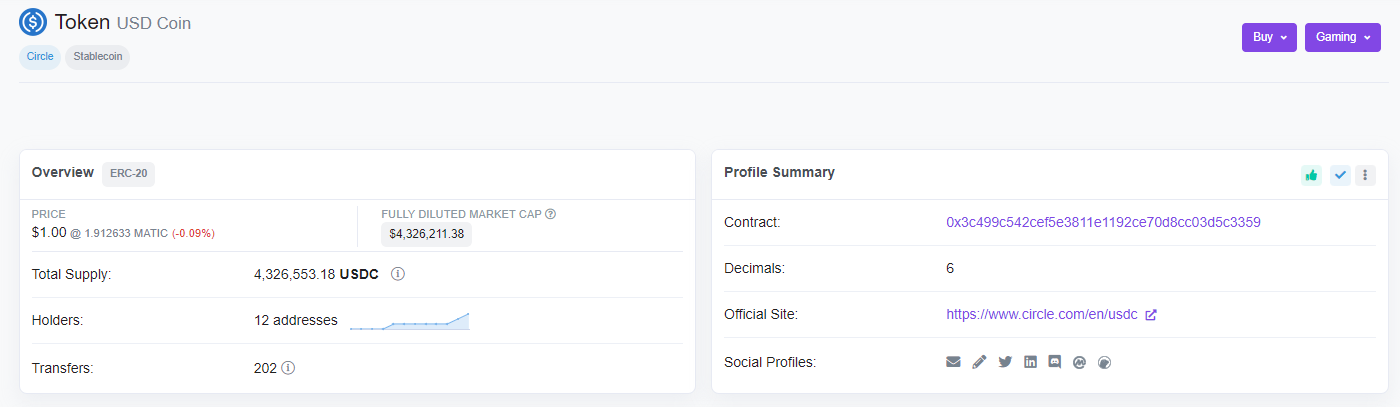 The new Polygon USDC token address indicates a current market capitalization of approximately 4.3 million USDC on the scaling protocol. Source: Polygonscan
Circle also emphasizes that the introduction of native Polygon USDC will facilitate low-cost global payments and remittances, as well as enhance access to trading, borrowing, and lending on prominent decentralized finance platforms, including Aave, Compound, Curve, Uniswap, and QuickSwap.
The USDC issuer is also planning to implement a cross-chain transfer protocol to Polygon to promote interoperability with other blockchain networks. This initiative aims to enable transfers of Polygon-based USDC to and from the Ethereum blockchain.
Magazine: The Truth Behind Cuba’s Bitcoin Revolution: An on-the-ground report
