Disclaimer: Information found on CryptoreNews is those of writers quoted. It does not represent the opinions of CryptoreNews on whether to sell, buy or hold any investments. You are advised to conduct your own research before making any investment decisions. Use provided information at your own risk.
CryptoreNews covers fintech, blockchain and Bitcoin bringing you the latest crypto news and analyses on the future of money.


The teams associated with the Floki protocol and the Bitget cryptocurrency exchange have accused one another of engaging in market manipulation following the listing and subsequent delisting of the protocol’s token, TokenFi (TOKEN), by Bitget. This information was shared in a social media update from the Floki team and a blog entry from Bitget on October 31.
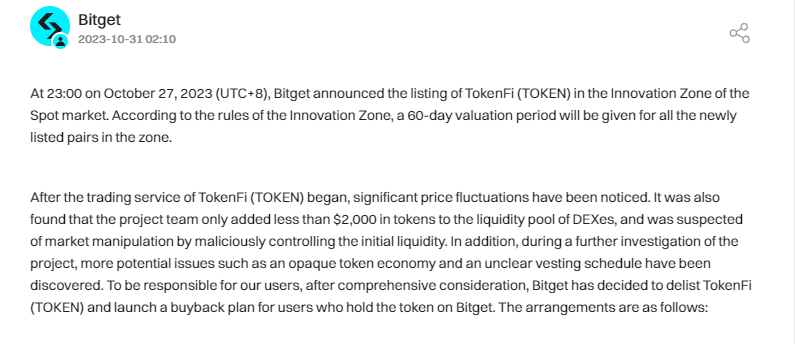
The Floki team asserted that Bitget listed the token prior to its official launch, labeling the Bitget listing as a “fake token,” while Bitget countered that the Floki team was “suspected of market manipulation through malicious control of the initial liquidity.”
The Floki team indicated that on October 18, they submitted a proposal to the Floki decentralized autonomous organization (DAO) to initiate a staking program featuring a reward token aimed at a trillion-dollar industry with substantial potential. Concurrently, the team was in discussions with centralized exchanges regarding the listing of TokenFi. The token’s name was not disclosed in the DAO proposal, nor did the team specify the intended purpose of the “reward token.” However, they claim this information had been shared with several centralized exchanges.
The team stated that they instructed centralized exchanges not to list the token until at least seven days post-launch, as doing so would breach governance rules set forth by the DAO. According to the Floki team, all exchanges consented to this condition. Nevertheless, they alleged that Bitget breached this agreement by listing TOKEN before waiting seven days after the launch. This meant that the token was unavailable for purchase at the moment it was listed on Bitget, the team asserted.
On October 26, Floki issued a caution to investors, warning that any current TOKEN listings on centralized exchanges were unauthorized, though they did not specifically name Bitget.
The TokenFi token was anticipated to launch at 3 p.m. UTC on October 27, as per a social media announcement from the team. Coincodex data indicates that it was initially priced at $0.00005011 and launched on October 28, although discrepancies in dates may have arisen from time zone differences. The price surged nearly immediately to $0.005850, representing an increase of 11,574%. At the time of publication, the price had climbed even further to $0.006053 per coin.
The Floki team claimed that Bitget listed TOKEN without possessing any of it to sell to its customers, resulting in an inability to process withdrawals. They asserted that Bitget faced a $20 million liability to customers without any TOKEN assets to cover this obligation.
Related Posts
Floki alleges that Bitget subsequently attempted to purchase tokens from the TokenFi treasury at a 90% discount from its current market price, which the team declined. Allegedly, Bitget issued its “delisting” statement in reaction to this refusal.
According to Bitget’s announcement, TOKEN was listed on October 27, 2023. Following the listing, the Bitget team observed “significant price fluctuations” for TOKEN. Due to these drastic fluctuations, the exchange suspected the development team of “market manipulation by maliciously controlling the initial liquidity.” Bitget claims that only $2,000 worth of initial liquidity was injected into the token’s pool. They also stated they uncovered “an opaque token economy and an unclear vesting schedule,” which rendered it impractical to continue offering TOKEN.
Related: FLOKI price soars 140% in a week — Are memecoins finally waking up?
In its statement, Bitget proposed to buy back all the TOKEN it had sold to its customers. Customers will be compensated at the token’s peak price before delisting, which is $0.00605002 per token, approximately 121 times its initial price. This indicates that any losses incurred prior to the delisting will be covered by the exchange. However, investors who purchased from Bitget will not gain from any token appreciation after the delisting.
The Floki team refuted Bitget’s assertion that Floki only provided $2,000 worth of tokens for its initial liquidity pool. They contended that there was nearly $2 million of liquidity in each of the two TOKEN pools. They shared an alleged screenshot from DEXTswap indicating the available amount.
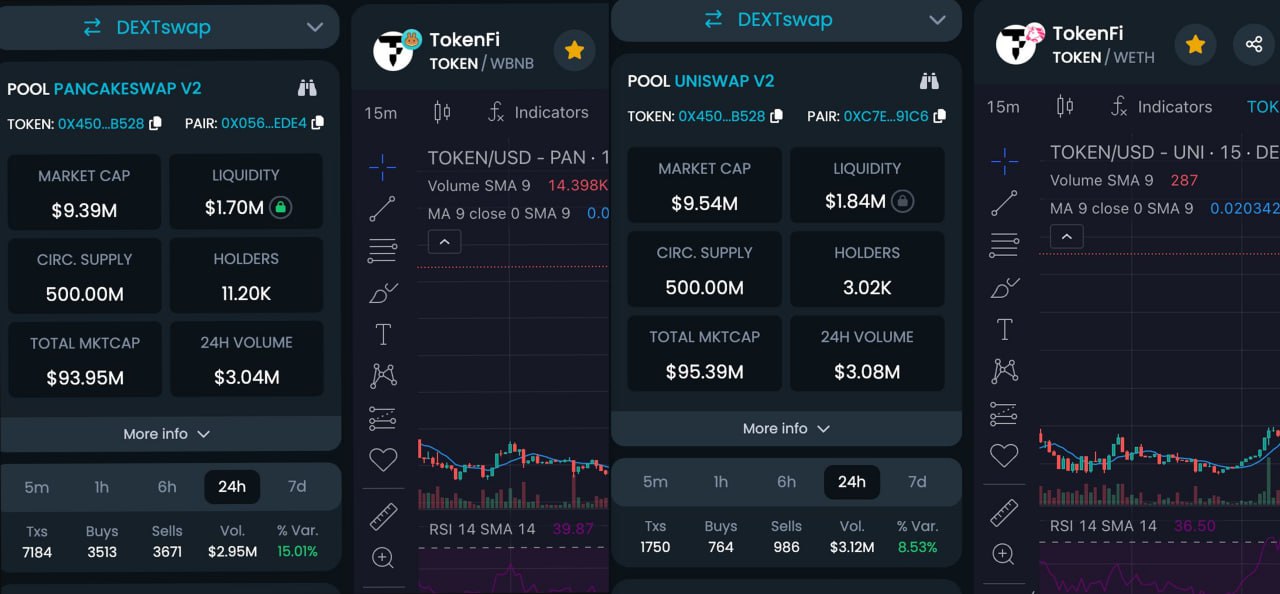
The screenshot displays current liquidity, not the initial liquidity to which Bitget referred. The contract addresses are abbreviated in the image, complicating the process of locating the pools in a block explorer. Cointelegraph was unable to verify the TOKEN’s initial liquidity by the time of publication.
TOKEN is not the only token-launch debacle that has led to millions in losses. The BALD token on Base plummeted 85% after its developer withdrew liquidity from the pool, despite their claims of not being responsible for the price decline. Investors also lost over $2.2 million during the launch of Pond0X, which purportedly contained a flawed transfer function.
