Disclaimer: Information found on CryptoreNews is those of writers quoted. It does not represent the opinions of CryptoreNews on whether to sell, buy or hold any investments. You are advised to conduct your own research before making any investment decisions. Use provided information at your own risk.
CryptoreNews covers fintech, blockchain and Bitcoin bringing you the latest crypto news and analyses on the future of money.


A bearish market structure has been exerting pressure on cryptocurrency prices for the last six weeks, resulting in the total market capitalization dropping to its lowest point in two months at $1.13 trillion. Based on two derivative indicators, crypto bulls may struggle to reverse the downtrend, although a shorter timeframe analysis shows a neutral outlook with Bitcoin (BTC), Ether (ETH), and BNB, on average, increasing by 0.3% from May 12 to May 19.
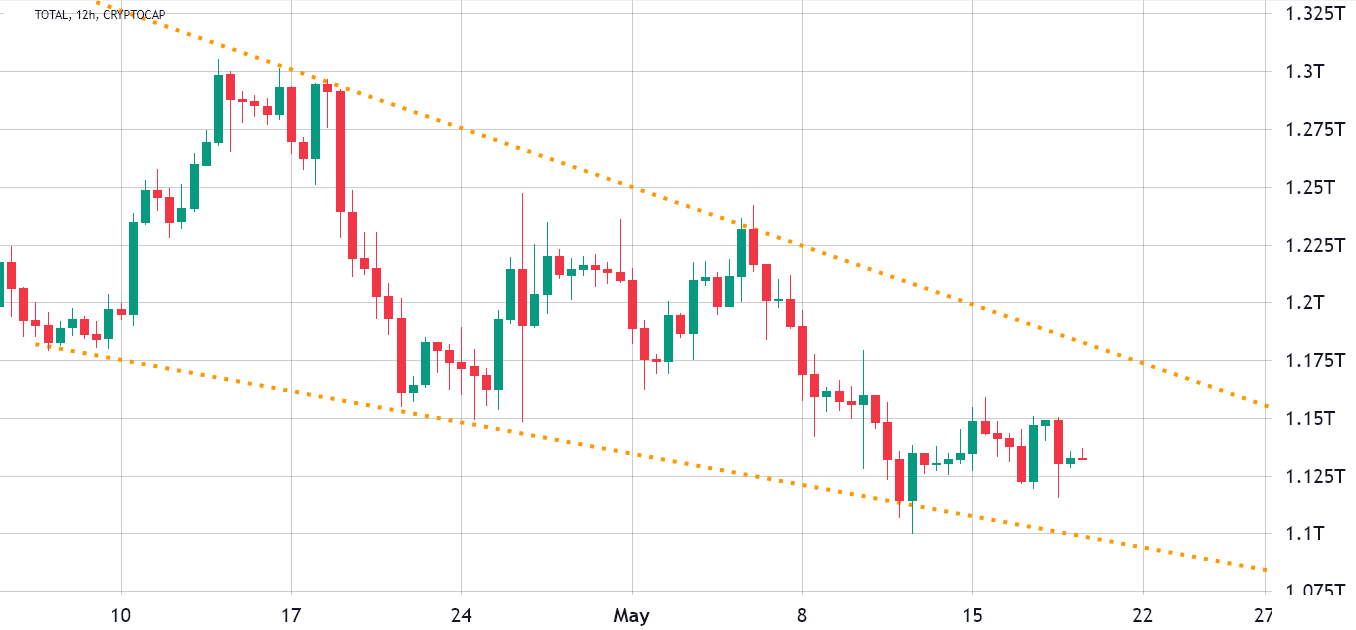 Total crypto market cap in USD, 12-hour. Source: TradingView
It is important to note that the descending wedge pattern that began in mid-April may persist until July, suggesting that any potential upward breakout will necessitate considerable effort from the bulls.
Additionally, there is the looming U.S. debt ceiling conflict, as the U.S. Treasury is rapidly depleting its cash reserves.
While most investors are optimistic that the Biden administration will reach an agreement before a potential debt default, the possibility of a government shutdown and subsequent default cannot be entirely ruled out.
Gold or stablecoins as a safe haven?
Even gold, historically regarded as the safest asset class globally, has not escaped the recent downturn, with the precious metal declining from $2,050 on May 4 to the current level of $1,980.
Related: Bitcoin, gold and the debt ceiling — Does something have to give?
Circle, the issuer of the USDC stablecoin, has exchanged $8.7 billion in Treasuries maturing in over 30 days for short-term bonds and collateralized loans with major banks such as Goldman Sachs and the Royal Bank of Canada.
As reported by Markets Insider, a representative from Circle mentioned that:
“The inclusion of these highly liquid assets also provides additional protection for the USDC reserve in the unlikely event of a U.S. debt default.”
The stablecoin DAI, overseen by the decentralized organization MakerDAO, approved an increase in its U.S. Treasuries holdings to $1.25 billion in March to “capitalize on the current yield environment and generate additional revenue.”
Derivatives markets show no signs of bearishness
Perpetual contracts, often referred to as inverse swaps, feature an embedded rate that is typically charged every eight hours.
A positive funding rate signifies that longs (buyers) are seeking more leverage. Conversely, a negative funding rate occurs when shorts (sellers) require additional leverage.
Related Posts
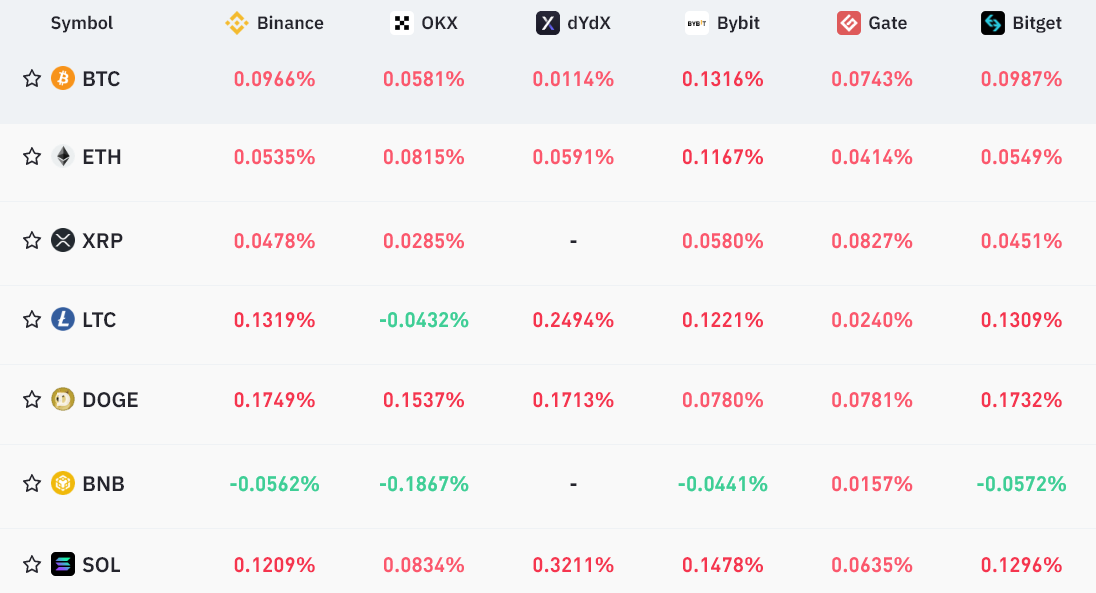 Perpetual futures accumulated 7-day funding rate on May 19. Source: Coinglass
The seven-day funding rate for BTC and ETH was neutral, reflecting a balanced demand from leveraged longs (buyers) and shorts (sellers) utilizing perpetual futures contracts. Interestingly, Litecoin (LTC) also showed no excessive long demand following a 14.5% weekly increase.
To eliminate external factors that may have solely influenced futures markets, traders can assess market sentiment by comparing the volume of call (buy) options to put (sell) options.
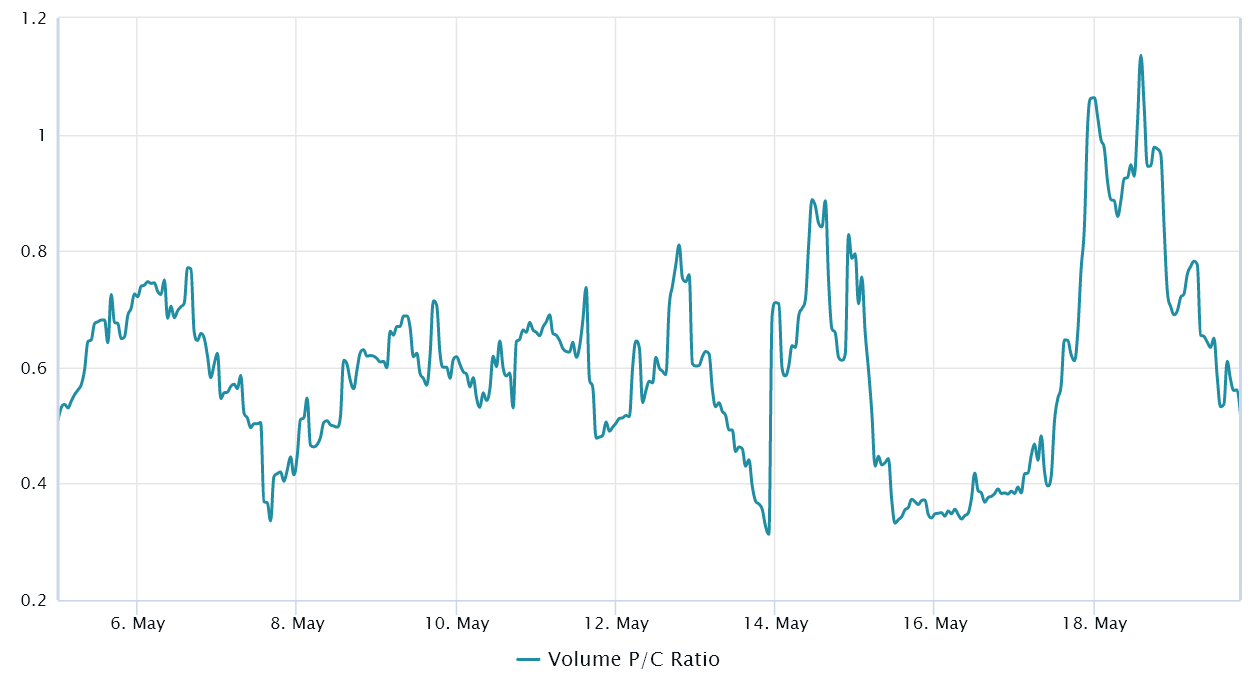 BTC options volume put-to-call ratio. Source: Laevitas.ch
The expiration of options can introduce volatility to Bitcoin’s price, which resulted in an $80-million advantage for bears during the latest May 19 expiry.
A 0.70 put-to-call ratio indicates that put option open interest is lower than the more bullish calls, suggesting a bullish sentiment. In contrast, a 1.40 ratio favors put options, which can be interpreted as bearish.
The put-to-call ratio for Bitcoin options volume has remained below 1.0 for the past few weeks, indicating a stronger preference for neutral-to-bullish call options. Notably, even when Bitcoin briefly dipped to $26,800 on May 12, there was no significant increase in demand for protective put options.
Glass half full, or investors prepping for the worst?
The options market indicates that whales and market makers are reluctant to acquire protective puts, even after Bitcoin experienced an 8.3% decline between May 10 and May 12.
However, given the balanced demand in futures markets, traders appear cautious about making further bets until there is greater clarity regarding the U.S. debt situation.
Less than two weeks remain until June 1, when the U.S. Treasury Department has cautioned that the federal government may be unable to meet its debt obligations.
Related: U.S. debt ceiling crisis: bullish or bearish for Bitcoin?
It remains uncertain whether the total market capitalization will manage to break free from the descending wedge pattern. From a more optimistic standpoint, professional traders are not utilizing derivatives to wager on a disastrous outcome.
Conversely, there appears to be little justification for bulls to act prematurely and place bets on a swift recovery in the crypto market given the prevailing uncertainty in the macroeconomic landscape. Thus, bears are currently in a favorable position according to derivatives metrics.
This article does not contain investment advice or recommendations. Every investment and trading move involves risk, and readers should conduct their own research when making a decision.
