Disclaimer: Information found on CryptoreNews is those of writers quoted. It does not represent the opinions of CryptoreNews on whether to sell, buy or hold any investments. You are advised to conduct your own research before making any investment decisions. Use provided information at your own risk.
CryptoreNews covers fintech, blockchain and Bitcoin bringing you the latest crypto news and analyses on the future of money.


The collapse of FTX catalyzed a significant increase in self-custody during 2022, prompting many cryptocurrency investors to shift from centralized exchanges (CEX) to hardware or software wallets.
The growing trend of self-custody might even eliminate the necessity for centralized exchanges in the future, as suggested by Binance CEO Changpeng Zhao. However, how would individuals trade cryptocurrencies without centralized exchanges?
The cryptocurrency sector already provides alternatives to trade cryptocurrencies like Bitcoin (BTC) for fiat currency without relying on a CEX such as Binance. Nonetheless, this process comes with certain advantages and disadvantages and may require further investigation.
This article will explore the simplest exchange methods to provide insights into purchasing or selling cryptocurrency without utilizing a centralized trading platform.
Bitcoin ATMs
Automated teller machines (ATMs) that support Bitcoin are likely one of the most convenient methods to exchange fiat currency for crypto and vice versa. Similar to traditional ATMs, Bitcoin ATMs enable users to deposit and withdraw funds using cash or a debit card. However, instead of a bank account, a Bitcoin ATM necessitates that users possess a BTC wallet address to facilitate deposits or withdrawals.
Much like a standard ATM, a Bitcoin ATM is equipped with a display screen, a QR scanner, a bill acceptor, and a cash dispenser. To link their Bitcoin wallet to a cryptocurrency ATM, users are typically prompted to scan a QR code associated with their BTC wallet address.
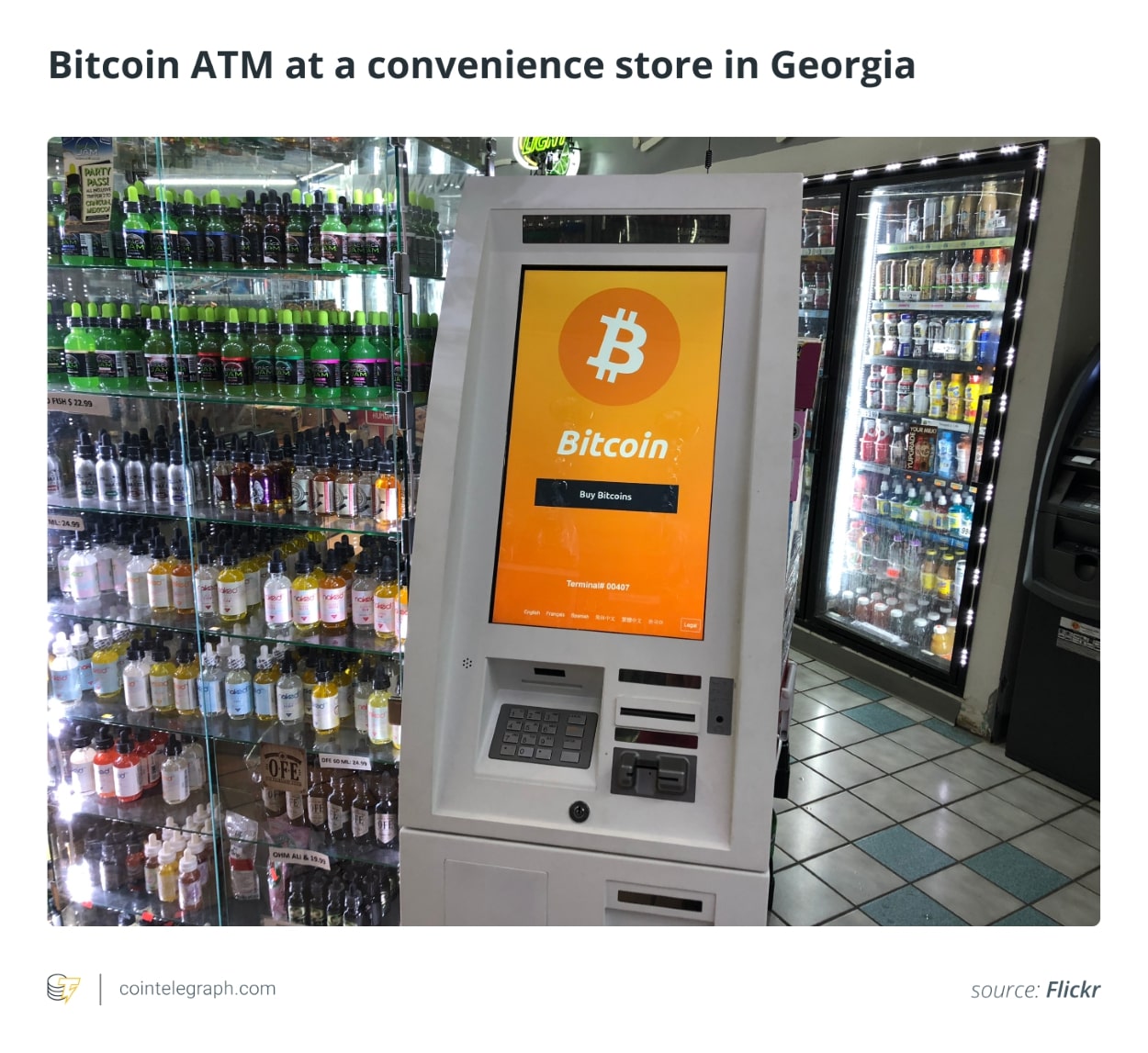
While Bitcoin ATMs offer a straightforward method for exchanging currency for cryptocurrencies, their global adoption is limited.
According to data from CoinATMRadar, there are approximately 34,000 Bitcoin ATMs across 80 countries, with nearly 85% of all crypto ATMs located in the United States. Around 4% of Bitcoin ATMs can be found in Europe, primarily in Spain, Poland, Romania, Switzerland, and Austria.
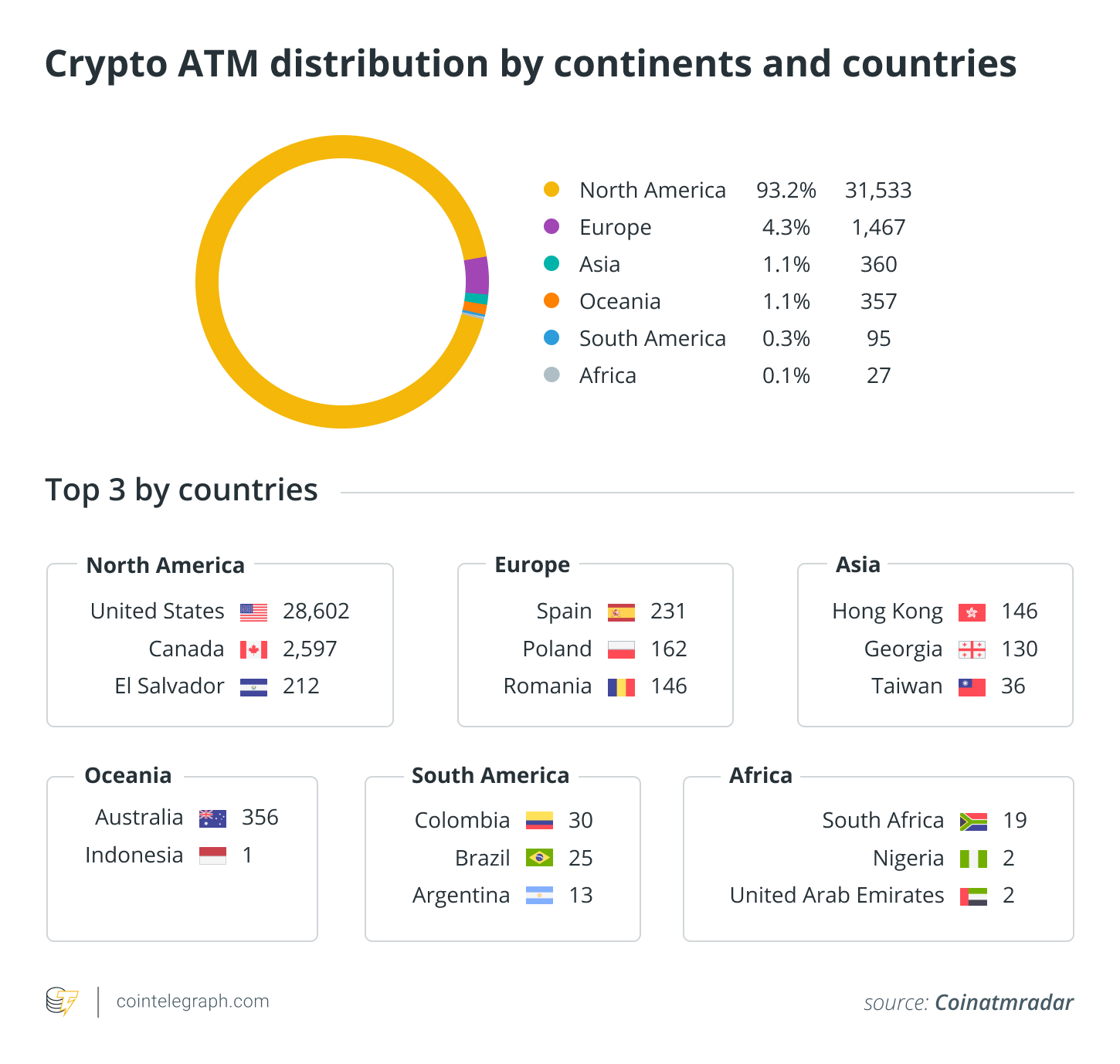
The network of global cryptocurrency ATMs has also experienced a considerable decline recently. As per CoinATMRadar data, 412 crypto ATMs were removed from operation worldwide in the first two months of 2023, contrasting with the installation of 1,000 crypto ATMs monthly from December 2020 to January 2022.
Given the limited availability of crypto ATMs, it is unwise to depend solely on their capacity to facilitate fiat-to-crypto exchanges. Some industry leaders have noted that regulators have increasingly scrutinized crypto ATMs, which may lead to further complications for this exchange method.
“For a long period, ATMs provided an excellent service to anyone seeking to buy and sell Bitcoin privately,” remarked Trezor’s Bitcoin analyst Josef Tetek to Cointelegraph. “Current global trends indicate that this era may be coming to an end, as ATM operators are becoming regulated like any other financial entity,” he added, implying that Bitcoin ATMs are likely to lose much of their privacy in the near future.
Another drawback of Bitcoin ATMs is their high transaction fees, which frequently range between 5% and 20%.
Peer-to-peer Bitcoin exchange platforms
Peer-to-peer (P2P) Bitcoin exchange platforms are among the most prevalent cryptocurrency exchange alternatives alongside Bitcoin ATMs. These platforms enable users to trade digital currency directly with one another without the involvement of a centralized intermediary to facilitate transactions.
Unlike CEXs, P2P exchanges do not depend on automated systems to finalize transactions, allowing users to manually select their preferred offers, trade directly with a counterparty, and manage funds using a self-custodial wallet. These platforms are less susceptible to risks compared to CEXs due to their independence from intermediaries controlling funds during trades.
Many industry leaders believe that P2P crypto marketplaces may represent the future of cryptocurrency due to their distinctive characteristics. “P2P exchanges are significantly more resilient to regulatory crackdowns compared to centralized exchanges,” Jan3 CEO Samson Mow told Cointelegraph, emphasizing the need for more P2P options.
“P2P services are the future of Bitcoin adoption, but only if they can effectively protect users’ privacy,” Trezor’s Tetek stated. He pointed out that certain regulatory measures, such as Know Your Customer (KYC), could effectively render P2P crypto services ineffective, asserting:
“Having a P2P service with KYC is merely a variation of utilizing a CEX but with inferior liquidity.”
While providing a more resilient option from a regulatory perspective, P2P services are often linked to security concerns, according to Quantum Economics founder and CEO Mati Greenspan. P2P exchanges like Binance P2P or the now-defunct Paxful and LocalBitcoins are “certainly a positive development,” he stated, adding:
“This type of online marketplace upholds the decentralized spirit of crypto, but it is also vulnerable to threats from both regulators and hackers.”
Crypto on-ramp/off-ramp integrations on software or hardware wallets
Another prevalent method of buying or selling crypto without a CEX is through an on-ramp or off-ramp solution provided within a self-custodial wallet via a third-party payment provider.
Related Posts
Software wallets such as Exodus and hardware wallets like Ledger and Trezor offer multiple ways to deposit or withdraw Bitcoin using their default software through various payment integrations. These wallets typically enable users to purchase crypto or cash out their coins using bank transfers, debit or credit card payments, Apple Pay, and other alternatives, depending on the user’s bank location.
Offering a straightforward alternative to Bitcoin ATMs or P2P services, wallet exchange integrations currently face challenges such as limited coverage due to the low adoption of crypto payment partnerships globally. As a result, residents in many regions may find it challenging to exchange their crypto for fiat since their banks are not supported within the payment provider’s network.
However, users might also discover that wallet exchange integrations can be somewhat expensive in terms of fees. For instance, some third-party application programming interface (API) providers on Exodus Wallet impose fees of up to 12% for automated clearing house transfers.
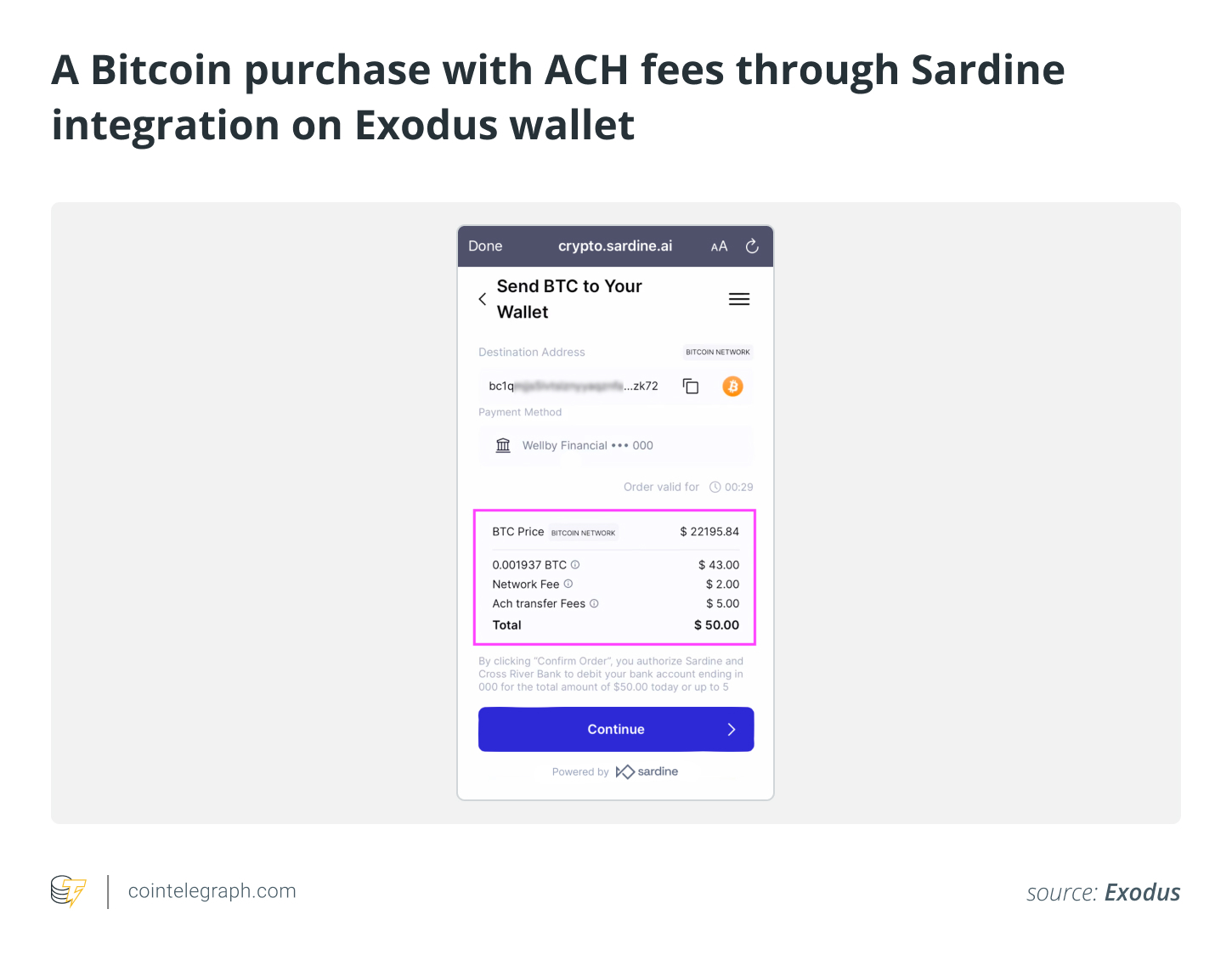
Software and hardware wallets are typically integrated with more than one off-ramp or on-ramp provider, offering an extensive range of options. Some of the providers include PayPal, MoonPay, Transak, Sardine, Banxa, Coinbase Pay, Onramp.money, and Mercuryo, among others.
Offline P2P exchange
It isn’t mandatory to rely on online exchange services to buy or sell Bitcoin. Individuals can do so in person or by engaging with investors seeking to cash out or acquire cryptocurrency via social media platforms.
“There are various alternatives available for offline transactions where the buyer meets the seller face-to-face. Depending on your location, this might occur at a standard currency exchange shop or through a familiar black market dealer,” Greenspan told Cointelegraph. He mentioned groups on messaging platforms like Telegram or WhatsApp, where buyers and sellers are regularly connecting. “I’ve even heard of individuals utilizing sites like Craigslist,” he added.
Offline P2P Bitcoin exchange is regarded as the “best option for privacy-conscious individuals,” according to Trezor’s BTC analyst Tetek. He emphasized that exchanging Bitcoin in person essentially returns to the foundational aspects of BTC trading. “Bitcoin meetups are often the ideal venues to connect with fellow Bitcoin enthusiasts looking to trade,” he noted.
As with any method, offline P2P exchange has its drawbacks, and there are significant concerns associated with this Bitcoin trading method.
The primary risks of offline P2P exchange revolve around safety and limited scalability, noted Quantum Economics’ Greenspan, adding:
“There are numerous disadvantages ranging from safety issues to the discomfort of dealing with a complete stranger, but primarily it’s just not a very scalable solution.”
This crypto exchange method also demands that users possess a higher level of knowledge and savvy compared to purchasing online through a well-known crypto exchange.
Can you buy Bitcoin on a DEX?
When exploring options for buying or selling Bitcoin without engaging with a CEX, one might consider utilizing a decentralized exchange (DEX) as an alternative. But should a DEX be classified as a standalone option to a CEX in this context?
Although DEXs provide the ability to buy or sell Bitcoin, they typically require users to have some knowledge of crypto prior to the transaction. This means that Bitcoin can only be acquired or withdrawn with the assistance of other cryptocurrencies on a DEX.
Moreover, certain obstacles currently hinder DEXs from being a viable alternative to CEXs for buying or selling crypto, according to Trezor’s Tetek. “Some of the significant challenges include a user-unfriendly experience, high spreads due to low liquidity, and worries about obtaining ‘dirty’ Bitcoin or fiat,” he stated. The analyst added that these issues must be resolved for greater adoption of DEXs.
It also depends on how one defines a DEX, Jan3’s Mow added. “If you’re referring to an Ethereum-based DEX, it’s not an alternative at all because, at the foundational level, Ethereum isn’t decentralized,” the executive contended, adding that a true DEX would not have any centralized element that could be shut down.
Is there a future without centralized crypto exchanges?
Despite the crypto industry providing numerous decentralized options for exchanging Bitcoin against fiat, CEXs continue to play a crucial role.
In addition to providing a straightforward entry point into the crypto market and Web3, CEXs are also an essential component of the industry regarding price discovery, according to Bitcoin advocate Mow. He remarked:
“Centralized cryptocurrency exchanges will always persist, and they represent a vital venue for price discovery and liquidity. Only regions that adopt a heavy-handed approach will push exchanges out, but that ultimately harms their populations.”
It remains uncertain whether CEXs will sustain their status as a pivotal part of the crypto industry in the years ahead. Some experts are optimistic that the industry will eventually eliminate centralized exchanges.
“For the time being, centralized exchanges remain a necessary burden on the industry, and I eagerly await the day when we can function without them entirely,” remarked Quantum Economics CEO Greenspan.
“Centralized exchanges pose risks not only to the privacy and security of Bitcoin users but also undermine the very purpose for which Bitcoin was created — establishing a parallel financial system and supporting the financial autonomy of its holders,” Trezor’s Tetek stated. He added that while CEXs have undoubtedly accelerated Bitcoin adoption in the past, they are gradually becoming its “greatest adversary.” The BTC analyst concluded:
“I can certainly envision a world without any CEXs. Once Bitcoin evolves into a global monetary standard, there will be no need to convert Bitcoin to fiat.”
