Disclaimer: Information found on CryptoreNews is those of writers quoted. It does not represent the opinions of CryptoreNews on whether to sell, buy or hold any investments. You are advised to conduct your own research before making any investment decisions. Use provided information at your own risk.
CryptoreNews covers fintech, blockchain and Bitcoin bringing you the latest crypto news and analyses on the future of money.

Wall Street advances tokenized equities, yet institutions remain reluctant to engage in trading them.

Exchanges are advancing towards blockchain-based equities and continuous trading, yet institutions express concerns regarding liquidity and funding risks.
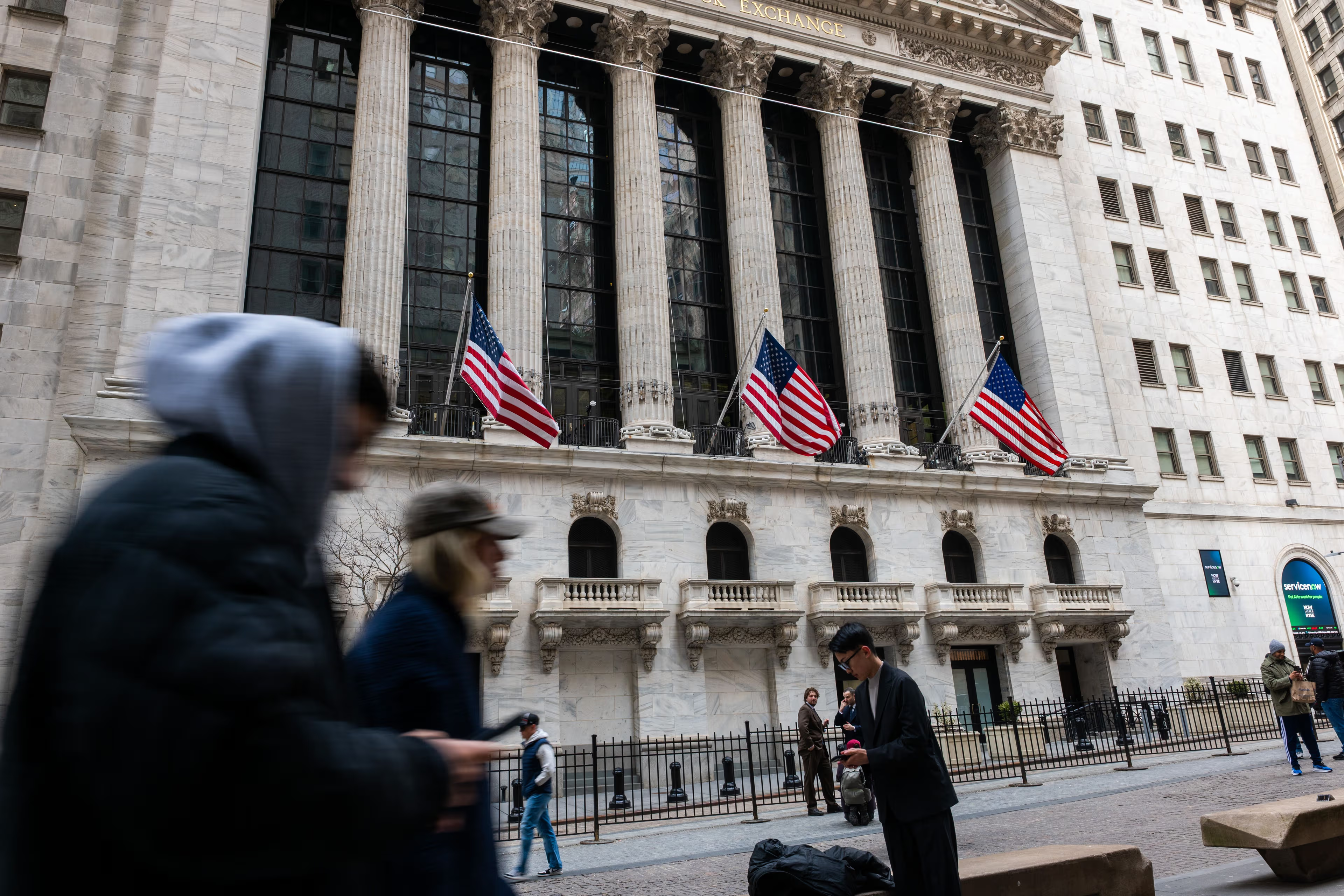 (Spencer Platt/Getty Images)
Key Points:
Related Posts
- Crypto exchanges and platforms are progressing towards tokenized stocks and near-constant trading, but numerous institutional investors remain apprehensive about immediate settlement.
- Major trading firms assert that real-time settlement necessitates trades to be fully prefunded, which could increase financing expenses, challenge liquidity during peak periods, and complicate daily market operations.
- Retail investors, particularly those abroad, are more prone to adopt tokenized markets initially, which could lead to a redistribution of liquidity and compel institutions to adapt while introducing new hazards of market fragmentation and ambiguity regarding ownership.
Wall Street is rapidly moving towards tokenized equities and round-the-clock trading, yet many institutional investors are hesitant about the instant settlement approach.
Tokenization entails the representation of conventional assets like stocks on blockchain systems. This method could potentially revamp market infrastructures that are decades old, enabling securities to be transferred and settled instantaneously while possibly allowing for 24/7 trading.
This concept has recently gained traction. Both ICE, the owner of the New York Stock Exchange, and Nasdaq have recently formed significant partnerships with cryptocurrency exchanges, aimed at launching tokenized stocks.
However, for numerous institutional traders, this transition raises tangible issues concerning liquidity, financing, and the daily functioning of markets.
“Institutional investors typically do not favor instant settlement,” stated Reid Noch, vice president of U.S. equity market structure at TD Securities. He noted that while the technology may streamline market backend processes, requiring immediate settlement would introduce new challenges for professional investors.
The existing U.S. framework settles stock trades one business day post-execution, referred to as T+1 settlement. This delay permits brokers and trading firms to net their positions and manage funding throughout the trading day. In contrast, instant settlement would demand that transactions be entirely funded prior to execution.
“No one genuinely wants to be prefunded,” Noch remarked. Should instant settlement become the norm across the market, trading firms would be compelled to secure financing throughout the day, which could heighten expenses and diminish liquidity during crucial moments.
The effects could be notably pronounced during busy periods, such as the market close when substantial volumes of trades occur simultaneously. Constraints on balance sheets could render these times more costly for investors, leading to uneven liquidity distribution throughout the trading day.
Conversely, retail traders might adopt tokenized markets at a quicker pace. Many of the anticipated advantages—such as possessing shares directly in digital wallets or trading outside conventional market hours—are designed for individual investors rather than large institutions.
Retail currently constitutes approximately 20% of U.S. equity trading volume, although in certain stocks, the percentage can exceed half of daily activity. In highly speculative “meme stocks,” retail involvement has at times surpassed 90%.
Tokenized trading platforms could be particularly attractive to international retail investors looking to trade U.S. stocks when American markets are not open, according to Noch. For those investors, establishing accounts with crypto platforms may be simpler than navigating the requirements of conventional brokers.
Over time, institutional investors may be compelled to follow if liquidity shifts towards tokenized platforms. “If retail liquidity moves there and becomes significant, institutions will have little choice but to engage,” Noch asserted.
Nonetheless, the transition presents risks. One concern is market fragmentation if various versions of the same stock emerge across different blockchains or tokenized platforms. This scenario could undermine the transparency and price discovery that support the U.S. equity market.
“Generally, most companies only have one stock,” Noch noted. “If there suddenly exist multiple tokenized versions with varying rights or liquidity profiles, it could lead to confusion regarding what investors truly own.”
Despite these apprehensions, industry momentum continues to grow. Exchanges are already investigating extended trading hours, with some proposing nearly continuous markets within the next few years.
Ultimately, tokenization could become integral to that evolution—modernizing the underlying infrastructure while gradually transforming how investors access stocks. However, for the moment, the technology may progress more rapidly among retail traders than the institutions that currently dominate the market.
