Disclaimer: Information found on CryptoreNews is those of writers quoted. It does not represent the opinions of CryptoreNews on whether to sell, buy or hold any investments. You are advised to conduct your own research before making any investment decisions. Use provided information at your own risk.
CryptoreNews covers fintech, blockchain and Bitcoin bringing you the latest crypto news and analyses on the future of money.

Vitalik Buterin explains the emergence of shiba inu tokens as a $1 billion fund for AI policy initiatives.

The Ethereum co-founder indicated he anticipated that the Future of Life Institute would liquidate $10-25 million from his 2021 meme coin contribution. Instead, it managed to liquidate approximately $500 million and shifted toward political advocacy, which he fears could result in “authoritarian” outcomes.

What to know:
- Vitalik Buterin shares how an unexpected influx of Shiba Inu tokens in 2021 transformed into approximately $1 billion in charitable contributions, including a substantial grant to the Future of Life Institute.
- Buterin states that FLI, which he initially supported for its comprehensive roadmap addressing existential risks, has since shifted towards aggressive political and cultural advocacy regarding AI that he fears could be authoritarian, unstable, and ineffective.
- While acknowledging some recent initiatives by FLI, such as a cross-ideological “pro-human AI” declaration, he now openly questions the use of his unintended contribution and cautions against regulation-first approaches that centralize authority and are easily circumvented.
The narrative of one of the largest AI policy funding sources in the world begins with a dog-themed cryptocurrency, a closet in Canada, and a 78-digit number.
In 2021, the developers of Shiba Inu transferred a significant amount of SHIB tokens to Vitalik Buterin’s wallet without prior consent. The premise was straightforward: advertise that “Vitalik holds half of our supply” in marketing efforts to leverage the association for becoming the next Dogecoin. The tokens rapidly increased in value, achieving a book value exceeding $1 billion.
Buterin sought to divest. In a post on X on Friday, he recounted his efforts to sell off the tokens before the bubble burst, including contacting his stepmother in Canada to retrieve a 78-digit number from his closet and combine it with another 78-digit number noted on a piece of paper in his backpack.
He liquidated what he could for ETH and contributed $50 million to GiveWell. However, he still possessed a substantial amount of SHIB.
There are often posts mentioning that I donated a very large amount of funds to @FLI_org years ago and connecting me to various policy actions that they take. I thought I would make clear the record both on the nature of my connection to them, and on similarities and differences…
— vitalik.eth (@VitalikButerin) March 13, 2026
He divided the remaining tokens in two. One portion was allocated to CryptoRelief, which utilized some of the funds for medical infrastructure in India and part for Balvi, Buterin’s own research initiative.
The other portion was directed to the Future of Life Institute, an organization dedicated to addressing existential threats from AI, biotechnology, and nuclear arms. FLI had provided him with a roadmap encompassing all major risk categories, along with initiatives promoting peace and sound epistemics.
Buterin anticipated that FLI would cash out between $10 to $25 million, considering SHIB’s limited liquidity. Instead, they managed to liquidate around $500 million. CryptoRelief achieved a similar outcome with its portion, he noted.
Related Posts
A meme coin that was initially dismissed had led to a billion-dollar philanthropic event, with half of the funds going to an organization that would soon alter its entire strategy.
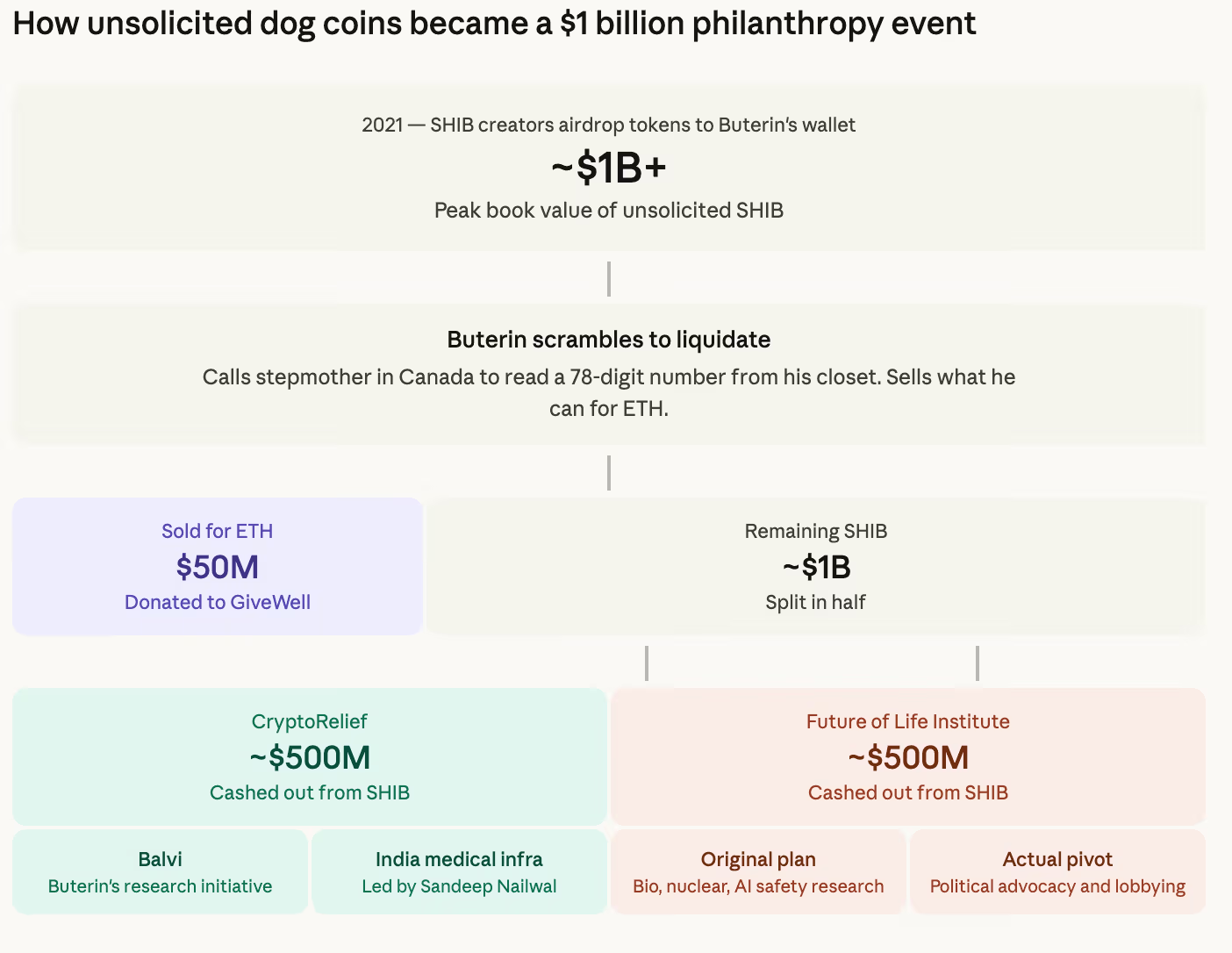
This shift is what prompted Buterin’s post on Friday. He indicated that FLI experienced “an internal pivot by which they started focusing on cultural and political action as a primary method, quite different from the original approach.”
According to Buterin, FLI justifies its new direction by claiming that AGI is progressing swiftly, necessitating an aggressive stance to counter the lobbying efforts of large AI corporations.
"My concern is that large-scale coordinated political action with significant financial resources can easily lead to unintended consequences, provoke backlash, and address issues in a way that is both authoritarian and unstable, even if that was not the original intent," he wrote.
He highlighted FLI’s biosafety strategy as an illustration. The organization’s main approach has involved embedding safeguards into AI models and bio-synthesis technologies to prevent them from generating hazardous outputs.
Buterin described this as “very fragile,” emphasizing that methods like jailbreaks, fine-tuning, and other workarounds make such limitations easy to bypass. He cautioned that the logical conclusion of this method might lead to “let’s ban open-source AI” followed by “let’s support one good-guy AI company to achieve global dominance and prevent others from reaching the same level.”
"Strategies like this can VERY EASILY backfire: they turn the rest of the world into your adversary," he wrote.
He also pointed out a structural issue with regulation-first approaches. When authorities restrict hazardous technologies, national security agencies are typically exempted, and those same agencies are often the source of the risks. He cited government lab leak programs as a pertinent example.
Nonetheless, Buterin expressed that he has been “heartened” by some of FLI’s recent initiatives, particularly a “pro-human AI declaration” that he stated, “brings together conservatives, progressives, and libertarians, as well as America, Europe, and China.” He also mentioned that FLI has been investigating methods to prevent the concentration of power from AI.
However, the fundamental message was unmistakable. A donation Buterin never intended, derived from tokens he never sought, supported an organization that altered its approach away from the one he endorsed and is now allocating hundreds of millions of dollars in ways that cause him discomfort. He has communicated his concerns to FLI on “several occasions” before making them public.
FLI did not promptly respond to CoinDesk’s inquiry regarding the donation amount and concerns related to AI safety.
