Disclaimer: Information found on CryptoreNews is those of writers quoted. It does not represent the opinions of CryptoreNews on whether to sell, buy or hold any investments. You are advised to conduct your own research before making any investment decisions. Use provided information at your own risk.
CryptoreNews covers fintech, blockchain and Bitcoin bringing you the latest crypto news and analyses on the future of money.

Understanding the Functionality of Vanity Addresses in Bitcoin: A Guide to Customizing Your Address

Have you ever considered if a Bitcoin (BTC) address — a sequence of 26–35 alphanumeric characters — could potentially contain human-readable words instead of random letters?
You may be familiar with the Lightning Network, which enables the creation of an appealing BTC address resembling an email or web domain. However, there is also a method for generating Bitcoin addresses with human-readable words directly on the original Bitcoin blockchain. These addresses are referred to as vanity Bitcoin addresses.
What is a vanity Bitcoin address?
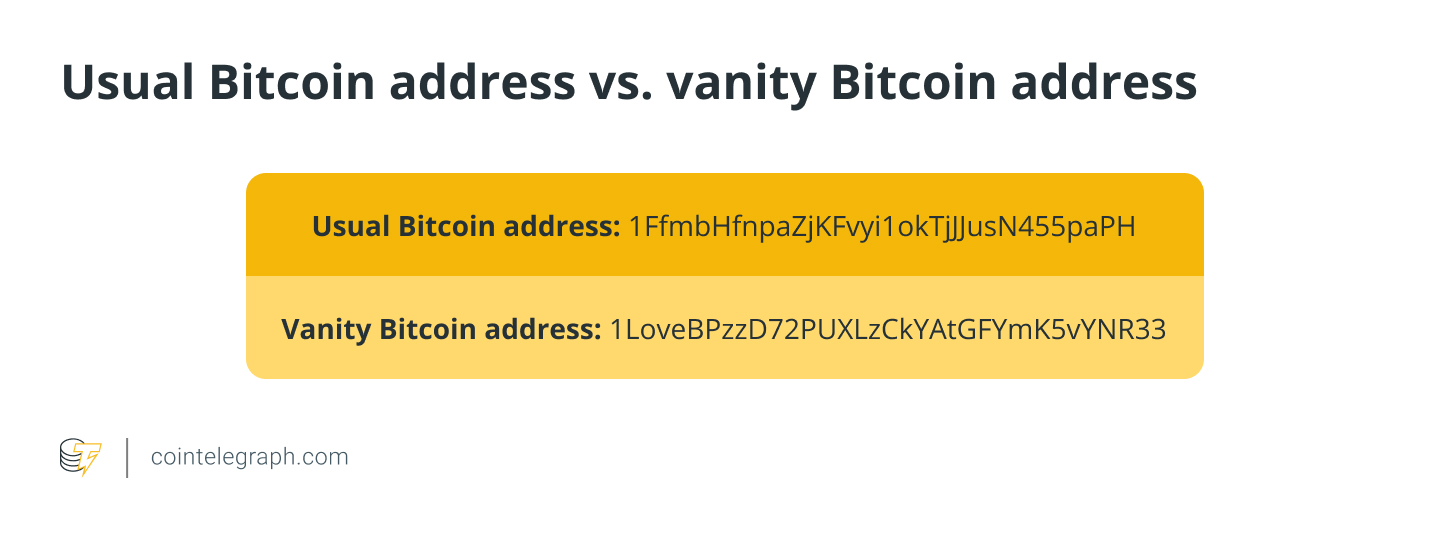
A vanity Bitcoin address is a customized BTC address that incorporates a particular pattern or word within its total string of 26-35 characters. In contrast to a standard Bitcoin address — composed of random characters — a vanity Bitcoin address permits users to personalize their addresses or even convey a specific message through the address itself.
The phrase “vanity address” derives from the literal meaning of “vanity,” which signifies an inflated sense of pride in oneself or one’s appearance. Accordingly, vanity addresses are utilized by individuals who wish to distinguish themselves and provide their wallet address with a unique identity.
Vanity Bitcoin addresses gained traction a few years after the anonymous Bitcoin creator Satoshi Nakamoto introduced the cryptocurrency in 2009. The first vanity address generator, named “VanityGen,” was launched as an open-source tool on GitHub in 2012. One of the earliest mentions of vanity addresses on Bitcointalk.org — a prominent crypto forum established by Nakamoto — dates back to 2013.
As per Trezor’s Bitcoin analyst Josef Tetek, Nakamoto did not utilize vanity addresses: “He vanished from the public eye before vanity addresses gained popularity,” Tetek informed Cointelegraph, referencing Nakamoto’s disappearance in 2011.
In addition to the Bitcoin blockchain, vanity addresses are also available on other networks, such as the Ethereum blockchain. Unlike Bitcoin vanity addresses, which allow users to select from 26–35 alphanumeric characters, Ethereum vanity addresses consist solely of hexadecimal numbers, as Ether (ETH) addresses can only include letters “A” through “F” and digits zero through nine.
According to the ETH Optimism vanity address generator, generating an Ethereum vanity address that begins with “0xFad69” could take up to five minutes.
How to create a Bitcoin vanity address?
There are two methods for creating a vanity BTC address: manually and by utilizing specialized vanity address generator services. The first approach relies on software and necessitates some computing power and coding expertise to execute programs that locate Bitcoin addresses starting with a specific word combination.
Many Bitcoin specialists, including Trezor’s Tetek, concur that the first method is the most secure way to create a vanity Bitcoin address, as it allows users to keep their seed phrase confidential. Being the sole owner of a private key or seed phrase ensures that the user is the exclusive holder of the funds linked to the address.
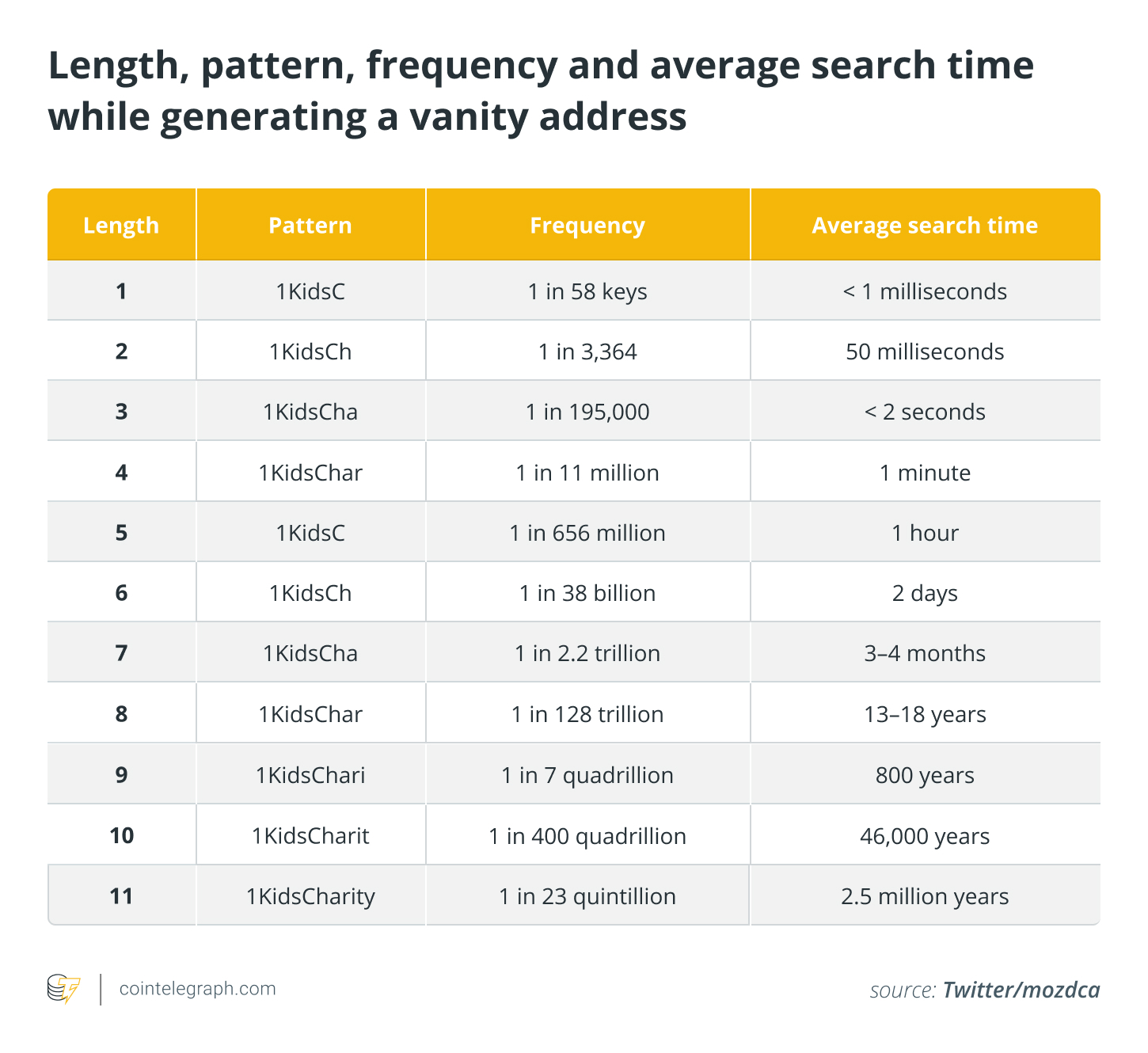
The manual approach involves installing vanity address-generating software like VanityGen, which can be found on the cloud-based software platform GitHub. Operating such software requires specific computing power specifications, with longer sequences of symbols necessitating more time to produce a vanity address.
Various sources estimate that generating a vanity address with a five-symbol word takes approximately one hour using a standard personal computer, while larger sequences, such as seven symbols, could take up to three months. More advanced setups utilizing powerful graphic cards or even application-specific integrated circuit (ASIC) chips can considerably shorten the time required to generate a vanity address.
The second method for creating a vanity address is simpler but less secure, as it involves outsourcing the address search to third-party services, commonly referred to as “vanity address miners.”
Relying on Bitcoin vanity services carries significant risks, as miners could potentially seize the address and its assets at any moment. This is because such miners are the first to obtain the private key before transferring it to the customer. The private key is generated at the time of creating a Bitcoin address and cannot be altered afterward.
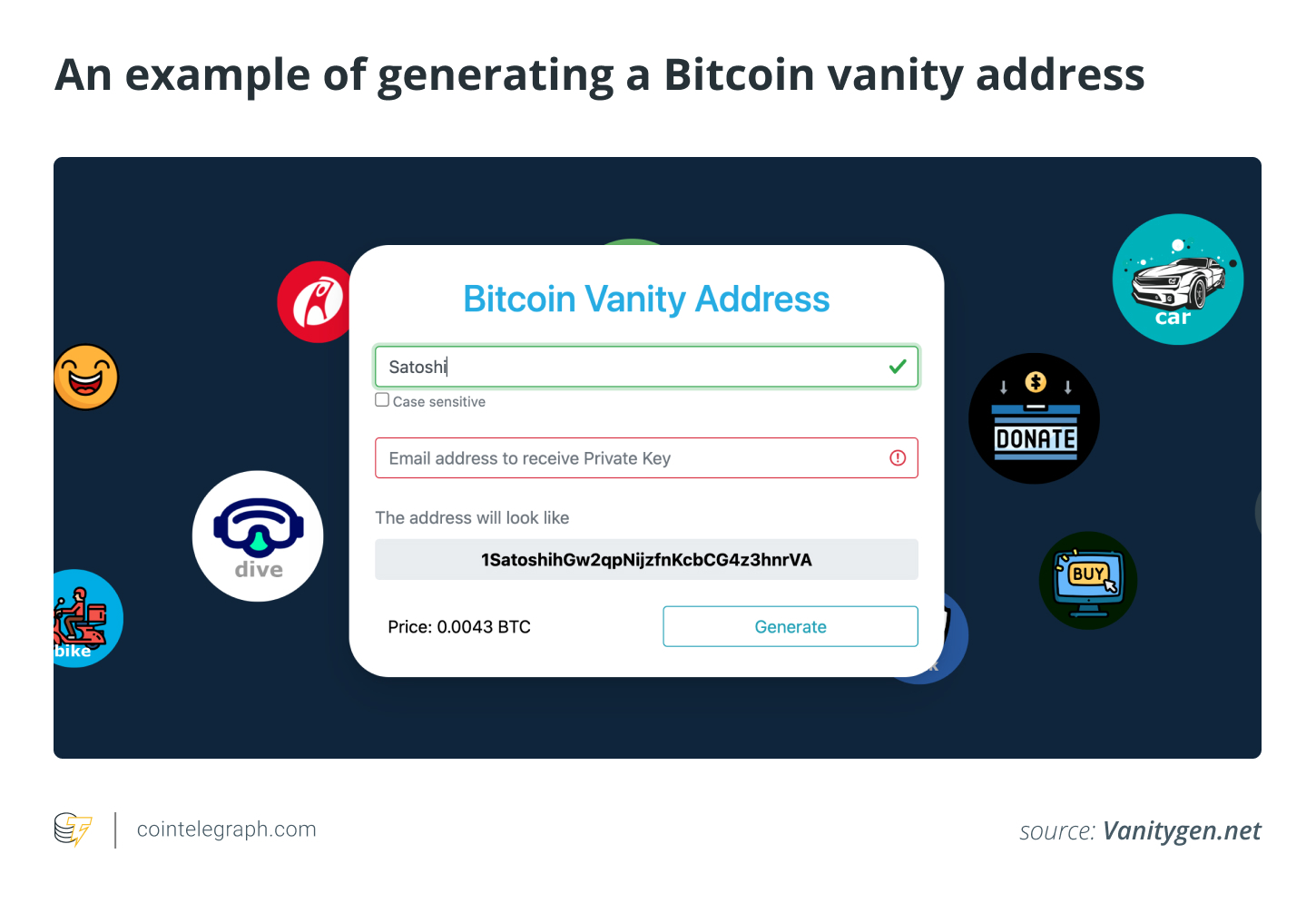
The vanity generation service is frequently offered through websites like Vanitygen.net, enabling users to simply request a specific desired word or sequence to be searched using computing power purchased online. These services often allow users to request a sequence of letters up to eight symbols. Once generated, the private key for the vanity address is sent to the customer’s email in exchange for the agreed-upon price.
For instance, generating a Bitcoin vanity address that starts with “1Satoshi…” would cost approximately 0.0217 BTC, valued at around $600 at the time of writing. Longer sequences like “1Nakamoto…” would require at least 0.11 BTC, or as much as $3,250.
Related Posts
It is crucial to understand that not all letters and numbers can be included in a vanity Bitcoin address, similar to a standard BTC address. Certain letters, such as the uppercase letter “O,” the uppercase letter “I,” the lowercase letter “L,” and the number “0,” are excluded from the set of 26–35 alphanumeric characters available in all Bitcoin addresses. These exclusions aim to help users avoid confusion when transferring funds on the Bitcoin blockchain.
The risks of using a Bitcoin vanity address
The choice to use a Bitcoin vanity address ultimately hinges on the motivations for having such an address, considering all potential risks. Some cryptocurrency exchanges, like BitMEX, have experimented with vanity addresses utilizing the native Segregated Witness (SegWit) address format Bech32 with the “bc1qmex…” prefix.
A representative from BitMEX informed Cointelegraph that most vanity addresses are employed for marketing purposes or regarded as “a bit of fun.”
“Bitcoin vanity addresses were quite popular on BitcoinTalk around 2011, when many solicited donations to their personal vanity address, for example, 1Name,” the BitMEX representative noted, adding:
“In the days before structured proof of reserves systems, the exchange-wide use of vanity addresses provided a way for users to informally sum up the reserves of an exchange.”
The firm also attempted to utilize vanity addresses to complicate the efforts of attackers to scam users since BitMEX only provided vanity addresses to users. However, one should not depend on vanity addresses as a security measure, as more sophisticated attackers could replicate the vanity address format, the representative cautioned.
BitMEX’s spokesperson stated that vanity addresses are most suitable for advanced users: “The primary drawback for individual users is diminished privacy. Generally, we would advise users against reusing addresses,” adding that newer BitMEX customer addresses no longer include a vanity prefix.
Trezor’s Bitcoin expert Tetek strongly discouraged the use of vanity addresses because such addresses — even if generated securely — encourage address reuse, which is considered poor practice regarding privacy. He stated:
“If a Bitcoin address is used multiple times, others can easily track the receiving and spending patterns of an individual. Consequently, it becomes easier to identify the owner of the address.”
In addition to privacy and asset safety concerns, vanity BTC addresses are also linked to security vulnerabilities. In 2022, hackers successfully stole $3.3 million in cryptocurrency through a vulnerability in the Ethereum vanity address-generating tool Profanity. Furthermore, in March 2023, attackers exploited compromised vanity addresses to steal $500,000 worth of tokens from the layer-2 scaling solution Arbitrum’s airdrop.
The future of Bitcoin vanity addresses
Although Bitcoin vanity addresses have seen a decline in popularity since 2011, there is no indication that such addresses have ceased to be used in recent years.
One report recently highlighted the use of a Bitcoin vanity address containing profane words seemingly aimed at Russia’s President Vladimir Putin. This address has conducted a total of 0.29 BTC ($7,595) in 67 transactions between 2018 and 2020, depleting its balance to zero.
One of its last recorded transactions included a transfer of 0.0004 BTC ($10) to the public Bitcoin address of renowned Bitcoin critic Warren Buffet, who received a BTC address and a gift from Tron founder Justin Sun.
Moreover, challenges and considerations remain. For example, the security risks associated with vanity address generators need to be addressed, prompting the creation of more secure and user-friendly tools. The process of creating vanity addresses could become more efficient and accessible to a broader audience, not just those with programming skills, as blockchain systems evolve and integrate new features.
However, the privacy concerns raised by address reuse will continue to be a significant factor. Therefore, users desiring personalized addresses must weigh the benefits of uniqueness against potential privacy infringements.
While it is essential to recognize that Bitcoin vanity addresses carry notable risks and costs, such addresses seemingly unlock some new and perhaps unconventional use cases for the cryptocurrency. With this in mind, it is up to Bitcoin users to determine whether the future of Bitcoin vanity addresses is promising or not.
Collect this article as an NFT to preserve this moment in history and demonstrate your support for independent journalism in the crypto sector.
