Disclaimer: Information found on CryptoreNews is those of writers quoted. It does not represent the opinions of CryptoreNews on whether to sell, buy or hold any investments. You are advised to conduct your own research before making any investment decisions. Use provided information at your own risk.
CryptoreNews covers fintech, blockchain and Bitcoin bringing you the latest crypto news and analyses on the future of money.

U.S. Treasury could increase T-Bill offerings as stablecoins target $2 trillion market valuation: StanChart

The bank indicated that stablecoins could create up to $1 trillion in additional demand for Treasury bills by 2028, enabling the government to increase issuance and potentially halt 30-year bond auctions.
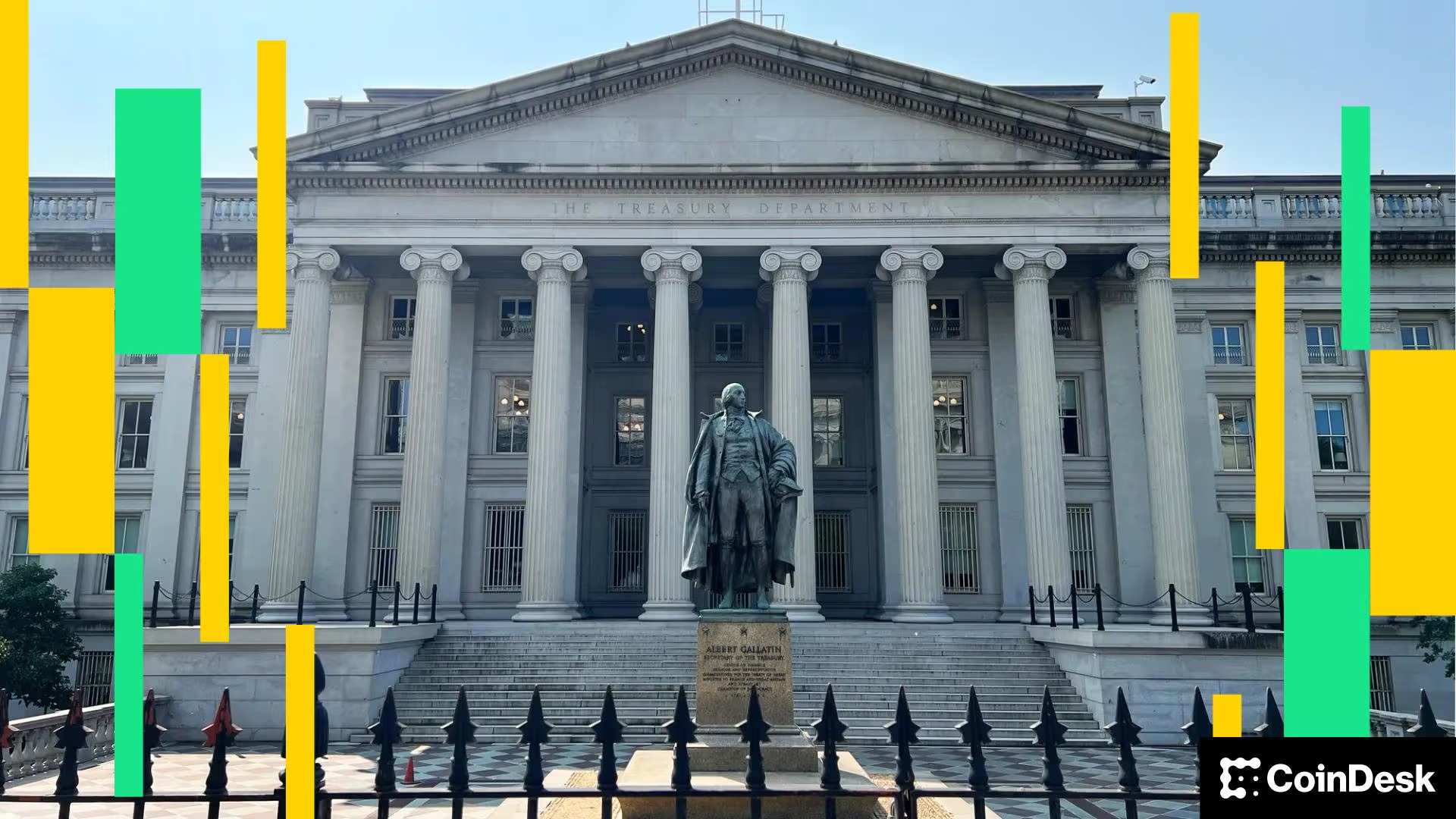 U.S. Treasury might increase T-Bill issuance as stablecoins target a $2 trillion market cap: StanChart. (CoinDesk)
Key points:
- Standard Chartered predicts the stablecoin market cap will reach $2 trillion by the conclusion of 2028, leading to a potential $1 trillion in additional Treasury bill demand.
- Alongside an estimated $1.2 trillion in anticipated Federal Reserve purchases, total new T-bill demand could approximate $2.2 trillion by 2028, compared to an estimated supply of around $1.3 trillion, resulting in an estimated shortfall of about $900 billion.
- The bank noted that the Treasury could increase bill issuance, possibly pausing 30-year auctions, to address the growing demand at the front end.
Standard Chartered continues to project the stablecoin market to reach $2 trillion by the end of 2028, which is expected to correspond to approximately $1 trillion in new Treasury bill demand, according to a report released on Monday.
As of early 2026, the overall stablecoin market capitalization stands at approximately $300-$320 billion.
STORY CONTINUES BELOWDon’t miss another story.Subscribe to the Crypto Daybook Americas Newsletter today. See all newslettersSign me up
"This will lead to approximately $0.8-$1.0 trillion of new demand for T-bills (for reserve purposes) from stablecoin issuers during that timeframe," stated Geoff Kendrick, head of digital asset research, along with U.S. rates strategist John Davies.
When combined with $1-$1.2 trillion in expected Federal Reserve purchases, total new T-bill demand could reach around $2.2 trillion by 2028, as indicated in the report. This contrasts with an anticipated net new supply of approximately $1.3 trillion, assuming bills’ portion of total debt remains stable, suggesting a possible deficit of $0.9 trillion.
Related Posts
Stablecoin issuers like Tether and Circle (CRCL) have emerged as significant purchasers of short-term U.S. government debt, maintaining tens of billions of dollars in Treasury bills as reserves that support tokens like USDT and USDC.
Tether has reported T-bill holdings comparable to those of mid-sized sovereign investors, while Circle also retains a considerable portion of its reserves in short-dated Treasuries through money market funds.
As the stablecoin market expands, issuers generally allocate new inflows into T-bills to earn yield while ensuring liquidity, effectively directing crypto-driven capital into U.S. government financing and bolstering demand at the front end of the yield curve.
The Treasury noted in its February 4 Quarterly Refunding Announcement (QRA) that it “is monitoring SOMA purchases of Treasury bills and the increasing demand for Treasury bills from the private sector,” a trend that Standard Chartered anticipates will grow.
The analysts indicated that the expected excess demand provides Treasury Secretary Scott Bessent an opportunity to increase T-bills’ proportion of issuance. Elevating that share by 2.5 percentage points over a three-year period could generate about $0.9 trillion in additional bill supply, bridging the gap.
Shifting that amount from longer-dated bonds might effectively suspend 30-year auctions for three years and alleviate upward pressure on long-term yields, according to the report.
Although not its primary scenario, the bank foresees the 10-year yield reaching 4.6% by the end of 2026, with analysts cautioning about increasing risks of front-end scarcity.
The growth of stablecoins has recently plateaued just above $300 billion, rising from $238 billion in April 2025, as crypto prices declined and post-GENIUS Act issuance slowed. Bitcoin has dropped over 50% from its peak of $126,000 in October 2025, dampening trading-driven demand. Standard Chartered perceives these challenges as cyclical and asserts that stablecoins could contribute nearly $1 trillion in additional T-bill demand by 2028, altering U.S. rate markets.
Read more: Standard Chartered anticipates bitcoin declining to $50,000, ether to $1,400 before recovery
