Disclaimer: Information found on CryptoreNews is those of writers quoted. It does not represent the opinions of CryptoreNews on whether to sell, buy or hold any investments. You are advised to conduct your own research before making any investment decisions. Use provided information at your own risk.
CryptoreNews covers fintech, blockchain and Bitcoin bringing you the latest crypto news and analyses on the future of money.

Tighter MiCA regulations may reduce the crypto sector throughout the EU, according to a Swiss wealth management firm.

Crypto wealth management firm Swissborg has received MiCA approval and is preparing to relocate its European operations to France, while aiming for expansion in markets such as Germany, Italy, and Spain.
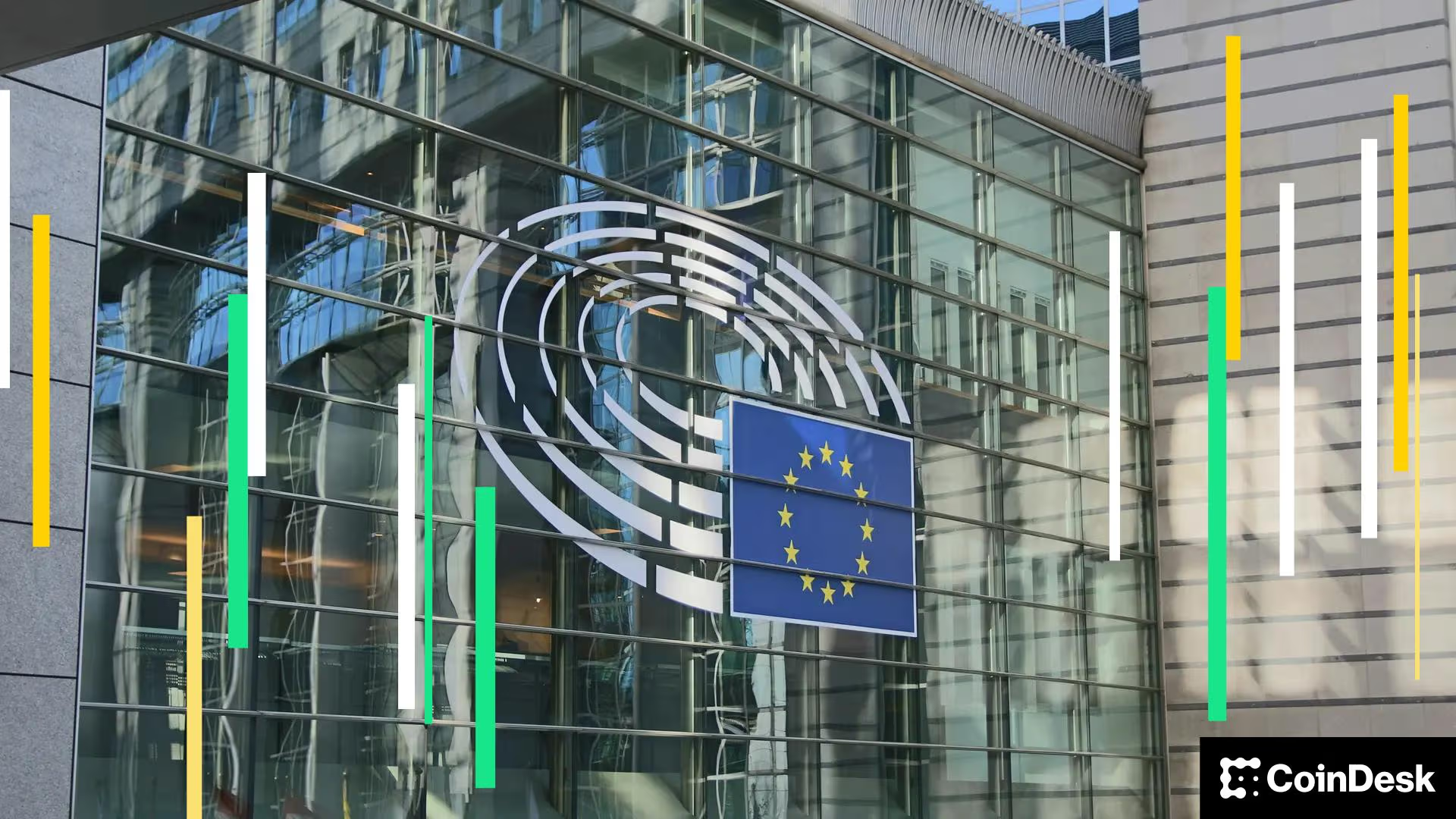 The EU’s new regulatory framework, MiCA, is transforming the cryptocurrency landscape in the European Union, according to SwissBorg. (Credit: Guillaume Périgois-Unsplash/Modified by CoinDesk)
Key points:
- The newly established MiCA regulations by the European Union are transforming the crypto landscape by elevating regulatory and operational benchmarks, potentially decreasing the number of minimally regulated platforms.
- SwissBorg, which has recently obtained a MiCA license and intends to transition its European operations to a newly approved French entity, aims to grow in significant EU markets as certain global exchanges reduce their presence in the region.
- The COO of SwissBorg anticipates that yield and staking offerings, especially those associated with stablecoins, will trend towards more transparent disclosures and standardized structures as regulatory bodies advocate for stricter guidelines and institutions gradually enhance their engagement.
The recently implemented Markets in Crypto Assets (MiCA) regulations by the European Union are starting to reshape the digital asset sector in the region, generating fresh opportunities and challenges for companies looking to operate within the bloc, as stated by a Swiss-based crypto wealth management platform.
Swissborg, which has one million registered users and manages $1.3 billion in assets, is among the firms betting that this shift will bolster Europe’s position in regulated digital asset markets following the acquisition of its MiCA license.
“The economics of crypto brokerage can be difficult during weaker market conditions, and some global platforms may need to reevaluate where they allocate their capital and operational resources,” commented SwissBorg Chief Operating Officer Jeremy Baumann to CoinDesk.
Over time, this may result in “a market with fewer but more robust participants. MiCA enhances the regulatory and operational criteria necessary to serve European clients, potentially reducing the number of less structured players,” he noted, referencing Gemini’s recent exit from the EU.
Baumann further mentioned that a reduction in global exchanges within the EU “creates opportunities for other European firms to solidify their market position.”
In September 2025, SwissBorg faced an exploit that it reported affected under 1% of its users. The company stated that 192,600 SOL (valued at $41.5 million) was stolen from an external wallet exclusively utilized for its SOL Earn strategy. The exploit was attributed to a compromised application programming interface (API) of a partner and not a breach of the SwissBorg platform itself.
Related Posts
The progression of yield and staking
Baumann expressed his expectation that yield and staking products will develop towards clearer disclosures, enhanced risk management, and more standardized frameworks.
“The regulations surrounding stablecoins are more comprehensive and will influence the design and distribution of specific yield models,” stated Baumann, whose mid-tier exchange currently has around $800 million in total value locked (TVL), according to Defilama data.
He also indicated that regulatory clarity could gradually encourage increased institutional involvement, adding that for the time being, the European digital asset market remains predominantly retail-driven.
“Traditional financial institutions can fulfill all three roles,” Baumann said. “They possess strong distribution capabilities and regulatory knowledge, making them competitors in various areas, but there are also avenues for collaboration.”
EU regulators seek defined stablecoin frameworks
Baumann also highlighted ongoing discussions regarding stablecoins and yield products. While much of this dialogue is currently taking place in the United States, European regulators are primarily concentrating on establishing clear guidelines concerning issuance, reserves, and distribution.
“As the market matures, yield solutions are likely to advance towards more transparent and well-structured models that balance innovation with financial stability,” he remarked.
SwissBorg sought authorization in France, recognized as one of the stricter regulatory environments in Europe. The approval affirms the integrity of the company’s internal controls, risk management practices, and protections for user assets, according to the firm.
The company intends to transition its European operations from its existing Estonian entity to the newly approved French crypto-asset service provider (CASP) entity in the upcoming months, contingent upon confirming operational readiness, with initial plans to focus on key crypto markets including Germany, the Netherlands, Italy, and Spain.
