Disclaimer: Information found on CryptoreNews is those of writers quoted. It does not represent the opinions of CryptoreNews on whether to sell, buy or hold any investments. You are advised to conduct your own research before making any investment decisions. Use provided information at your own risk.
CryptoreNews covers fintech, blockchain and Bitcoin bringing you the latest crypto news and analyses on the future of money.

This situation could lead to Gary Gensler stepping down, according to a former SEC official.

The securities regulator of the United States may completely alter its stance on crypto enforcement, contingent upon a significant election in the U.S. in 2024, as stated by former SEC official John Reed Stark.
In a tweet dated Aug. 13, the former chief of the SEC Office of Internet Enforcement suggested that a Republican President could significantly transform the regulatory landscape for crypto, which might include the possible resignation of SEC chair Gary Gensler.
At present, there are several Republican candidates in the race. Former President Donald Trump is the leading candidate among Republican voters, followed by Florida Governor Ron DeSantis in a distant second place, and South Carolina Senator Tim Scott thereafter.
If a Republican were to win the presidency, Stark indicated that Gensler would likely be succeeded by crypto-friendly Hester Peirce, commonly known as “Crypto Mom.”
Will the SEC Approve Any Of The Recent Bitcoin Spot ETF Applications?
People often ask for my opinion on whether the SEC will approve any of the recent spate of bitcoin spot ETF applications, which is an interesting and important question.
My take is that the current SEC will… pic.twitter.com/lPXebl03Y4— John Reed Stark (@JohnReedStark) August 13, 2023
Stark highlighted Peirce’s history of dissent regarding many of the regulator’s crypto-related enforcement actions, and elaborated that if Peirce were to lead the SEC:
“The world should expect that most U.S. SEC crypto-related enforcement and most crypto-related SEC disruption would grind to a screeching halt.”
Stark also pointed out the growing polarization surrounding crypto regulation within the SEC and U.S. politics at large.
Related Posts
When Stark began discussing crypto in 2017, he noted that a variety of politicians shared a common perspective, with then-President Donald Trump, Secretary Hillary Clinton, and Congresswoman Maxine Waters all agreeing that crypto posed a “dangerous and horrific plague.”
Currently, crypto has evolved into a much more contentious topic. Republican candidate Ron DeSantis has stated his intention to “protect” Bitcoin (BTC) and has pledged to prohibit central bank digital currencies (CBDCs) if he becomes President.
Conversely, Democratic Senator Elizabeth Warren has made several determined efforts to impose restrictions on all forms of crypto in the nation, even forming an “anti-crypto army” as part of her Senate re-election campaign.
Until a Republican occupies the Oval Office, Stark expressed skepticism that the regulator would adopt a more favorable attitude toward crypto, forecasting that the SEC will deny the current batch of spot Bitcoin ETFs for a variety of “compelling” reasons.
Referencing an Aug. 8 Better Markets SEC Comment letter, Stark noted that spot Bitcoin markets have a history of artificially inflated trading volumes, are heavily concentrated among a few participants, and depend on a limited number of select entities to sustain the Bitcoin network. This situation reportedly leaves investors “extremely vulnerable” to manipulation by malicious actors.
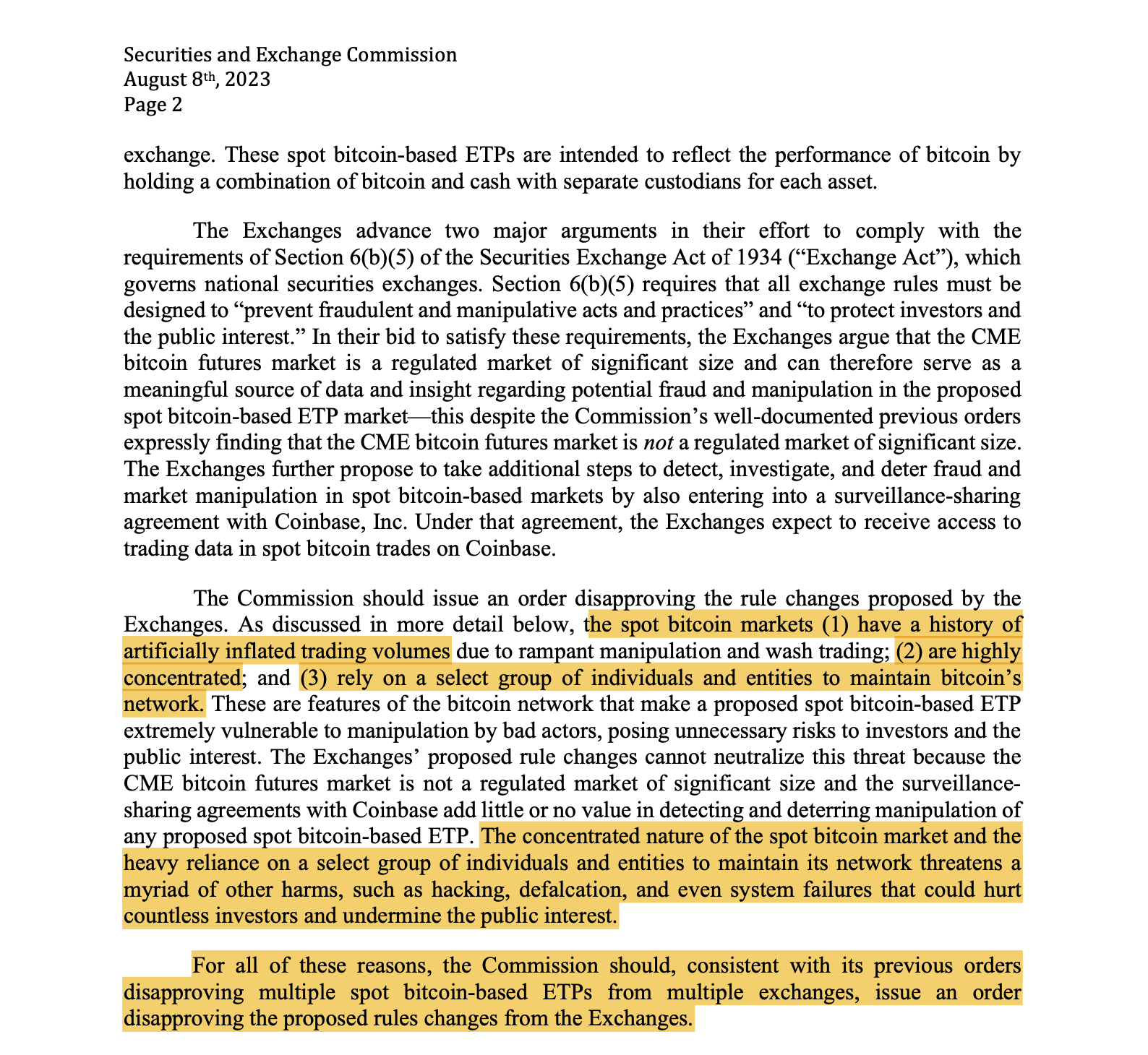 Better Markets letter to the SEC, recommending a rejection of spot Bitcoin ETF products. Source: Better Markets
Despite numerous prominent figures from traditional finance, such as BlackRock and Fidelity, submitting applications for a spot Bitcoin ETF, Stark is convinced that the SEC will ultimately reject all pending filings.
Magazine:Blockchain games aren’t really decentralized… but that’s about to change
