Disclaimer: Information found on CryptoreNews is those of writers quoted. It does not represent the opinions of CryptoreNews on whether to sell, buy or hold any investments. You are advised to conduct your own research before making any investment decisions. Use provided information at your own risk.
CryptoreNews covers fintech, blockchain and Bitcoin bringing you the latest crypto news and analyses on the future of money.

The previous highs of Bitcoin are no longer out of reach, indicating that the era of rapid price surges may have concluded.

Bitcoin’s price retraces to previous highs, indicating slower growth and a maturing market.
 BTC is trading close to its earlier bull cycle peak.
What to know:
- The current bear market for Bitcoin has driven prices down to approximately $70,000, revisiting the previous cycle’s record high and differing from earlier trends where past peaks were seldom retested.
- Each new bull market has yielded smaller percentage increases, illustrating the principle of diminishing returns as higher prices necessitate significantly more capital to elevate bitcoin to new heights.
- Traders’ focus on the $70,000 level may influence whether this bear market phase is approaching its conclusion.
Since its launch, bitcoin has functioned like an adventurous climber reaching new heights, seldom revisiting the ledges it has left behind. Its price rarely pulled back to previous bull-market peaks, even during prolonged and challenging bear markets.
However, this pattern appears to have shifted, indicating that the market has developed, and the period of rapid, substantial gains may be behind us.
BTC trades near former peak
Bitcoin has been hovering around $70,000 since early February – significantly below the $126,000 peak of the 2023-2025 bull run.
The $70,000 threshold is significant as it represents the record high in the 2019–2022 market cycle. In other terms, this bear market has retraced to a previous summit.
This situation is atypical. In earlier bear markets, such as those in 2014 and 2018, bitcoin never returned to prior cycle peaks. The only exception was in 2022, when prices fell below the 2017 high of $20,000. At that time, analysts regarded it as an anomaly, attributing it to crypto scams and extensive deleveraging.
What distinguishes the current retrace is that it is occurring without extreme catalysts. The market has simply reverted to a previous peak as part of the natural fluctuations of a bear cycle.
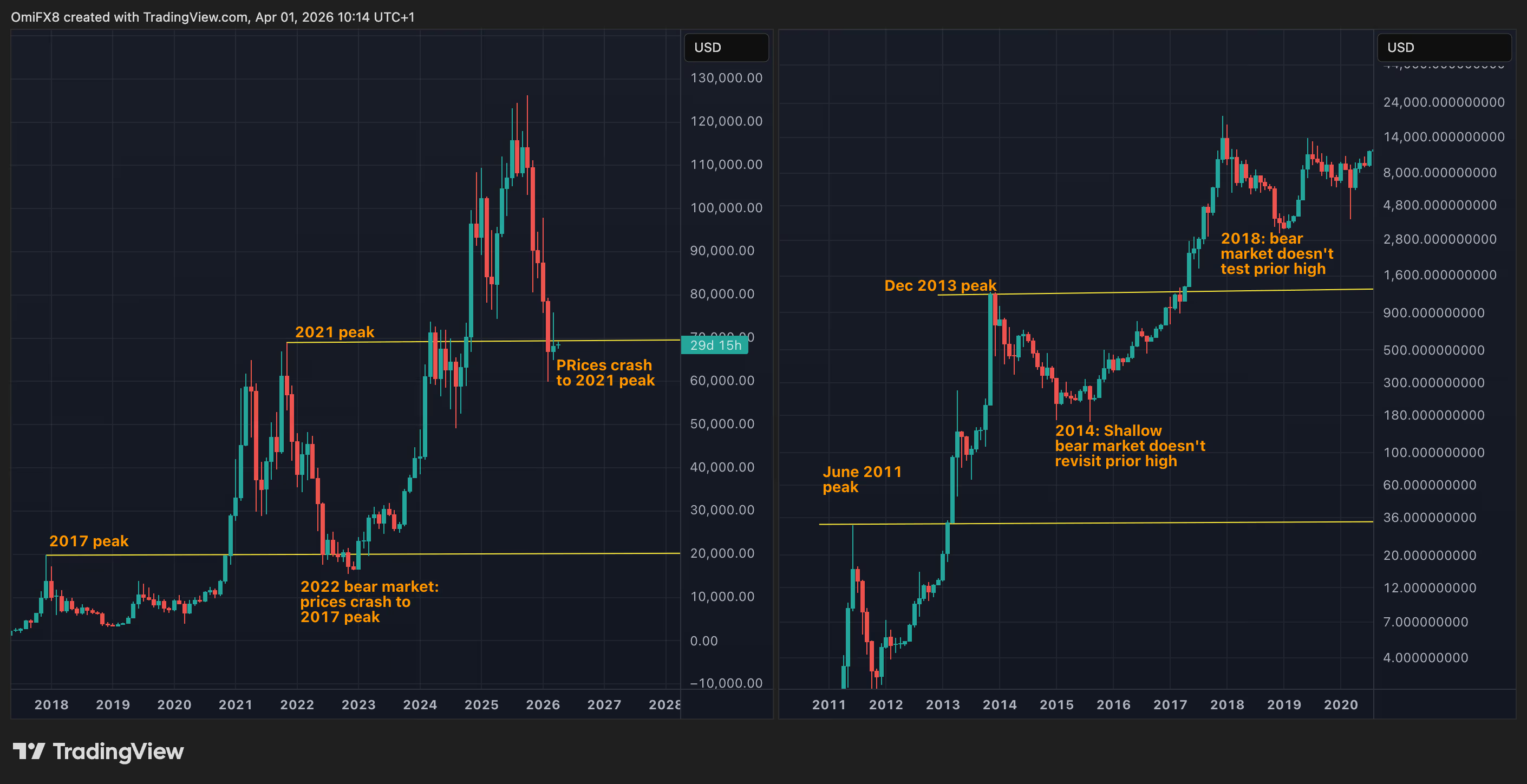 BTC’s bear markets are now testing previous cycle highs. (TradingView)
Slowing growth and the principle of diminishing returns
Related Posts
Each new bull market has not produced the exponential gains of previous cycles. Driving prices significantly beyond earlier peaks has become increasingly difficult, making retracements to historical highs more commonplace. In essence, previous peaks are no longer considered unreachable.
This situation exemplifies the principle of diminishing returns. As bitcoin’s value increases, achieving higher prices demands progressively larger amounts of capital. The times when modest inflows could spark substantial rallies are largely behind us, resulting in price movements that are more gradual and predictable.
A review of historical growth illustrates this trend:
- The peak in 2013 was 38 times higher than that of 2011.
- The peak in 2017 was 16 times higher than that of 2013.
- By 2021, the increase had decelerated to just 3 times the 2017 level.
- The projected peak for 2025, exceeding $126K, is less than double the 2021 peak.
While prices continue to rise, the rate of growth is consistently declining.
Institutionalization and wider market engagement
This deceleration is partly attributed to the institutional adoption of Bitcoin and the expansion of the derivatives market. Traders now have structured methods to speculate on volatility, timing, and market direction, not solely on price increases. This increased participation has moderated extreme price fluctuations.
This contrasts sharply with the pre-2020 period, when trading was primarily limited to buying and selling on the spot market. During that time, only bullish advocates of bitcoin actively engaged, often entering the market at the first signs of a downturn.
Behavioral trends and future outlook
Historical peaks often serve as significant support levels due to a behavioral phenomenon known as anchoring bias, where traders fixate on former highs as benchmarks.
Many who missed the initial breakout are inclined to buy when prices return to these recognizable levels, propelling the next phase of a bull run. This behavioral inclination, coupled with the self-reinforcing characteristics of support and resistance, helps clarify why the recent downward trend has paused around the $70,000 mark.
A strong rebound from this level could indicate that the bear market has reached its conclusion, akin to late 2022, when the downward trend halted around $20,000.
Nevertheless, if the principle of diminishing returns holds true, the upcoming uptrend may be more subdued and akin to traditional finance, rather than the frenetic rallies of earlier speculative periods.
