Disclaimer: Information found on CryptoreNews is those of writers quoted. It does not represent the opinions of CryptoreNews on whether to sell, buy or hold any investments. You are advised to conduct your own research before making any investment decisions. Use provided information at your own risk.
CryptoreNews covers fintech, blockchain and Bitcoin bringing you the latest crypto news and analyses on the future of money.

The NYSE aims to integrate blockchain technology into Wall Street while maintaining the current framework.

The head of product development at the exchange, Jon Herrick, indicated that blockchain technology will be integrated into current systems instead of supplanting them.
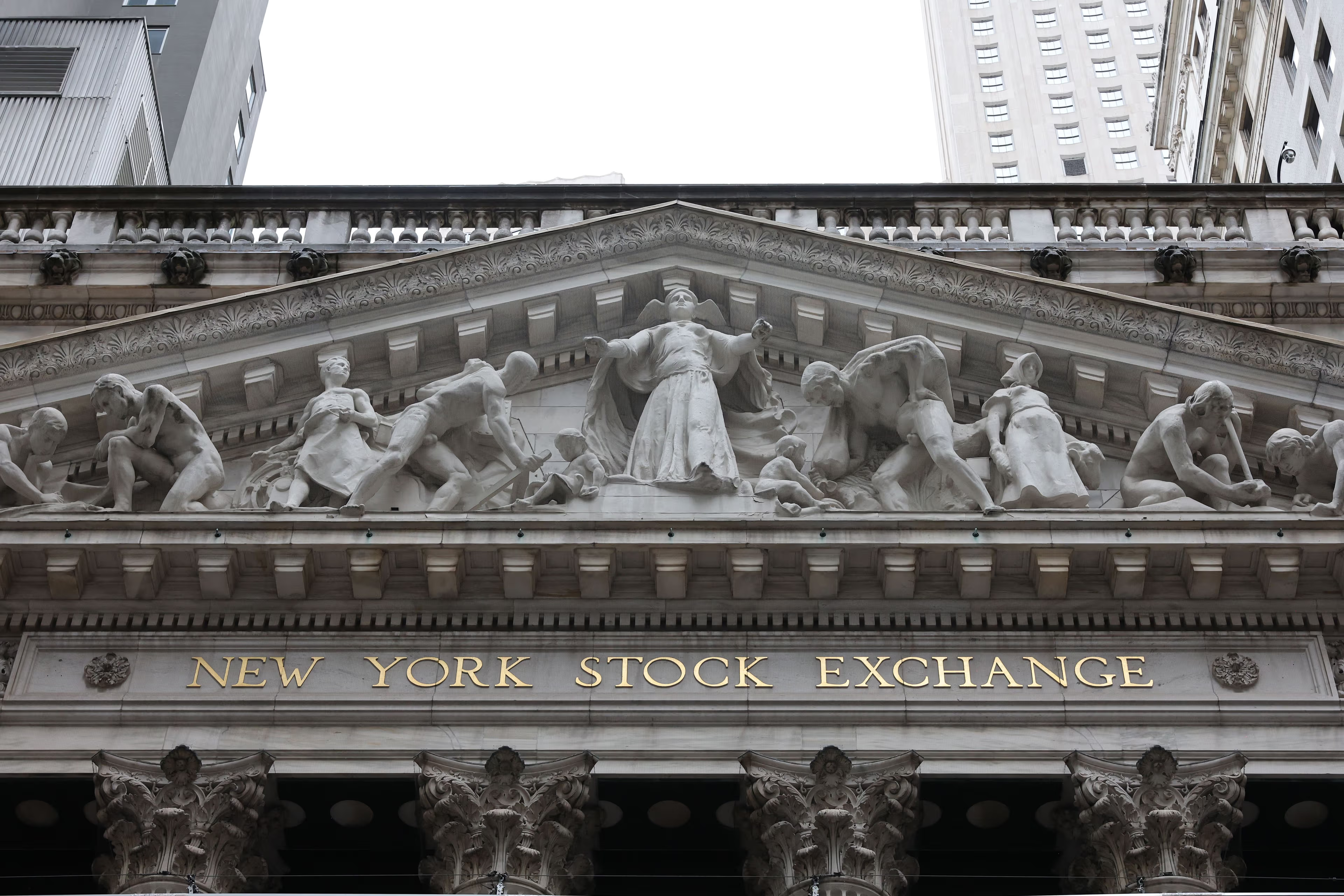 (Michael M. Santiago/Getty Images)
What to know:
- The New York Stock Exchange is implementing a strategy to incorporate blockchain technology into its existing market framework rather than completely replacing traditional systems.
- Jon Herrick, the chief product officer at NYSE, stated that the exchange aims for interoperability and explores tokenization applications such as real-time or near real-time settlement and extended trading hours.
- While highlighting the advantages of regulation, centralized clearing, and investor protections, Herrick anticipated that the difference between traditional and tokenized assets may largely diminish over the next decade.
The New York Stock Exchange (NYSE) is focused on incorporating blockchain technology into the current market framework rather than substituting it, as stated by chief product officer Jon Herrick.
The exchange is “striving for interoperability” and “building on what already exists,” as it investigates how tokenized assets might operate within existing systems, Herrick remarked.
Related Posts
This approach reflects a broader perspective on market evolution. “One must be aware of the inherent positive aspects of the market that have developed thus far … it’s about balancing both elements,” he mentioned during his presentation at the Digital Asset Summit in New York on Thursday, referring to the necessity of preserving components like regulation, clearing systems, and investor protections.
Instead of positioning blockchain as a substitute for traditional finance, Herrick portrayed a scenario where both systems converge. “It’s not about one side being more correct than the other … [they] should, I believe, eventually integrate.”
His remarks arise as exchanges, asset managers, and banks experiment with tokenization, which allows assets like stocks and funds to be represented on blockchain platforms. Proponents suggest that this model could facilitate quicker settlement, around-the-clock trading, and wider global market access.
The NYSE is investigating some of these applications, including real-time or near real-time settlement and extended trading hours. The Intercontinental Exchange (ICE), the parent company of NYSE, recently made a strategic investment in crypto exchange OKX. ICE will license OKX’s spot crypto prices for its crypto futures products, while OKX will provide ICE futures and tokenized equities to its clients in the U.S.
However, Herrick warned that current systems provide efficiencies that may not be easily replicated. For instance, centralized clearing helps mitigate risk by netting transactions among market participants.
Nevertheless, over time, the separation between traditional and tokenized assets may diminish. “Perhaps a decade from now, whether [a] security is tokenized or not should not be a concern,” he stated.
Currently, the exchange’s strategy indicates a more gradual, incremental approach, integrating blockchain technology progressively into the existing financial system rather than transforming it suddenly.
