Disclaimer: Information found on CryptoreNews is those of writers quoted. It does not represent the opinions of CryptoreNews on whether to sell, buy or hold any investments. You are advised to conduct your own research before making any investment decisions. Use provided information at your own risk.
CryptoreNews covers fintech, blockchain and Bitcoin bringing you the latest crypto news and analyses on the future of money.

The era of cryptocurrency excitement has concluded, paving the way for the development of genuine infrastructure.

Nikolic contests a recent CoinDesk opinion piece that claims “crypto’s rock ‘n’ roll era is over,” asserting that this transition is beneficial for the industry’s developers.
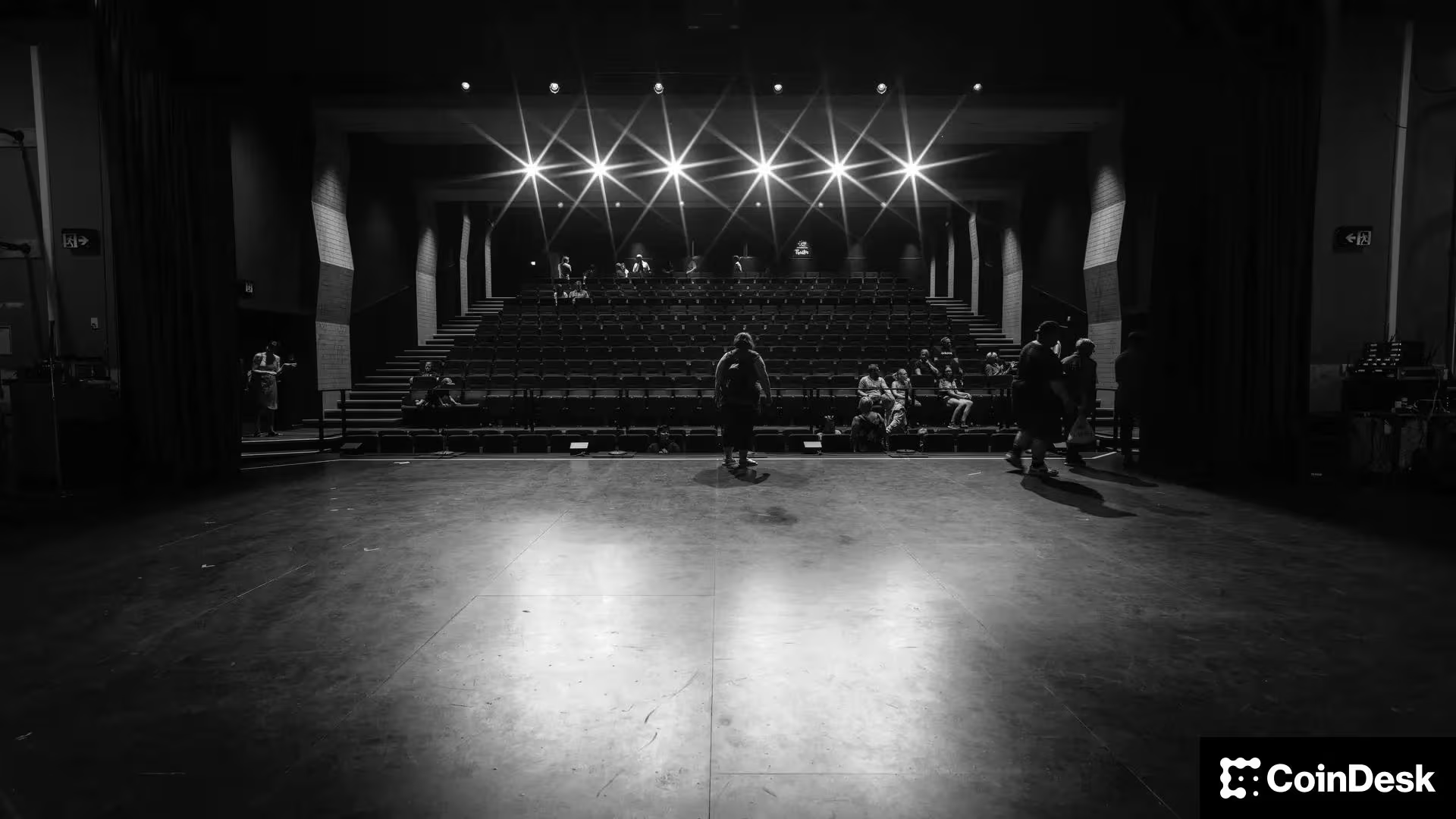 (Photo by Mark Thompson/Unsplash)
Leah Callon-Butler recently mentioned that the rock-and-roll era of crypto has concluded, and she is largely correct regarding the trend. However, my experience in the music industry during the actual decline of rock and roll reveals additional insights.
I held a product leadership role at Universal Music throughout the torrent era. I was present in the meetings where executives opted to litigate against grandmothers rather than innovate with platforms like Spotify. I observed significant legal expenditures overshadowing investments in artists. Ultimately, I was dismissed for highlighting that we had already experienced a loss.
Thus, when someone employs rock and roll as a metaphor for current developments in digital assets, I comprehend the deeper implications of that metaphor.
This is what the conclusion of the rock and roll era genuinely entailed from an insider’s perspective. The most vibrant and thrilling aspects of the culture faded away while the mundane infrastructure beneath it subtly became the focal point. The rock stars vanished. Streaming executives ascended to prominence. Meanwhile, the audience expanded even as the cultural landscape became less engaging.
Callon-Butler presents this situation as a form of lamentation. The cypherpunk ideal has been softened by the introduction of ETFs and institutional custody. The laser eyes meme has been adopted by leaders. I acknowledge the sense of loss. I experienced it while observing Universal Music shift from supporting artists to refining playlists.
However, this is where the music industry’s analogy proves beneficial, and this aspect is often overlooked.
The labels persisted. They embraced streaming and branded it as progress. They transitioned from opposing Napster to acquiring shares in Spotify. The same executives who sought to dismantle file sharing ultimately gained from the infrastructure that file sharing necessitated. The establishment assimilated the revolution and redefined it.
This parallels the current situation with digital assets. JP Morgan is emulating what Universal did with streaming. They are repackaging what they once opposed and marketing it as a product. Just like in the music realm, the audience will likely grow, the infrastructure will improve, and the culture may become less captivating. Callon-Butler accurately captures that aspect.
Related Posts
However, what she overlooks is what transpired next in music, an event the establishment could not absorb.
As Universal focused on becoming a streaming entity, countless teenagers with personal blogs and home studios were creating something the labels could not encompass. The Swedish death metal enthusiast. The Brazilian baile funk artist. The Detroit techno archivist. They were unaware of one another’s existence. They even disregarded Universal’s significance. They simply wanted to express their passion.
In a collective effort, without any formal coordination, they developed something institutions could not imitate: endless specificity. Every conceivable preference established its own ecosystem. Each microgenre formed its own distribution pathway. The monoculture fragmented into a complexity so intricate that no corporate framework could reconstruct it.
The rock and roll era is undeniably finished. The crucial question is what is being constructed in the silent areas where institutions are not observing.
Stablecoins are facilitating value transfer across borders for individuals unfamiliar with DeFi. Tokenized assets are establishing markets in regions where conventional finance has historically neglected to venture. Self-custody solutions are gradually improving while the focus is on ETF inflows. This is the unremarkable infrastructure that paves the way for the forthcoming wave.
I grew up in Argentina, witnessing a government abruptly freeze bank accounts and declare that people’s dollars were now worth a fraction of their previous value. That experience imparts a lasting lesson about money. It teaches that those who develop the infrastructure during quieter times are the ones who become significant when the situation becomes turbulent again.
Callon-Butler questions whether crypto will retain its uniqueness. I would suggest reframing the question. The music industry maintained its eccentricity; it simply ceased to be unusual in the areas under executive scrutiny. The uniqueness transitioned to the peripheries, to home producers, niche communities, and distribution methods that operated independently.
The conclusion of crypto’s rock-and-roll era represents the most optimistic development for the industry. It signifies that seasoned players have entered the scene, bringing with them capital that remains steadfast during fluctuations. Crypto requires stable institutional infrastructure, and that is precisely what is currently under development.
Yet, somewhere, a young individual in Lagos, Buenos Aires, or Beirut is innovating on these frameworks in ways that no boardroom has yet envisioned. They may not even be aware of the establishment’s existence. They simply require the infrastructure to function.
That marks the onset of the intriguing phase.
