Disclaimer: Information found on CryptoreNews is those of writers quoted. It does not represent the opinions of CryptoreNews on whether to sell, buy or hold any investments. You are advised to conduct your own research before making any investment decisions. Use provided information at your own risk.
CryptoreNews covers fintech, blockchain and Bitcoin bringing you the latest crypto news and analyses on the future of money.


When social media claimed Netanyahu was deceased, crypto prediction markets estimated the likelihood at 5%. The market was accurate — and now Washington aims to intervene.
 Benjamin Netanyahu (Getty images)
Key points:
- As rumors circulated regarding Netanyahu’s alleged demise, Polymarket’s betting contracts indicated a different narrative — estimating the chance of him exiting office at merely 4–5%, despite the conspiracy dominating social media platforms.
- The difference with the Khamenei market is significant: when the Iranian Supreme Leader was actually killed, Polymarket surged to 100%, demonstrating that the same crowd that disregarded the Netanyahu rumor recognized how to value a genuine occurrence.
- Prediction markets are currently experiencing political pushback, with Democratic senators advocating for a prohibition on contracts linked to deaths — coinciding with the markets showcasing their highest informational relevance.
The rumor followed a well-known wartime pattern. Iran’s Islamic Revolutionary Guard Corps asserted that it had attacked Benjamin Netanyahu’s office. Following this, fake screenshots emerged — fraudulent posts from the Israeli prime minister’s official account declaring him deceased. Additionally, there was a stir over a low-resolution still from a press conference that, from a specific angle, seemed to depict Netanyahu’s right hand with six fingers, prompting contrarian commentators to celebrate.
Conservative influencer Candace Owens vocally supported these claims on X, questioning Netanyahu’s whereabouts and why his office was “releasing and deleting fake AI videos.” Iran’s Tasnim News Agency, associated with the Islamic Revolutionary Guard Corps, published an article titled “New Video of Netanyahu Proves Fake,” detailing alleged clear indicators that a later coffee shop clip, shared by Netanyahu’s own account to refute the claims, was generated by artificial intelligence. The conspiracy had turned into a self-sustaining narrative; every denial was interpreted as fresh proof.
While fact-checkers rushed to respond and podcasters speculated, one data source provided a clear, immediate signal. On Polymarket, the largest crypto prediction market globally, the contract for “Netanyahu out by March 31” was trading around 4 to 5 cents, suggesting a roughly 4 to 5% chance of him leaving office before the month’s end. The market remained stable. For anyone observing that figure, the entire conspiracy theory unraveled at a glance.
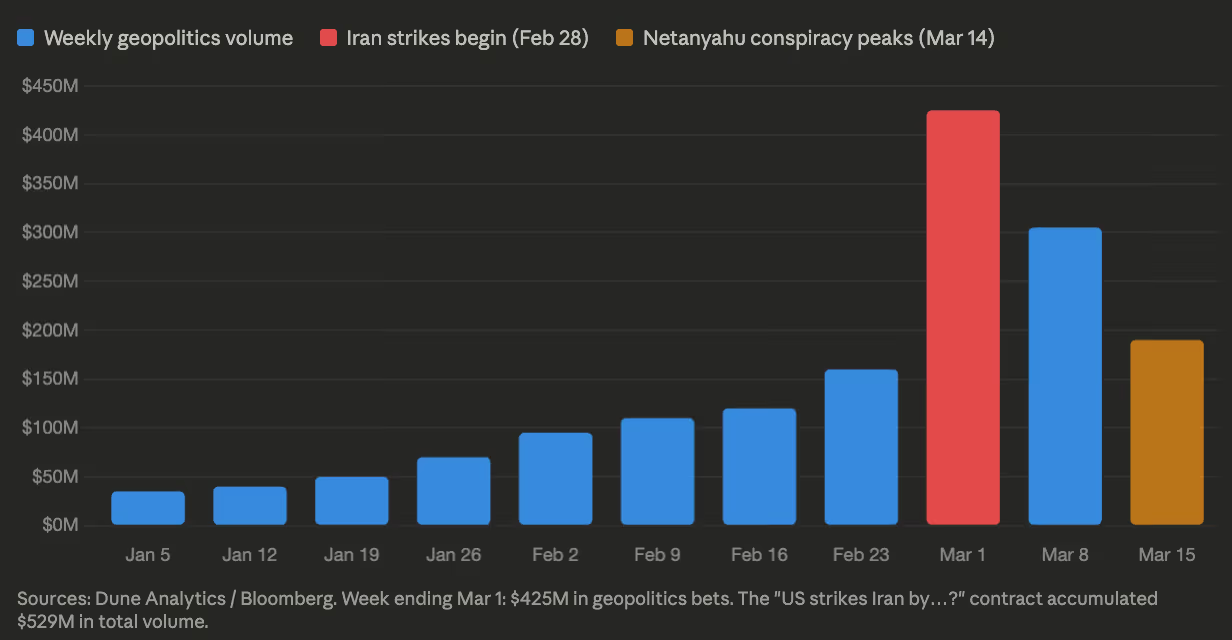 Polymarket volume (Dune Analytics)
A record-breaking backdrop
To comprehend why the Netanyahu rumor gained traction when it did, it is essential to grasp the information context from which it arose.
Since the U.S. and Israel initiated strikes against Iran on February 28, Polymarket has evolved into something resembling a real-time geopolitical intelligence hub. During the week ending March 1, bettors placed $425 million in geopolitical wagers on the platform alone — a significant increase from $163 million the previous week — with total platform wagering reaching an unprecedented $2.4 billion. The “US strikes Iran by…?” contract amassed $529 million in total volume, establishing it as one of the largest individual markets Polymarket has ever hosted and the fourth-largest in its entire “Politics” category.
This marks a remarkable trajectory for a platform that recorded $73 million in total trading volume in 2023 and was forced offshore following a CFTC settlement a year later. By 2025, Polymarket had processed about $22 billion in notional trading volume throughout the year — a figure that highlights how swiftly the platform has transitioned from a crypto novelty to a prominent financial infrastructure.
This is no longer merely a crypto curiosity. In October 2025, the Intercontinental Exchange, which owns the New York Stock Exchange, invested $2 billion into Polymarket, valuing it at $9 billion, and launched a “Polymarket Signals and Sentiment” tool that delivers real-time prediction market data directly to Wall Street trading desks. When the Iran conflict began, equity and oil futures markets were closed for the weekend. Polymarket was operational.
The market as instant truth machine
Prediction markets do not feature death contracts in the traditional sense. Rather, Polymarket offers “politician out by X date” markets, which resolve to “Yes” if a leader resigns, is ousted, or steps down. They do not directly assess the probability of death. However, in a context where the conspiracy theory suggests Netanyahu has been killed and the government is orchestrating a cover-up, these contracts serve as a potent proxy.
Related Posts
The rationale is straightforward. A leader who has died or become incapacitated cannot indefinitely govern from office. Eventually, a resignation, removal, or credible leak would emerge. If any of that occurred, the payout on a “Yes” share at 5 cents would be substantial: a $1 payout on a 5-cent share represents a 20-to-1 return.
One trader was prepared to make that bet on a large scale. A single Polymarket account placed $151,000 on Netanyahu being out before March 31, accumulating nearly 3.8 million shares at 4.7 cents each. If successful, this position would yield $3.8 million. Currently, it is down by approximately $26,000.
This figure reflects the upper limit of rational belief in the conspiracy. At the peak of online fervor, the most aggressive speculator on record was willing to risk $150,000 on the theory — indicating he recognized the odds were unfavorable. The market as a whole assigned the probability at around 5%. Social media declared it certain. The financial backing suggested otherwise.
“Whether a politician is in or out of office is a highly significant outcome for many individuals,” stated Aaron Brogan, a managing attorney at Brogan Law who has provided guidance on prediction market regulations. “These markets are precisely the types of markets that event contract rules were designed to accommodate.”
Why the odds are hard to fake
The 2024 US election cycle provided a clear demonstration of prediction market efficiency — and the limitations of attempts to dismiss its signals. When Polymarket indicated Donald Trump was trading at a notable premium over Kamala Harris, critics alleged manipulation. They claimed a French trader had artificially inflated Trump’s odds using multiple accounts for political gain.
Experts were not convinced. As Flip Pidot, co-founder of American Civics Exchange, remarked to CoinDesk at the time: a true manipulator attempting to influence the price would simply place blind bets and allow themselves to be filled at deteriorating prices. The French trader did the opposite — strategically dividing orders across accounts to reduce slippage. This is what profit-seeking behavior looks like, not propaganda.
The deeper reason manipulation struggles to persist is expected value arbitrage. If a price is artificially lowered or elevated, profit-driven traders will rush in to exploit the discrepancy until it stabilizes. Cross-market arbitrage reinforces this: Polymarket prices are updated in real time in relation to Kalshi, Betfair, and others. If odds deviate significantly across platforms, traders quickly sell the higher price and purchase the lower one, aligning markets toward a consensus.
Harry Crane, a statistics professor at Rutgers University who studies prediction markets, views the Netanyahu incident as an almost perfect example of this dynamic. “These markets serve as an antidote to propaganda precisely because their resolution rules anchor outcomes to verifiable sources rather than narrative,” he told CoinDesk. “I understand why governments wish to limit them — not due to concerns over leaking classified information, but because verifiable price signals are more challenging to control.”
This framing aligns directly with the Netanyahu conspiracy. Those asserting he was deceased were engaging in a structurally similar approach as those who claimed Polymarket was rigged in 2024: attacking the signal rather than addressing it.
What the market is actually pricing — and what it isn’t
Crane is cautious regarding the limitations of the signal, and his caveat is worth noting.
“The market is solely pricing the probability that Netanyahu is verifiably out of office according to these rules,” he stated. The resolution criteria specify that the contract resolves to “Yes” if Netanyahu announces his resignation or is otherwise removed from office, confirmed by official sources or a consensus of credible reporting. If a government successfully concealed a leader’s death to the extent that no credible source ever verified it, the market could resolve “No” — accurately, according to its own rules, yet failing to capture the underlying reality.
This dynamic was evident in real time. Domer — a well-known prediction market trader known as ImJustKen online — openly held a No position on Netanyahu leaving office before March 31. Not because he was convinced Netanyahu was alive, but because he doubted a departure would ever be validated under the market’s resolution criteria, even if it occurred. He was assessing the verification gap, not the conspiracy itself.
However, this caveat highlights a significant aspect of the conspiracy itself. The Netanyahu death rumor only holds if you subscribe to a cover-up so extensive — involving Israeli officials,
