Disclaimer: Information found on CryptoreNews is those of writers quoted. It does not represent the opinions of CryptoreNews on whether to sell, buy or hold any investments. You are advised to conduct your own research before making any investment decisions. Use provided information at your own risk.
CryptoreNews covers fintech, blockchain and Bitcoin bringing you the latest crypto news and analyses on the future of money.

Tech investor and former Snap executive states that cryptocurrency is incompatible with AI investments as it represents ‘a different category.’

Former Snap strategy chief and Credit Suisse banker states that cryptocurrency lies outside his AI thesis.
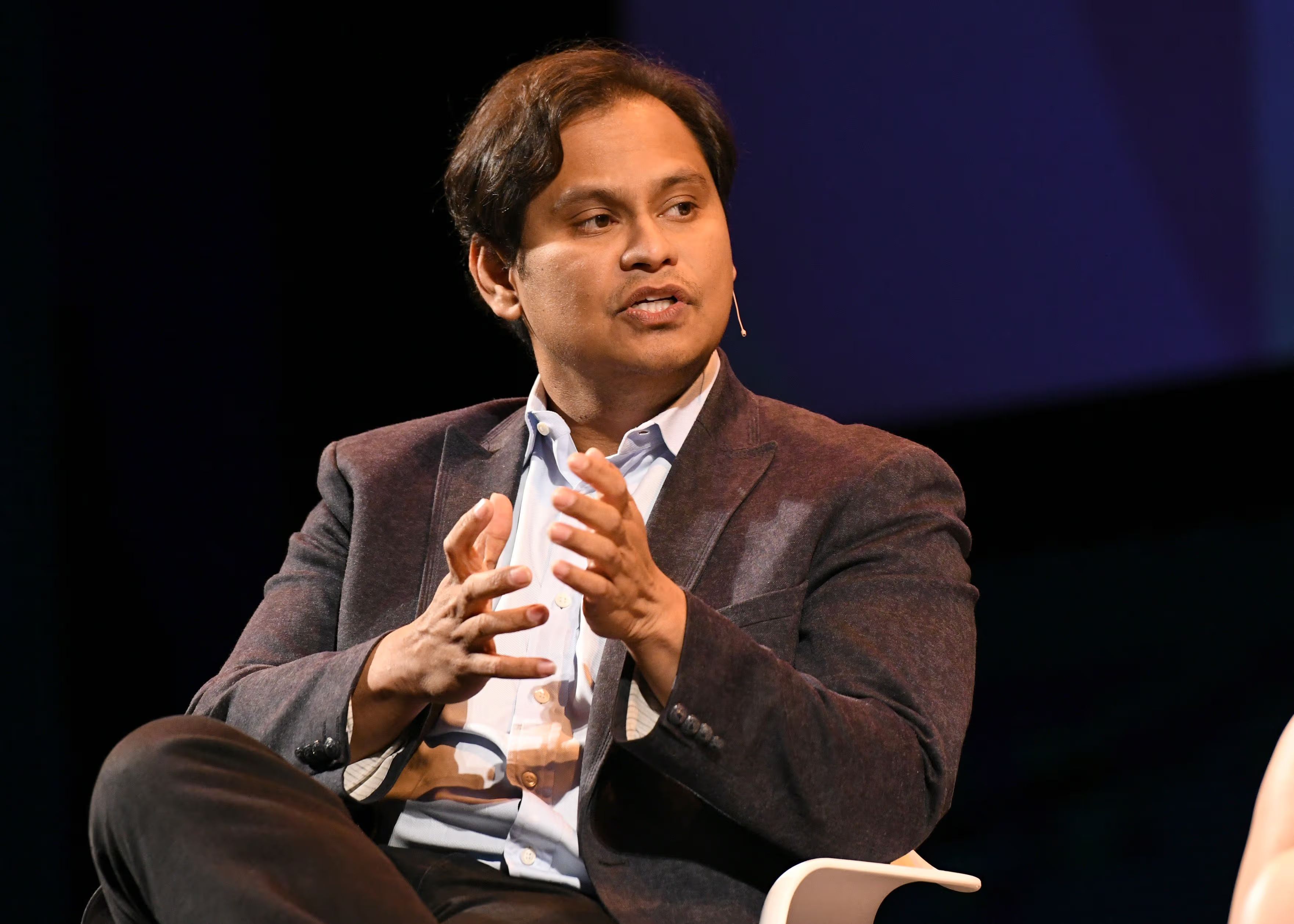 (Craig Barritt/Getty Images)
Key points:
- Imran Khan, a tech investor, states that cryptocurrency has a minimal impact on his AI investment strategy as he believes crypto and AI stem from fundamentally distinct investment theories.
- His firm, Proem Asset Management, concentrates its AI investments on productivity and economic advancement, while limiting direct token investments and considering crypto-related holdings as part of a wider technology strategy.
- Khan suggests that concerns regarding AI-induced job losses mirror previous technological upheavals, even as AI stocks experience a downturn and several institutional investors subtly reconsider crypto as a possible long-term asset.
Imran Khan, a tech investor, indicates that cryptocurrency does not significantly influence his AI investment approach, contending that the asset class operates on a fundamentally different premise compared to the AI-driven productivity surge.
Despite the prevailing notion that AI and crypto will merge, Khan maintains that he primarily views them as separate investment categories.
“Crypto is a distinct entity,” he remarked in an interview. “In terms of AI, you are investing for productivity and economic advancement.” This distinction implies that crypto seldom aligns with the framework employed by his firm, which emphasizes companies benefiting from transformative technology trends.
Khan is the founder and chair of the investment committee at Proem Asset Management, a technology-centric investment firm managing $450 million in assets. Prior to establishing Proem, he was the chief strategy officer at Snap (formerly Snapchat), where he played a key role in the company’s public offering and previously led global internet investment banking at Credit Suisse, contributing to significant transactions, including Alibaba’s record-setting IPO.
Nonetheless, he does not oppose cryptocurrency.
While direct token investments have not typically aligned with the firm’s investment philosophy, which prioritizes fundamental private equity, Proem has held stakes in Coinbase (COIN), Robinhood (HOOD), as well as bitcoin miner Iren (IREN) and spot bitcoin via the iShares Bitcoin Trust (IBIT), as per its latest 13F filing. These investments are not part of the firm’s AI strategy but rather reflect its broader focus on the technology sector, according to Khan.
Intersection of Crypto and AI
While Khan asserts that the two sectors are entirely distinct, some investors argue that a convergence of AI and crypto is logical since both depend on decentralized computing networks and data infrastructure.
Related Posts
The rationale is that blockchains can serve as payment systems and coordination frameworks for AI services that function across the internet without centralized ownership. In fact, last month, a report from Citrini Research that highlighted concerns about an AI bubble and triggered a brief market downturn noted that autonomous AI agents would disrupt conventional payment systems by circumventing credit card networks in favor of stablecoins.
Others suggest that blockchain-based systems could assist in tracking how AI models utilize data, validating outputs, or managing digital identities for autonomous software agents.
Although the concept of merging the two industries remains largely experimental, it has sparked a surge of startups aiming to connect AI development with crypto-based frameworks. Concurrently, numerous bitcoin miners have already transitioned into the AI sector by adapting their data centers and energy infrastructure to facilitate artificial intelligence computing.
Even bitcoin could gain from the expansion of AI, according to NYDIG, a financial services and infrastructure firm. The firm’s analyst posited that if AI leads to job and wage reductions, decreasing consumer demand, it could compel policymakers to lower rates to stabilize the economy, thus introducing a wave of liquidity that could bolster bitcoin prices.
Concerns about an AI Bubble
Khan’s remarks come as the AI investment surge that followed the debut of ChatGPT is starting to exhibit signs of pressure.
Nvidia (NVDA) — the leading supplier of chips essential for training AI models — and Broadcom (AVGO), a networking and custom AI chip manufacturer, have both seen declines of about 5% year-to-date, indicating rising skepticism regarding the speed of returns from substantial AI investments.
Meanwhile, the Citrini report that prompted the AI alarm presented a hypothetical scenario for 2028, where rapid AI adoption results in substantial white-collar job losses and a significant decline in consumer spending.
While this scenario raises concerns, Khan is adopting a broader perspective, asserting that similar apprehensions have accompanied nearly every technological advancement.
“If you examine Karl Marx’s writings, he expressed the same concerns about machinery 200 years ago,” Khan noted. “Currently, we are experiencing an AI revolution that could rival the Industrial Revolution, and people are voicing the same concerns.”
He further remarked that new technologies have historically transformed labor markets instead of entirely eliminating jobs.
“With the advent of new technology, new types of jobs are created,” Khan stated.
