Disclaimer: Information found on CryptoreNews is those of writers quoted. It does not represent the opinions of CryptoreNews on whether to sell, buy or hold any investments. You are advised to conduct your own research before making any investment decisions. Use provided information at your own risk.
CryptoreNews covers fintech, blockchain and Bitcoin bringing you the latest crypto news and analyses on the future of money.

Stanley Druckenmiller suggests that stablecoins and bitcoin may transform the financial landscape.

The billionaire investor indicated that stablecoins could potentially become the primary payment system in 10-15 years, and reaffirmed that cryptocurrency might supplant the U.S. dollar as the global reserve currency.
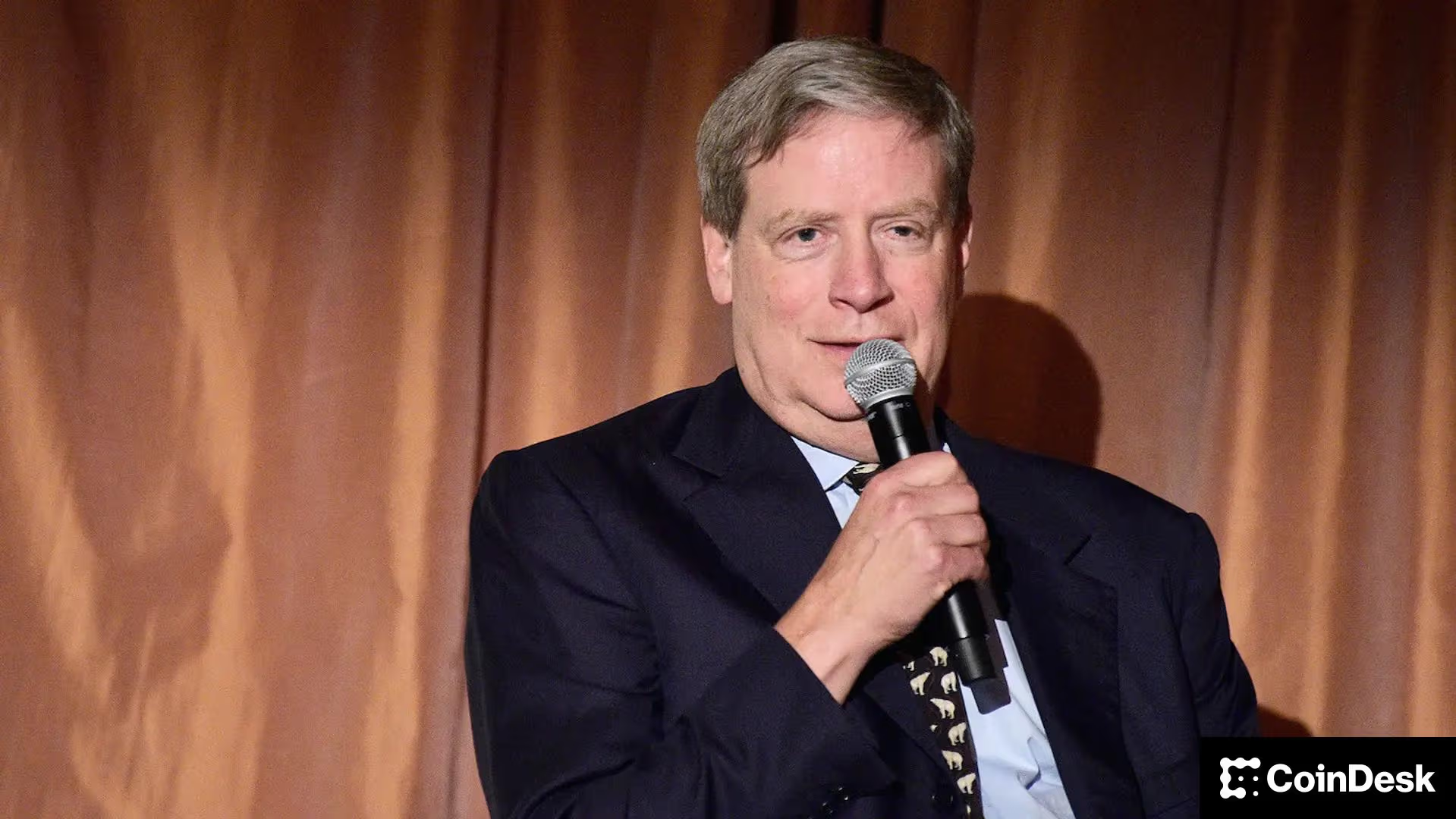 Stanley Druckenmiller (Stefanie Keenan/Getty Images for CHIPS modified by CoinDesk)
What to know:
- Billionaire investor Stanley Druckenmiller stated that he anticipates stablecoins will significantly influence global payment systems within the next 15 years, noting their increased efficiency, speed, and cost-effectiveness compared to existing infrastructure.
- He commended stablecoins like USDT and USDC as effective applications of blockchain technology, while also reiterating his stance that much of the wider cryptocurrency landscape remains “a solution looking for a problem.”
- Druckenmiller remarked that bitcoin has likely secured its position as a store of value and raised concerns about the longevity of the U.S. dollar as the global reserve currency, suggesting it might be replaced in 50 years.
Billionaire investor Stanley Druckenmiller indicated that stablecoins could form the foundation of global payment systems in the next decade or two, while also emphasizing his ongoing skepticism towards much of the broader cryptocurrency landscape.
“I assume our entire payment systems will be stablecoins in 10 or 15 years,” he conveyed in an interview shared by Morgan Stanley on Thursday. He described the fiat-pegged tokens as “efficient, quicker and cheaper” than conventional payment systems, adding that “Blockchain and the utilization of stablecoins are remarkably beneficial in terms of productivity.”
Stablecoins such as Tether’s USDT and Circle Internet’s (CRCL) USDC are cryptocurrencies intended to maintain a stable value, typically pegged to a fiat currency, most frequently the U.S. dollar, and are widely utilized across digital asset markets for trading, payments, and transfers.
Druckenmiller’s perspectives align with recent comments from Australian investment bank Macquarie, which stated that these tokens are already transforming payments and banking. It pointed out that they are transitioning from a specialized crypto trading tool into a possible component of global financial infrastructure.
Related Posts
Regarding other cryptocurrencies, however, the seasoned investor reiterated a critique he has held for years about the broader crypto sector.
“I stated this a long time ago, and I’m going to reiterate: it’s a solution searching for a problem.”
Bitcoin’s resilience
Despite his doubts regarding much of the cryptocurrency ecosystem, Druckenmiller has previously recognized that bitcoin has carved out a niche as a store of value.
“I’m actually disheartened it evolved into a store of value because it wasn’t initially required for that,” Druckenmiller remarked in the Morgan Stanley interview. “But it’s developed a brand, and people are fond of it. Therefore, it’s likely to serve as a store of value.”
Druckenmiller questioned the duration for which the U.S. dollar will maintain its role as the world’s reserve currency. This perspective is not new; in 2021, he indicated that the dollar was diminishing in its global standing and suggested at that time that cryptocurrency might take its place.
“We’re doing everything possible to undermine it. However, I’m 72, so it will probably outlast me.”
“I doubt it’ll still be the reserve currency in 50 years, but I have no idea what might replace it. Perhaps some cryptocurrency I don’t favor.”
