Disclaimer: Information found on CryptoreNews is those of writers quoted. It does not represent the opinions of CryptoreNews on whether to sell, buy or hold any investments. You are advised to conduct your own research before making any investment decisions. Use provided information at your own risk.
CryptoreNews covers fintech, blockchain and Bitcoin bringing you the latest crypto news and analyses on the future of money.



- Cynthia Lummis believes that the Biden administration’s suggested 30% tax on electricity for Bitcoin miners is misguided and could negatively impact the sector.
- China prohibited Bitcoin mining in 2021, leading to the United States rapidly emerging as a global leader in this area.
- The proposed tax might drive Bitcoin mining operations abroad and adversely affect America’s energy infrastructure and economic development.
Senator Cynthia Lummis is critical of the Biden administration’s proposal to impose a 30% tax on the electricity consumed by Bitcoin miners.
She argues that this action could disrupt the thriving Bitcoin mining sector in the U.S., which expanded significantly following China’s ban on Bitcoin mining.
Previously, China was a dominant force in Bitcoin mining until the Chinese Communist Party (CCP) halted operations in 2021, allowing the U.S. to take the lead.
Thanks to America’s robust energy market and legal framework, it quickly drew substantial investments and skilled professionals in the Bitcoin mining industry.
The Threat Of The 30% Excise Tax
Fast forward a few years, and the U.S. has become the operational hub for numerous large Bitcoin mining firms. However, the new tax proposed by the Biden administration could alter this landscape.
Cynthia contends that this tax could drive the industry out of the country and into the hands of other nations. She also believes that the Treasury’s rationale for the tax is rooted in outdated perspectives on energy consumption and technology.
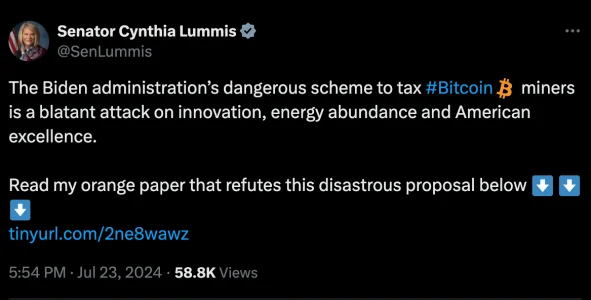 Senator Cynthia Lummis calls Biden’s Bitcoin mining tax senseless
Related Posts
Through her report, Cynthia aims to dispel misconceptions surrounding the tax proposal. She emphasizes the economic and energy advantages that Bitcoin mining provides, such as job creation, support for energy infrastructure, and fostering innovation.
She asserts that this tax would undermine these benefits and negatively impact a burgeoning segment of the American economy. She took the opportunity to clarify how blockchain technology operates and the specifics of Bitcoin mining.
Since Bitcoin’s inception in 2009, mining has evolved from personal computers to extensive operations. With affordable, dependable energy, strong property rights, and adherence to the law, the U.S. has become an ideal location for mining. Cynthia stated:
“Bitcoin miners are lawful American businesses that pay standard taxes and bring significant economic benefits to underserved areas.”
Even if the administration’s intentions are legitimate, Cynthia believes the tax could have unintended consequences. She describes it as a poorly conceived policy that could undermine the very goals it seeks to accomplish.
The administration claims that Bitcoin mining poses risks to local utilities’ grid operations but provides no supporting evidence. Research indicates that Bitcoin mining actually enhances energy grids.
Bitcoin miners function as flexible loads that assist in balancing energy grids. They can modify their energy consumption based on supply and demand, thereby mitigating the risk of blackouts and disruptions.
The Bitcoin Mining Council reported in August 2023 that the available interruptible load from Bitcoin miners constitutes approximately 25% of all installed utility battery storage in the U.S. and Canada, and this figure is on the rise.
Studies also indicate that Bitcoin mining can help restore equilibrium to a grid following a disaster. Research from 2023 suggests that Bitcoin mining is ten times more effective than current technology in returning a grid to the appropriate frequency during a crisis.
Cynthia concluded her report by stating, “If America fails to create a supportive and stable environment for Bitcoin mining, we risk squandering the advantages we currently enjoy and may find ourselves playing catch-up in a race we once had every opportunity to lead.”
