Disclaimer: Information found on CryptoreNews is those of writers quoted. It does not represent the opinions of CryptoreNews on whether to sell, buy or hold any investments. You are advised to conduct your own research before making any investment decisions. Use provided information at your own risk.
CryptoreNews covers fintech, blockchain and Bitcoin bringing you the latest crypto news and analyses on the future of money.


As the CLARITY Act encounters a deadlock on Capitol Hill, the Trump administration is shifting towards executive alternatives and family-supported stablecoins to reform the financial landscape without awaiting legislative approval, asserts Dale.
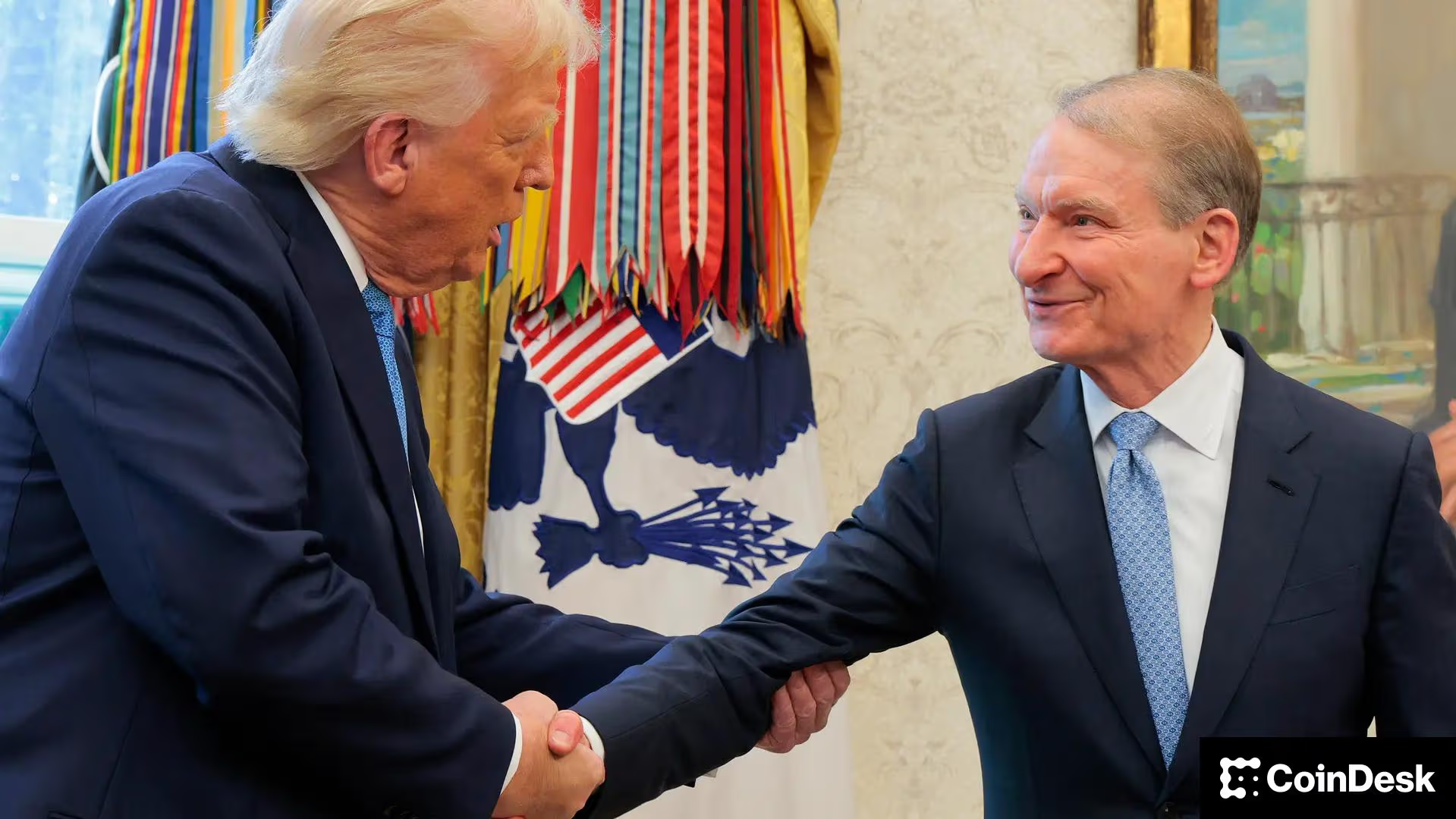 (Photo by Chip Somodevilla/Getty Images)
The White House has established a deadline of March 1st for the banking sector and cryptocurrency companies to finalize an agreement on stablecoin yield, paving the way for the Clarity Act, which is intended to establish a robust legal framework for the industry in the United States.
Clarity was approved by the House seven months ago. The Senate has set numerous deadlines for its progress, all of which have been missed. The most recent deadline also passed without a resolution.
The cryptocurrency sector has been focused on legislation as the next significant driver, as though it represents the sole route towards the essential regulatory clarity in the largest economy worldwide.
However, legislation is not the exclusive option.
The existing statutes that grant authority to the market regulators at the Securities and Exchange Commission and the Commodity Futures Trading Commission are comprehensive and adaptable. These agencies are currently taking action.
New legislation would protect against future challenges from figures like Gary Gensler, but Gensler’s tenure is over. President Donald Trump appointed a sympathetic chair to support the industry, in contrast to Gensler’s choice, who was adversarial.
While other actions taken by Trump regarding cryptocurrency have faced political challenges, it appears that his primary requirement was to select the appropriate leader for the SEC, which I believe he has accomplished.
Trump appointed veteran Paul Atkins, who possesses the expertise to create regulations that can endure legal scrutiny. Additionally, Trump assigned one of Atkins’ deputies to head the other investment agency, the CFTC, ensuring that rulemaking is consistent across markets. The industry must simply avoid another FTX-like failure to succeed.
The outcome is in the hands of the crypto sector.
Not his first rodeo
Paul Atkins served for six years at the SEC during the 2000s, working under three different chairs. Since then, he has acted as an advisor to the Chamber of Digital Commerce and to Securitize.
He was sworn in in April 2025. A few weeks later, he addressed an event at the SEC office, asserting that the agency has the authority to provide the crypto sector with the necessary rulemaking to function.
Later, in a meeting with several reporters, he was questioned about whether he needed to wait for Congress to draft market-structure legislation before he could proceed. He reiterated that his staff can and would take action with or without new legislation.
Atkins assured action confidently, resembling a regulator who comprehends the extent of his current authority.
Harmonization
Atkins will collaborate with the chief of the SEC’s counterpart, the CFTC.
Related Posts
Gensler was never in sync with Rostin Benham, the former head of the CFTC. Benham persistently urged Congress to act, while Gensler maintained that such action was unnecessary.
Benham clearly did not consider every coin a security, whereas Gensler regarded only Bitcoin as exempt from his oversight. They were not aligned.
To effectively oversee and instill confidence in founders, it is crucial that the agencies do not dispute when and if a digital asset transitions from SEC jurisdiction to that of the CFTC.
It is likely that one reason Atkins has not yet released draft rules for public review is that he aimed to do so in coordination with the CFTC. However, Trump altered his approach regarding the appointment of a chair for that agency, and the new leader, Michael Selig, was not sworn in until late December.
It would not be surprising if, in the future, it is revealed that Atkins persuaded the president to alter the course on CFTC chair appointments to ensure effective collaboration between the two agencies.
Anticipate an official memorandum of understanding between the two agencies outlining their responsibilities soon. This arrangement will echo the historic Shadd-Johnson accord of 1981.
The new sheriff
By this fall, it is anticipated that Project Crypto will have submitted draft rules—each developed in consultation with the other—before their respective commissions.
By next spring, these rules are expected to be revised based on public feedback and likely finalized.
This will mark the first administration to actually create rules considering decentralized financial networks.
Under new regulations, it should become feasible, for instance, for exchanges like Kraken, Coinbase, and Crypto.com to finally assert that all their operations are registered with an agency and subject to state oversight.
It should also be possible for new businesses to raise capital through token sales. Some of these tokens will likely possess rights that entrepreneurs previously evaded during the regulation-by-enforcement period, such as the capability to distribute profits.
If the rules are crafted conservatively enough to withstand judicial challenges, the industry is likely to have two or three years to expand before it becomes possible to reverse the achievements of Atkins and Selig (as doing so will necessitate both a Senate appointment process and a new rulemaking process).
Fait accompli
While it is well known that the cryptocurrency industry has always been inclusive of new participants, the president’s family did not benefit digital assets by launching memecoins, a stablecoin, and bitcoin miners. Such actions may have been sufficient to derail any hopes of meeting the crypto lobby’s aspirations for this congressional session.
However, while Congress hesitates, agency staff are drafting regulations.
If the SEC and CFTC collaborate efficiently—both agency heads announced today that several crypto policies are forthcoming—the arrangement they establish may eventually become law regardless. After all, Congress solidified the Shadd-Johnson accord in the early 1980s.
Thus, the lobbyists may ultimately achieve the legislation they desire, but only after cryptocurrency has become mainstream—without Congress, which is why Trump’s choice to appoint Paul Atkins may have already provided the industry with enough legal leeway to realize its potential.
