Disclaimer: Information found on CryptoreNews is those of writers quoted. It does not represent the opinions of CryptoreNews on whether to sell, buy or hold any investments. You are advised to conduct your own research before making any investment decisions. Use provided information at your own risk.
CryptoreNews covers fintech, blockchain and Bitcoin bringing you the latest crypto news and analyses on the future of money.


The notorious security breach of Mt. Gox in 2014, which resulted in the loss of 850,000 Bitcoin (BTC) belonging to investors, led its users into a seemingly endless, decade-long quest for reimbursement of their funds.
Throughout the years, Mt. Gox has consistently delayed its plans to repay the funds that the crypto exchange had prevented its users from withdrawing since February 25, 2014.
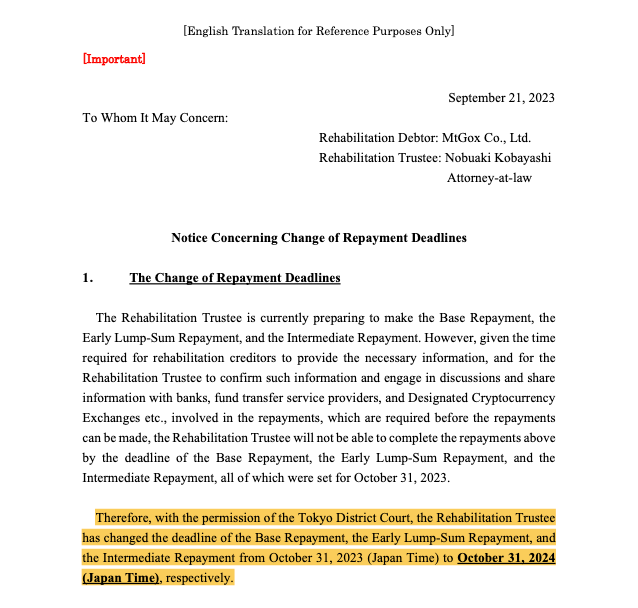 Latest notice concerning the change of repayment deadlines. Source: Mtgox.com
However, with Mt. Gox postponing its repayment deadlines by an additional year, from October 31, 2023, to October 31, 2024, the wait for resolution extends into the 11th year for Mt. Gox investors.
Mt. Gox 2014: The year of the largest Bitcoin hack (Avg. BTC price $420)
Shortly after Mt. Gox lost 850,000 BTC in the February 2014 breach, leaked documents indicated that the crypto exchange had become insolvent. It stated:
“The cold storage has been wiped out due to a leak in the hot wallet. The reality is that MtGox can go bankrupt at any moment, and certainly deserves to as a company.”
It was widely believed that the collapse of Mt. Gox would signify the demise of Bitcoin, given that the exchange handled 70% of the total circulating Bitcoin at that time. Mt. Gox subsequently filed for bankruptcy protection in the Tokyo District Court, Japan, after incurring nearly $500,000 in losses.
The exchange soon faced numerous lawsuits as investors expressed concerns regarding Mt. Gox’s intentions to return their funds. The atmosphere of distrust intensified throughout the year as Mt. Gox provided no updates on reimbursement while removing its website and social media presence.
Mt. Gox 2015: Back and forth with Tokyo court (Avg. BTC price $260)
During its ongoing bankruptcy proceedings in the Tokyo District Court, Mt. Gox CEO Mark Karpelès was detained without charge for 23 days by Japanese authorities for allegedly manipulating the computer system to inflate his account. Law enforcement struggled to connect criminals to crypto-related offenses due to the absence of cryptocurrency regulations.
On April 22, 2015, Mt. Gox’s bankruptcy trustee, Nobuaki Kobayashi, directed users to submit claims for their missing Bitcoin via mail or through a form accessible with a Mt. Gox login and password.
It was anticipated that Mt. Gox would return approximately 20% of the users’ funds, considering the decline in Bitcoin’s market price.
Mt. Gox 2016: Investors go through the claim process (Avg. BTC price $620)
Mt. Gox disclosed that only $91 million in assets were earmarked for distribution to claimants. However, not all investors concurred with Mt. Gox’s purported plans to reimburse a minimal portion of funds. Consequently, total claims for reimbursement soared to $2.4 trillion, despite the actual loss being around $500,000.
This year also marked a significant shift in the crypto community’s focus towards the importance of storing cryptocurrencies in cold wallets.
After facing two arrests in 2015 under allegations of embezzling $3 million of customer funds, Karpelès was released from custody on July 13, 2016, after posting a bail bond of nearly $100,000.
Mt. Gox 2017: Legal struggles and introduction of Karpeles coin (Avg. BTC price $5,000)
Discussions regarding fund reimbursement were overshadowed by the legal proceedings against former Mt. Gox CEO Karpelès concerning his involvement in fund embezzlement.
Karpeles admits operating Willy bot, now called an “obligation exchange”, but says it was for good of company so not illegal #KarpelesTrial
— Kolin Burges (@The_K_meister) July 11, 2017
During the trial, Karpelès acknowledged operating a so-called “Willy Bot” (obligation exchange). The bot earned its name from Mt. Gox traders who were concerned about the manipulation of the exchange’s trading volumes at its peak.
On November 28, 2017, Karpelès announced his intention to conduct an initial coin offering (ICO) to raise $245 million to “revive” Mt. Gox. However, he later abandoned the idea after realizing the legal challenges associated with launching an ICO campaign.
Mt. Gox 2018: A slow year for creditors (Avg. BTC price $7,000)
Following a significant price recovery in 2017, on August 1, 2018, Mt. Gox updated its fundamental policy for preparing a rehabilitation plan. It stated:
“Mt. Gox is not capable of returning all BTC deposited by creditors. Accordingly, we consider that all assets of Mt. Gox should be distributed to creditors and not to shareholders.”
Related Posts
At that time, the exchange believed that most of the assets, including approximately 166,000 BTC and 168,000 Bitcoin Cash (BCH) and other derivatives currently held by Mt. Gox, should be allocated to creditors during the first payment.
Despite ongoing discussions, a resolution that could meet legal and creditor requirements was never achieved.
Mt. Gox 2019: Plan extensions and delays (Avg. BTC price $8,000)
Anticipation surrounding Mt. Gox reached a peak as a rehabilitation plan appeared to be in progress.
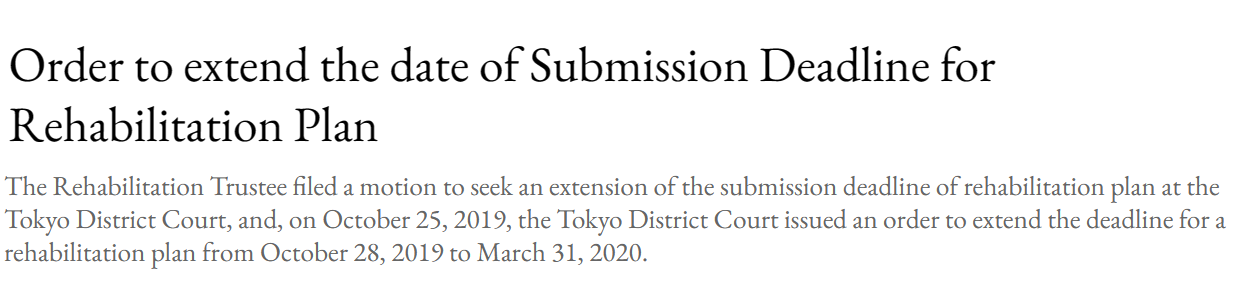 Mt. Gox extends deadlines for rehabilitation plans. Source: Mt. Gox
However, Mt. Gox petitioned the Tokyo court to extend the deadline for submitting the rehabilitation plan. On October 25, 2019, the Tokyo District Court granted an extension for the rehabilitation plan deadline from October 28, 2019, to March 31, 2020.
Mt. Gox 2020: Plan extensions and delays (Avg. BTC price $11,000)
Contrary to the five-year trend of delaying reimbursements to users, in early 2020, New York-based private equity firm Fortress proposed to buy out creditor claims from Mt. Gox. If the deal had been finalized, eligible creditors would have received $1,293 for each Bitcoin they held in the exchange’s wallet.
By March, Mt. Gox released yet another draft rehabilitation plan, which outlined its intentions to liquidate cryptocurrencies other than BTC and BCH. However, investors faced further delays after the Tokyo court approved Mt. Gox’s request for another extension, citing “matters that require closer examination.”
The court granted the motion, thereby postponing the Mt. Gox Bitcoin settlement date to October 15, 2020, which was subsequently delayed into the following year.
Mt. Gox 2021: Bitcoin bull run creates hopium (Avg. BTC price $37,000)
On October 20, 2021, creditors of Mt. Gox approved a rehabilitation plan aimed at compensating them for billions in lost Bitcoin. According to Mt. Gox trustee Nobuaki Kobayashi, approximately 99% of the creditors affected by the collapse supported the latest reimbursement plans.
With Bitcoin reaching an all-time high of $69,000, it was widely believed that the value held in Mt. Gox’s Bitcoin reserves could be sufficient to cover the total losses for investors.
Amid positive investor sentiment, users awaited further guidance while anticipating the implementation of the approved plans.
Mt. Gox 2022: Registrations for reimbursement continue (Avg. BTC price $42,000)
The optimism from 2021 carried into 2022 as investors queued to provide details for registering repayment methods.
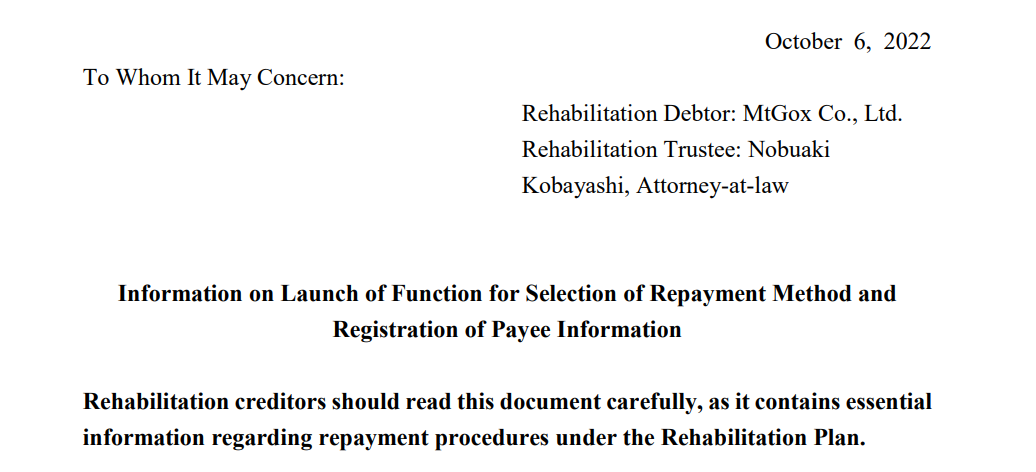 Mt. Gox shares repayment method plans. Source: Mt. Gox
There were also speculations that the release of 150,000 BTC could trigger a “black swan” event for the Bitcoin ecosystem. Mt. Gox creditors were given until January 2023 to register and select a repayment method as part of the plan for compensating their losses.
Related: Mt. Gox repayment date looming: Is Bitcoin in trouble?
Mt. Gox 2023: The day that never comes (Avg. BTC price $27,000)
The deadlines for reimbursement registrations were postponed twice in 2023. However, on April 7, Mt. Gox trustee Kobayashi announced that the deadline for creditors to submit their repayment information — including clarification of payee and payment type — had elapsed.
To the disappointment of creditors, Mt. Gox rescheduled the repayment deadline to October 2024.
Mt. Gox has yet to respond to Cointelegraph’s inquiry regarding its commitment to reimburse users’ funds. In a letter dated September 21, Kobayashi stated that, with the approval of the Tokyo District Court, he had extended the deadline for the base repayment, the early lump-sum repayment, and the intermediate repayment.
Collect this article as an NFT to preserve this moment in history and show your support for independent journalism in the crypto space.
Magazine: ‘AI has killed the industry’: EasyTranslate boss on adapting to change
