Disclaimer: Information found on CryptoreNews is those of writers quoted. It does not represent the opinions of CryptoreNews on whether to sell, buy or hold any investments. You are advised to conduct your own research before making any investment decisions. Use provided information at your own risk.
CryptoreNews covers fintech, blockchain and Bitcoin bringing you the latest crypto news and analyses on the future of money.

Morgan Stanley states that Wall Street’s initiative into cryptocurrency has been developing for several years.

Morgan Stanley’s Amy Oldenburg stated that banks are venturing into crypto not due to hype, but following extensive infrastructure advancements over the years.
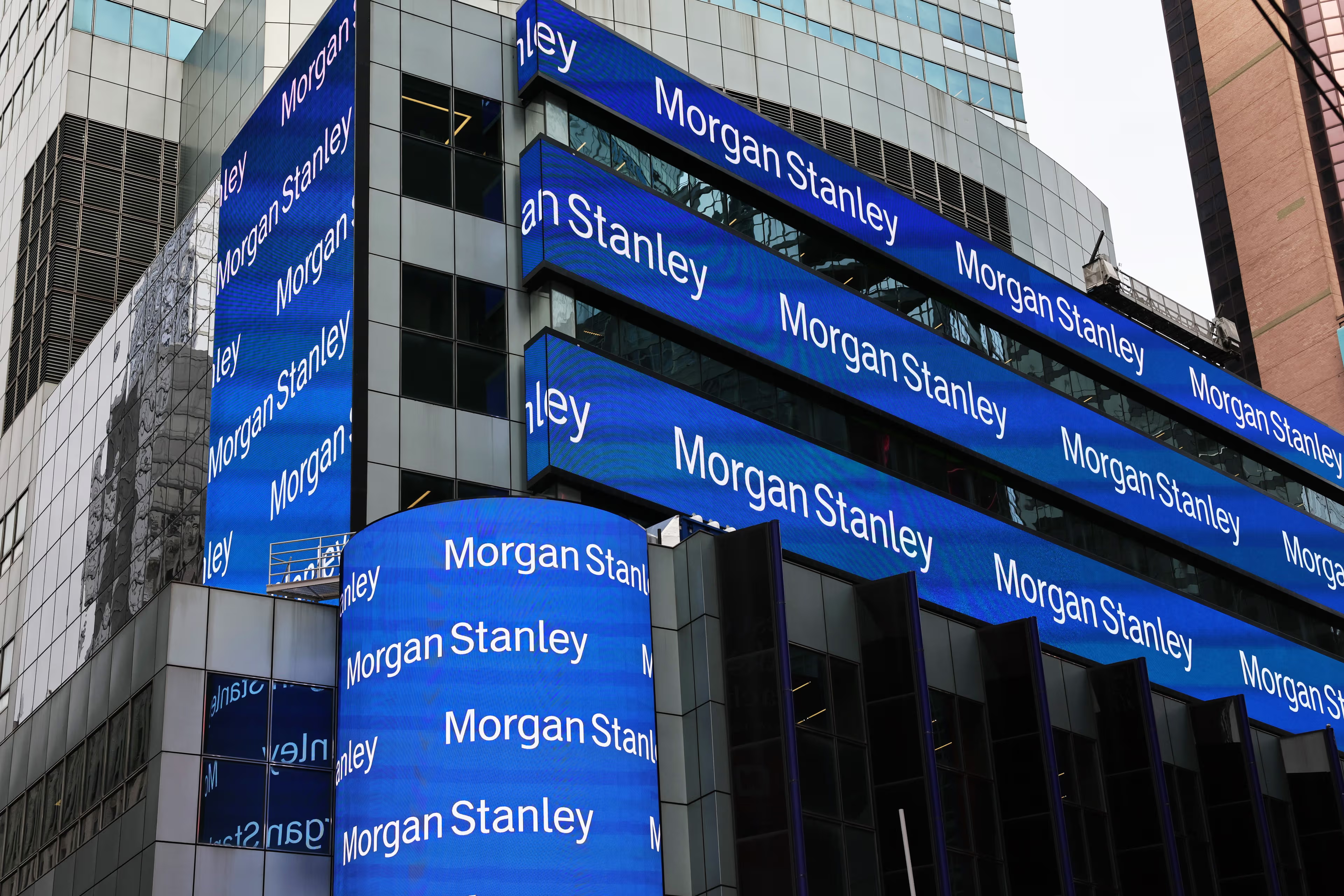 (Michael M. Santiago/Getty Images)
What to know:
- Amy Oldenburg, Morgan Stanley’s head of digital assets, remarked that Wall Street’s entry into crypto is the result of years of foundational work to modernize financial infrastructure, rather than a sudden fear of missing out.
- The bank is broadening its digital asset approach across trading, asset management, and infrastructure, with intentions to facilitate tokenized equities on its alternative trading system by the latter half of 2026.
- Oldenburg noted that enhancing outdated banking systems and collaborating within the global financial network remain significant challenges, even as interest in instruments like stablecoins surges and institutional crypto engagement gradually increases.
NEW YORK — Amy Oldenburg, the head of digital asset strategy at Morgan Stanley (MS), dismissed the notion that Wall Street is currently engaging with crypto solely due to fear of missing out, asserting that major banks are moving forward after extensive groundwork.
“TradFi is experiencing FOMO and is now becoming involved … it really isn’t accurate,” Oldenburg stated during a panel discussion at the Digital Asset Summit in New York on Tuesday. “We’ve been on a journey toward modernizing financial infrastructure for years.”
Her remarks emerge as prominent U.S. banks, historically regarded as cautious or delayed participants in the crypto space, begin to broaden their service offerings. For an extended period, institutions like Morgan Stanley limited their activities to indirect exposure, such as providing affluent clients access to bitcoin funds.
More recently, this has expanded to include spot bitcoin exchange-traded funds (ETFs) on its E*Trade platform, and the bank has also filed this month to initiate its own spot bitcoin ETF.
Related Posts
Wider participation has been hampered by regulatory ambiguity and issues related to custody, compliance, and market structure. That perspective is beginning to evolve, and Morgan Stanley has now articulated a more structured digital asset strategy, encompassing trading, asset management, and infrastructure.
Oldenburg indicated that the bank is gearing up to facilitate tokenized equities trading on its alternative trading system.
“One of the initiatives we are planning for the second half of 2026 is activating our trajectory cross … to support tokenized equities later this year,” she explained. The platform currently accommodates equities, ETFs, and American depositary receipts (ADRs), which she identified as a logical foundation for growth.
Internally, the transition necessitates a reconstruction of core systems. “We are having to re-educate ourselves about what legacy infrastructure, pipes, and plumbing entail,” Oldenburg remarked, highlighting the difficulty of modernizing aged financial frameworks to enable quicker settlement and continuous trading.
She also pointed out a disparity between crypto startups and large institutions.
“There are numerous other connectivity points that we need to integrate,” she noted, acknowledging that founders often underestimate the intricacy of bank systems.
Nevertheless, sectors like stablecoins are gaining popularity as a method for facilitating faster and cheaper monetary transactions compared to traditional systems.
However, adoption is contingent on coordination across the financial ecosystem. “We cannot simply modernize independently,” Oldenburg stated. “This is an incredibly complex, interconnected global network.”
Despite low token values, she observed that activity continues to grow. “It is still very early stages,” Oldenburg remarked, indicating that Wall Street’s deeper integration with crypto may be gradual, but it is indeed in progress.
