Disclaimer: Information found on CryptoreNews is those of writers quoted. It does not represent the opinions of CryptoreNews on whether to sell, buy or hold any investments. You are advised to conduct your own research before making any investment decisions. Use provided information at your own risk.
CryptoreNews covers fintech, blockchain and Bitcoin bringing you the latest crypto news and analyses on the future of money.

Matt Hougan of Bitwise reflects on $1 million bitcoin — analysts concur but discuss his timeline.

Hougan states that bitcoin could achieve that milestone if it secures a larger portion of the global store-of-value market, although experts suggest it may require years of institutional acceptance and macroeconomic changes.
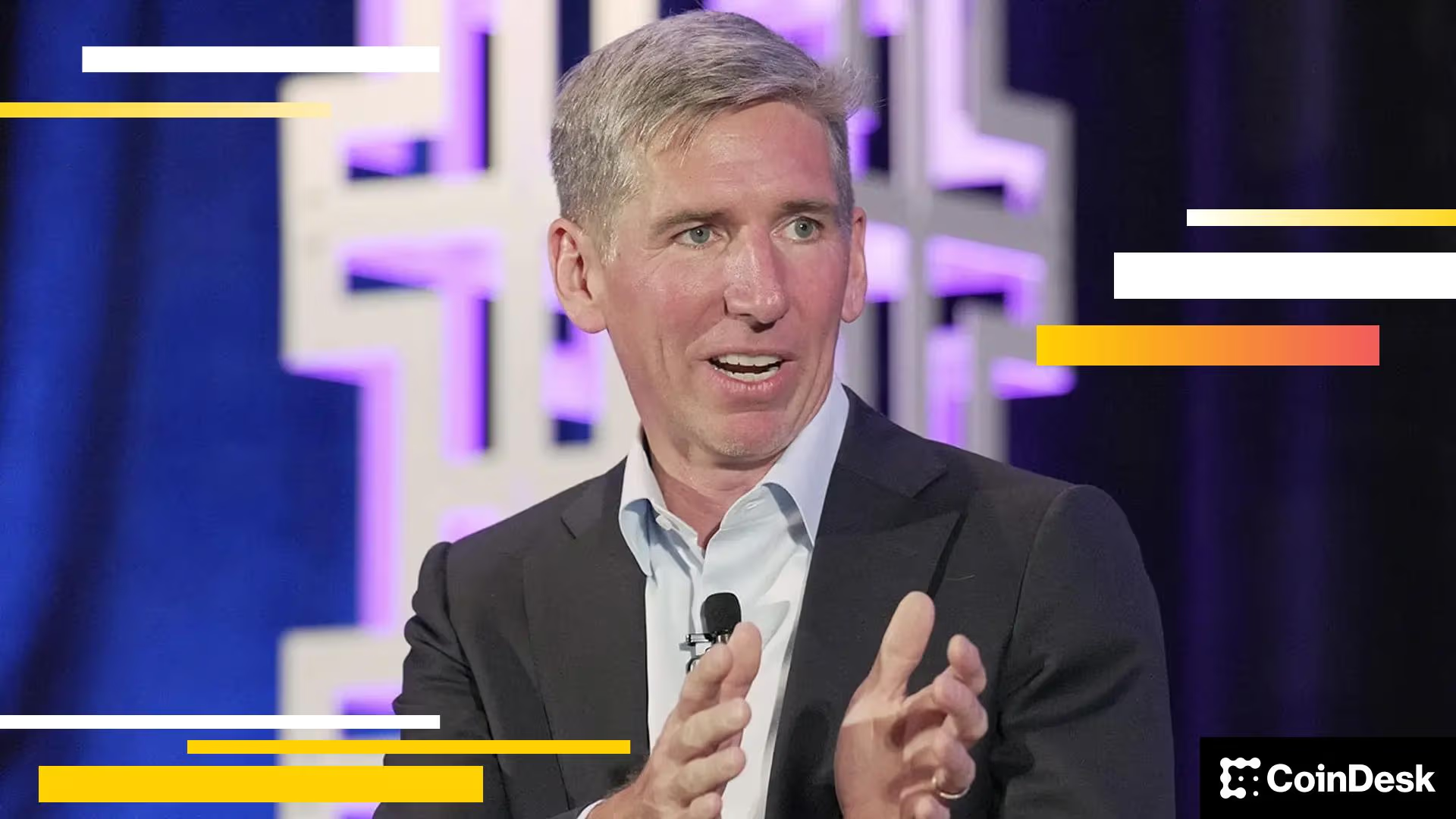 Bitwise CIO Matt Hougan revisits his $1 million BTC projection. Multiple analysts concur with the perspective but not with the timing. (Suzanne Cordiero/CoinDesk/Shutterstock)
What to know:
- According to Bitwise CIO Matt Hougan, bitcoin could reach $1 million per coin if it secures a notably larger share of the global store-of-value market, which is presently led by gold and government bonds.
- Experts suggest that the $1 million objective is less of a precise forecast and more a shorthand for bitcoin’s evolution into a significant global monetary asset, with the result depending on prolonged institutional adoption and the growth of the store-of-value market.
- Proponents argue that geopolitical tensions, possible crises in conventional “safe” assets, and bitcoin’s limited supply could all expedite its ascent, although most envision the timeline extending over a decade or more rather than being imminent.
Bitcoin could ultimately reach $1 million per coin if it captures a larger share of the global store-of-value market currently dominated by gold and government bonds, as stated by Bitwise Asset Management CIO Matt Hougan.
In a report earlier this week, Hougan indicated that bitcoin’s long-term potential hinges less on short-term market fluctuations and more on how much of the global wealth preservation market the cryptocurrency can absorb over time.
"One million sounds outrageous," said Hougan. "It suggests bitcoin will increase 14-fold from its current price."
He highlighted several factors that support that prediction, including the swift expansion of the global store-of-value market, which encompasses gold, government bonds, and other defensive assets, having grown from approximately $2.5 trillion in 2004 to nearly $40 trillion today. Bitcoin currently holds about 4% of that market by value.
If the leading cryptocurrency were to capture roughly half of that market under existing conditions, its price could approach the $1 million threshold within about a decade, Hougan noted. If the overall store-of-value market continues to grow, bitcoin would require a smaller share to attain that level.
The $1 million price fixation
The $1 million projection has become a recurring topic within the crypto sector. Recently, Eric Trump reaffirmed his $1 million BTC prediction. In August, Coinbase CEO Brian Armstrong suggested bitcoin could reach that price by 2030.
Jack Dorsey, who led X (formerly Twitter) until 2021 and co-founded payment company Block (formerly Square), stated that bitcoin could hit $1 million within five years. Arthur Hayes, former CEO of BitMEX, believes it could occur as soon as 2028. Cathie Wood’s Ark Invest estimated that bitcoin could reach $3.8 million by the decade’s end. Bernstein projected $1 million by 2033.
So, why has the $1 million target emerged as such a frequently referenced benchmark for bitcoin? CoinDesk inquired with several market analysts.
“It’s a straightforward headline and serves as shorthand for the notion that Bitcoin could compete with gold as a store of value. The specific figure is less significant than the proportion of global wealth Bitcoin secures,” remarked Mati Greenspan, market analyst and founder of Quantum Economics.
Jason Fernandes, another market analyst and co-founder of AdLunam, views the milestone as more psychological than an exact valuation point, reflecting the belief that bitcoin could ultimately win the store-of-value argument.
However, he also feels that part of the narrative is influenced by marketing dynamics. “Some aspects of the narrative are promotional since round numbers are easily communicated and resonate with holder incentives,” Fernandes explained, while adding that the foundational thesis is not solely based on hype.
Related Posts
“I believe many investors make a ‘static denominator’ error, valuing bitcoin against today’s store-of-value market instead of a significantly larger future one,” he said.
For Fernandes, the critical question is not whether a $1 million bitcoin is theoretically achievable, but whether institutional adoption can accumulate sufficiently long to justify that price.
Analysts agree on direction, but not the timeline
Some analysts who shared their insights with CoinDesk indicated that Hougan’s projection is reasonable over the long haul, although most frame it as a decade-scale adoption narrative rather than an immediate forecast.
“Geopolitical tension reinforces the Bitcoin argument,” noted Greenspan. “During uncertain periods, investors seek neutral stores of value, and Bitcoin increasingly fits into that category alongside gold.”
Greenspan acknowledged that the milestone is achievable but would likely require a decade or more, necessitating ongoing institutional adoption and clearer regulatory frameworks.
Fernandes stated that Hougan’s argument essentially revolves around market share. Bitcoin does not need to entirely replace gold, he contended; it merely needs to capture a fraction of a growing global store-of-value market.
“A $1 million bitcoin presumes long-term adoption and market share gains within the global store-of-value market,” Fernandes stated. “It’s a perspective on bitcoin’s final state if it evolves into a significant global monetary asset.”
Institutional adoption remains the key driver
Hougan has asserted that bitcoin’s capped supply of 21 million coins and its decentralized framework provide it with features akin to traditional stores of value, such as gold.
Fernandes emphasized that the long-term $1 million thesis is heavily reliant on sustained institutional adoption and growth in the global store-of-value market.
“BTC doesn’t need to supplant gold or fiat; it just needs to secure approximately 17% of a projected $121 trillion store-of-value market over the next decade to justify a $1 million valuation,” Fernandes stated.
Greenspan remarked that geopolitical instability could further enhance bitcoin’s attractiveness as a neutral asset.
“In uncertain times, investors look for neutral stores of value, and bitcoin increasingly sits in that bucket alongside gold,” he noted, while also indicating that achieving such a valuation would likely necessitate years of consistent adoption.
Nima Beni, founder of Bitlease, suggested that the timeline could accelerate if trust in traditional financial assets diminishes.
“Bitcoin reaches $1 million when faith in traditional ‘safe’ assets falters,” he stated, citing potential sovereign debt crises or disruptions in the gold market as possible catalysts.
Despite the optimistic projections, analysts indicated that bitcoin’s journey toward such valuations would depend more on long-term adoption and macroeconomic conditions than on short-term market fluctuations.
