Disclaimer: Information found on CryptoreNews is those of writers quoted. It does not represent the opinions of CryptoreNews on whether to sell, buy or hold any investments. You are advised to conduct your own research before making any investment decisions. Use provided information at your own risk.
CryptoreNews covers fintech, blockchain and Bitcoin bringing you the latest crypto news and analyses on the future of money.


In the last year, some investors discovered the hard way why it is essential to transfer their cryptocurrency offline. Those who stored Bitcoin (BTC) and altcoins on exchanges such as FTX lost access to their assets, in some cases permanently. These occurrences highlighted the well-known crypto saying: “Not your keys, not your coins.”
However, FTX’s misfortune turned into an opportunity for hardware wallet producer Ledger. The bankruptcy filing of the Bahamas-based exchange in November 2022 resulted in “our biggest sales day ever,” according to Ian Rogers, the firm’s chief experience officer, who spoke with Cointelegraph, adding that “November became our largest sales month on record.”
Ledger, based in Paris, has experienced significant growth recently, although the past year has not been without its challenges. For example, in May, the company faced backlash when it introduced a new service for storing secret recovery phrases called Ledger Recover. Nevertheless, it continues to be one of the most recognized and widely used crypto wallet manufacturers globally.
Cointelegraph recently met with Rogers and Ledger CEO Pascal Gauthier in New York City to discuss the evolving crypto landscape in the United States, the latest developments in crypto storage, and the differences in conducting business in the U.S. and Europe, among other subjects.
Cointelegraph: Many believe that the crypto/blockchain sector is still stagnant or at best moving sideways, but do you find reasons for optimism even in the U.S.?
Pascal Gauthier: What transpired in 2023 — which went largely unnoticed — was a shift in the perception of Bitcoin. When the SEC [Securities and Exchange Commission] suggested that Bitcoin was a utility and/or commodity — rather than a security [like other altcoins] — this initiated two significant developments: major firms like BlackRock began their ETF [exchange-traded fund] application processes, and the media narrative surrounding Bitcoin shifted almost instantaneously.
At the start of 2023, Bitcoin was associated with drug dealers, terrorists, and considered harmful to the environment, but it quickly became widely accepted. The largest financial institutions in the U.S. are now engaging with Bitcoin.
CT: Was the BlackRock application for a spot-market Bitcoin ETF a pivotal moment?
PG: Substantial capital is entering the crypto space; this has been announced. It may take a few years for it to fully materialize, but if you consider Fidelity, BlackRock, Vanguard…
CT: What about U.S. regulations? Aren’t they still an obstacle?
PG: The next administration will determine the future of crypto in the United States. If Biden remains in office, this administration may continue its aggressive stance toward crypto. If a different individual takes over, we will see what unfolds.
CT: Let’s discuss offline storage devices. Mark Cuban remarked in 2022 that crypto wallets were “awful.” Did he have a valid point?
PG: Many of our early users utilized our [cold wallet] product for “buy and hold.” You would acquire a Ledger [device], store your Bitcoin in it, and then set it aside and forget about it. However, that is not our current recommendation.
Recent: AI a powerful tool for devs to change gaming, says former Google gaming head
Today, you can connect your wallet to Web3 and utilize your private keys for various activities, including buying, selling, swapping, and staking crypto, as well as interacting with DApps [decentralized applications] and even filing your taxes.
CT: On a scale of 1 to 10, how would you rate cold wallets today in terms of user experience (UX)?
PG: For the industry, it’s a three. For Ledger, perhaps a four — and we are aiming for a 10. The industry has significant work to do regarding UX and UI [user interface].
Ian Rogers: Your hardware-software combination today is not solely about hardware and software. It’s an end-to-end experience.
When you purchase an Apple iPhone, for example, you’re not just acquiring a piece of hardware; you’re investing in the Apple experience. We ultimately aspire for that to be the case with Ledger. Our goal is to provide the best user experience possible without compromising security or self-custody.
CT: Nonetheless, there are UX challenges, such as the 24 seed words required to recover your private key if you misplace your Ledger device. Some users take extreme measures to protect those words, even engraving them in steel in case of a house fire. Doesn’t that seem a bit excessive?
PG: It is somewhat outdated to have something like a metal plate in your home. It’s not very 21st century. However, we have developed a solution for this.
Related Posts
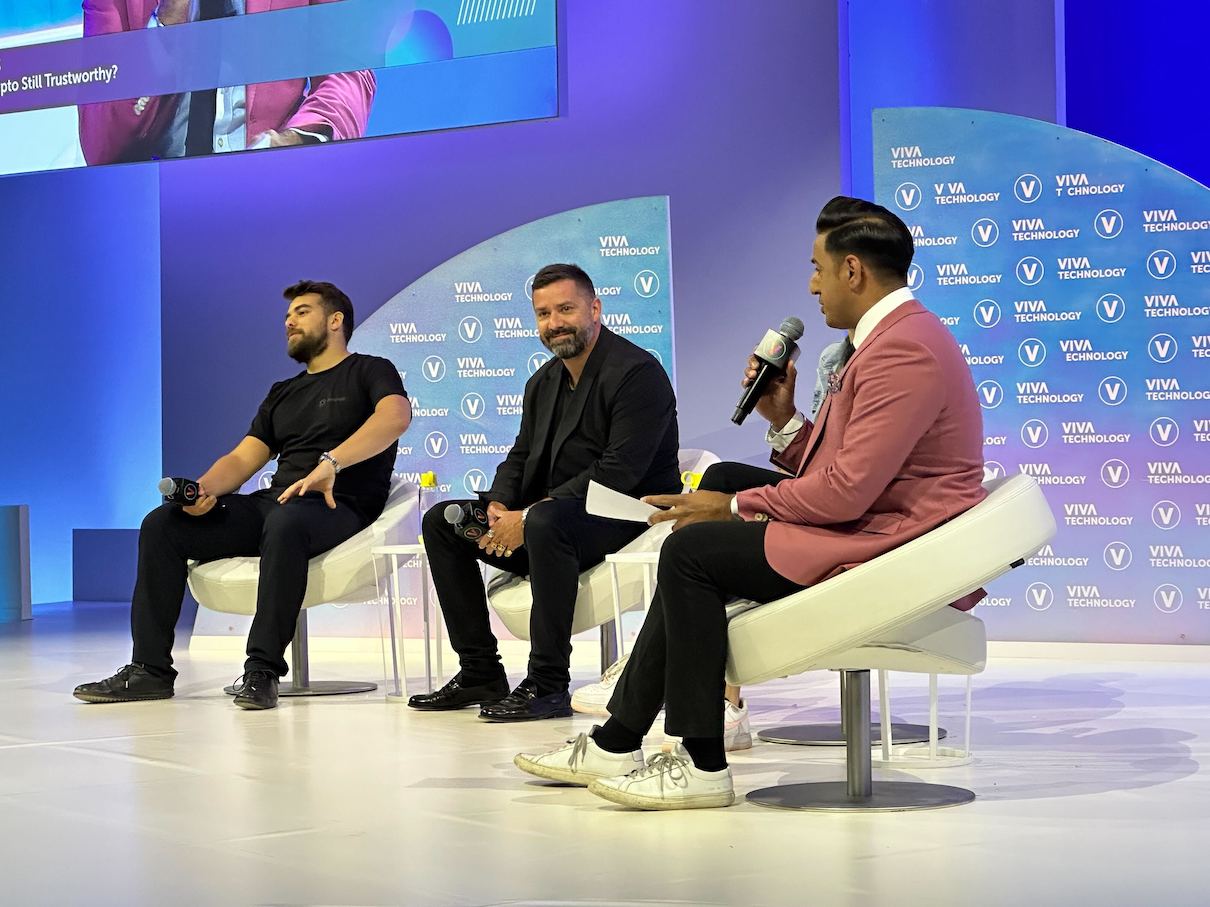 Gauthier (center) speaking at the Viva Technology conference. Source: X
When you utilize a Ledger product, you receive your Ledger device and a PIN code. Additionally, you will have those 24 words that essentially serve as your master password. It is crucial to keep those 24 words secure, and this poses a significant barrier to entry for many individuals. They lack confidence in their ability to safeguard those 24 words. They fear losing them.
Thus, we introduced a service called Ledger Recover [i.e., an optional paid subscription service provided by Coincover that is anticipated to launch in October] to address this issue. It enables you to divide your private key into three encrypted shards and send them to three distinct custodians. They cannot manipulate the [single] encrypted shard. Only you can reassemble your 24 words if needed.
CT: Isn’t there already a similar concept with “social recovery,” where you entrust your cold wallet recovery to several friends or “guardians?”
PG: Social recovery is not particularly effective. We’ve created something akin to social recovery — but with businesses [i.e., Ledger, Coincover, and EscrowTech]. You will need to present your ID if you wish to initiate the shard recovery.
CT: You faced criticism when you first announced the Ledger Recover service in May. Subsequently, the launch was delayed amid the “backlash.” There were security concerns. Some claimed these three shard-holding companies could reconstruct your private key.
PG: There is still much education needed for individuals to truly understand how security functions. People suggested [at that time] that it could be a beneficial product if it were more transparent and easier to adopt. Therefore, we did not launch in May as planned, opting instead to make the product ‘open source,’ which enhances transparency, though not security.
CT: But couldn’t three sub-custodial companies, at least theoretically, collaborate and reconstruct your private key?
PG: That is not feasible. They lack the necessary tools to decrypt and reconstruct.
CT: Shifting to Ledger’s business model, do you ever worry that as large institutions like Fidelity Investments or banks like BNY Mellon enter the crypto market, users may simply store their crypto with them? If they experience a hack, those large custodial institutions would then compensate them. Or at least that is sometimes the perception.
PG: We are a pure technology company. Therefore, when Fidelity decides to become a [retail] crypto custodian, they will likely approach us to acquire a portion of our technology to develop their own technology stack.
CT: Your business spans multiple continents. You’re based in France, yet you sell many of your devices in the United States. You have direct experience with both business environments — the U.S. and Europe. Are there significant differences regarding crypto?
PG: Europe tends to over-regulate or implement regulations too quickly, generally speaking. Some argue that Europe has clarity due to MiCA [Markets in Crypto-Assets, the EU’s new crypto legislation], while the U.S. suffers from a lack of clarity and numerous lawsuits.
However, in the U.S., the legal framework is slow and cumbersome. Changing laws in the U.S. takes time, but when changes do occur, they are often improvements.
Magazine: 6 Questions for JW Verret — the blockchain professor who’s tracking the money
When examining the largest tech leaders globally, most are American or Chinese. None are European.
CT: Are you associating heavy regulation with a lack of innovation?
PG: It’s difficult to determine if they are directly correlated, but Europe has historically imposed stringent taxation and regulation.
Ian Rogers: In my view, there is no doubt they are connected. At LVMH [the French luxury goods conglomerate where Rogers served as chief digital officer for five years], we collaborated with numerous startups. Every European startup aimed to reach the U.S. or China to “achieve scale” before returning to Europe. Europe is not an ideal market for startups.
CT: Yet Ledger remains optimistic about the future of cryptocurrencies and blockchain technology as a whole?
PG: Things are not necessarily as they appear. It was our [late] French president François Mitterrand who said: “Give time for time.” There is something unfolding now, and only time will reveal what is truly happening.
