Disclaimer: Information found on CryptoreNews is those of writers quoted. It does not represent the opinions of CryptoreNews on whether to sell, buy or hold any investments. You are advised to conduct your own research before making any investment decisions. Use provided information at your own risk.
CryptoreNews covers fintech, blockchain and Bitcoin bringing you the latest crypto news and analyses on the future of money.


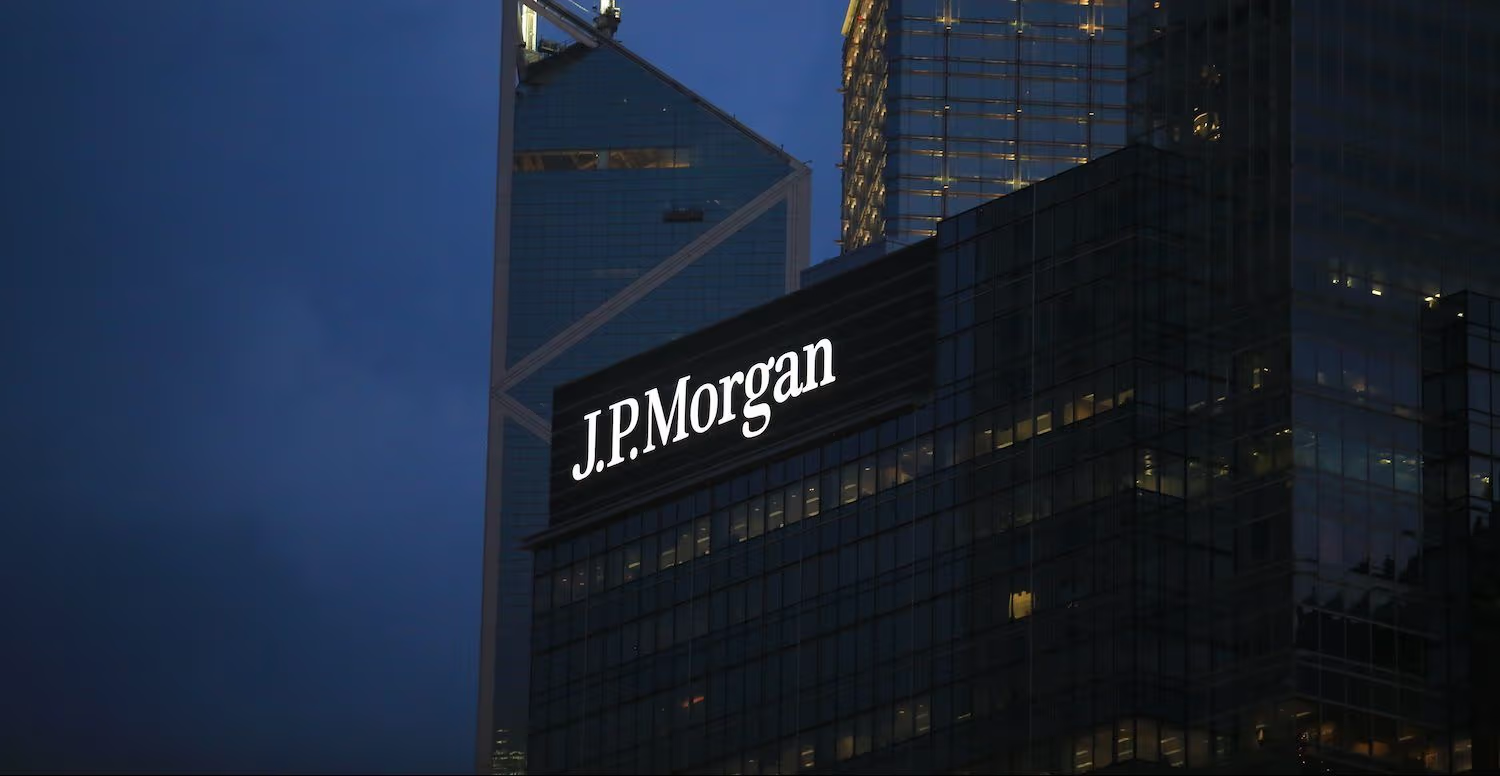
JPMorgan is considering a potential entry into prediction markets as cryptocurrency companies, startups, and competitors like Goldman Sachs strive to lead in this rapidly evolving sector.
What to know:
- JPMorgan Chase’s CEO Jamie Dimon has indicated that the bank is contemplating a foray into prediction markets, while also clarifying that it would steer clear of sectors such as sports and politics, and comply with rigorous regulations on insider trading.
- Goldman Sachs CEO David Solomon has similarly shown interest in prediction markets, having recently met with major platforms as the industry grows beyond initial frontrunners Polymarket and Kalshi.
- The emergence of both blockchain-driven and traditional prediction market platforms, along with the Commodity Futures Trading Commission’s initial steps toward establishing a regulatory structure, is attracting significant financial institutions despite ongoing legal ambiguities.
JPMorgan (JPM) CEO Jamie Dimon mentioned that the bank is contemplating a venture into the prediction markets domain, reflecting the increasing interest from prominent financial entities in a field that has seen rapid growth in recent months, including among cryptocurrency-focused firms.
“It’s possible one day we’ll do something like that,” Dimon stated on CBS on Tuesday, while excluding markets related to sports or politics.
"There are several areas we will not engage in. Clearly, we maintain strict policies regarding insider information.”
Goldman Sachs (GS) has articulated comparable aspirations. CEO David Solomon noted during the bank’s January earnings call that the firm is actively investigating this sector. “I personally met with the two leading prediction companies and their executives in the past two weeks and spent several hours with each to gain further insight,” he remarked. “We have a dedicated team here that is engaging with them and exploring this opportunity.”
Related Posts
These remarks underscore the rapid advancement of the industry. Not long ago, prediction markets were a specialized segment of finance dominated by merely two credible entities: Polymarket and Kalshi. Currently, competition is escalating swiftly.
A number of crypto-centric platforms, including Coinbase (COIN) and Robinhood (HOOD), have incorporated prediction market trading into their services, broadening access for retail users and boosting overall market activity.
Simultaneously, the early leaders are continuing to expand. Polymarket has established significant partnerships and received investments, including connections with Intercontinental Exchange, the parent organization of the New York Stock Exchange. The company is estimated to have a valuation of approximately $20 billion. Competing platform Kalshi recently achieved a $22 billion valuation following a funding round led by Coatue Management.
The two platforms employ distinct technological methods. Polymarket functions on blockchain infrastructure, utilizing networks such as Polygon (POL) to log trades and finalize positions via smart contracts. Users deposit stablecoins, wager on event outcomes, and receive automated payouts based on confirmed results.
In contrast, Kalshi does not utilize blockchain technology, operating more akin to a conventional exchange, providing event contracts under a regulated framework with centralized order matching and settlement.
It remains uncertain how JPMorgan or Goldman Sachs would organize their own offerings, particularly regarding whether they would implement blockchain-based systems or adhere to traditional infrastructures.
Regulatory conditions present a significant uncertainty. The legal standing of prediction markets in the U.S. is still in flux, particularly concerning the types of events that can be offered and the classification of contracts. Major banks may opt to await clearer regulatory guidance before introducing products.
Earlier this month, the Commodity Futures Trading Commission (CFTC) took two substantial steps towards developing a regulatory framework for prediction markets, indicating that oversight of the sector is starting to materialize.
