Disclaimer: Information found on CryptoreNews is those of writers quoted. It does not represent the opinions of CryptoreNews on whether to sell, buy or hold any investments. You are advised to conduct your own research before making any investment decisions. Use provided information at your own risk.
CryptoreNews covers fintech, blockchain and Bitcoin bringing you the latest crypto news and analyses on the future of money.


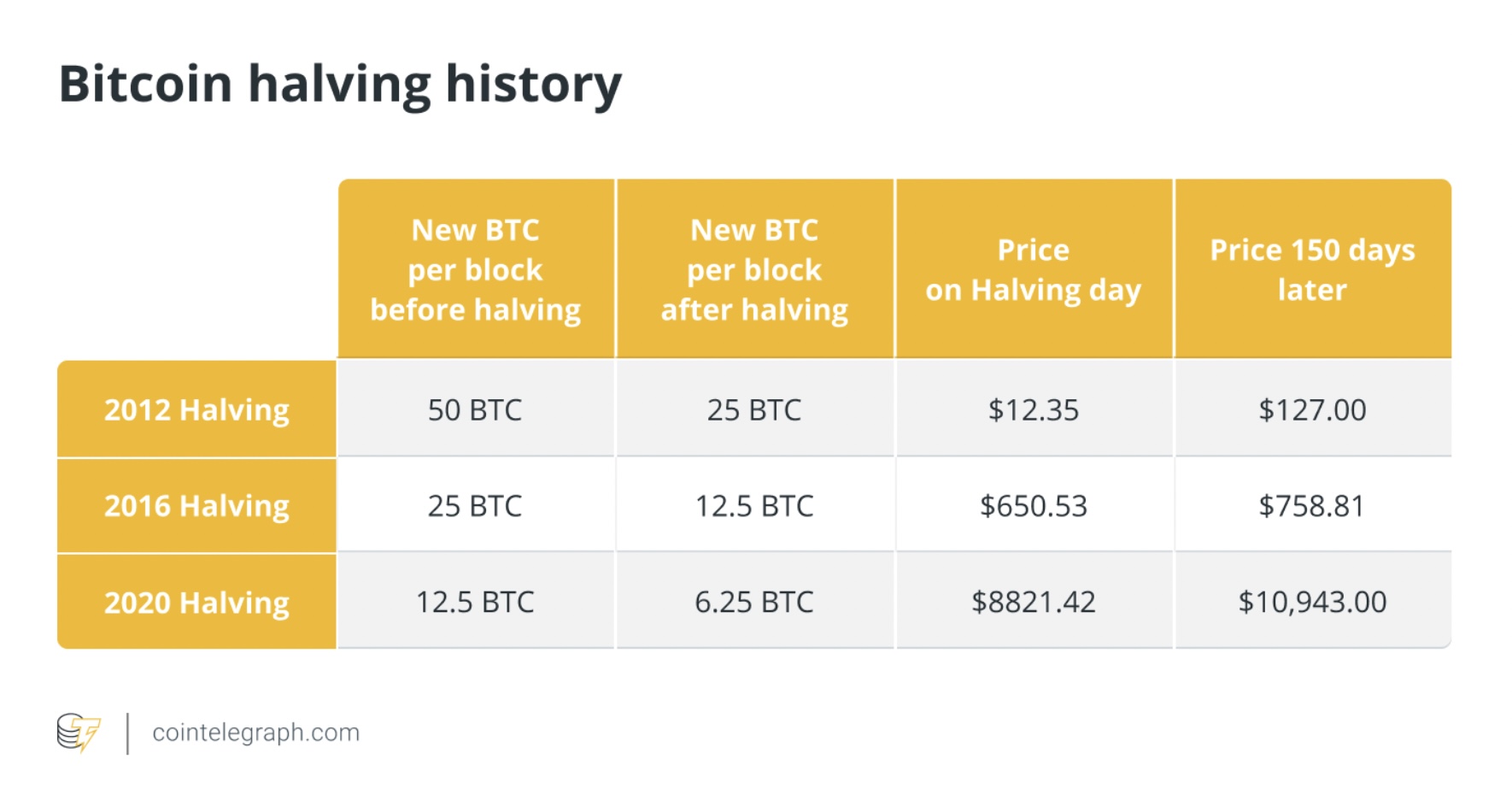
Only seven months are left until the upcoming Bitcoin (BTC) halving in April 2024. This event occurs roughly every four years and represents a deflationary mechanism that halves the creation of new coins.
The halving of Bitcoin is a significant occasion for cryptocurrency investors and has historically resulted in an increase in Bitcoin’s value. However, its effects on the mining sector present a more intricate scenario. It diminishes block rewards, which are a key source of income for miners. The halving in 2024 will lower the reward from 6.25 BTC to 3.125 BTC. Consequently, miners must adjust their strategies to offset the diminished rewards that follow the halving.
Let’s examine the strategies and alternative revenue sources that could assist Bitcoin miners in challenging market conditions.
Shifting perspectives
Bitcoin mining is a competitive endeavor where miners compete for block rewards. This competition is influenced by Bitcoin’s block time, which averages around 10 minutes per block at the protocol level. Regardless of whether the network’s computational power is relatively low at 1 kH/s or escalates to an impressive 200 million TH/s, the same block rewards must be shared among miners.
Related: An ETF will bring a revolution for Bitcoin and other cryptocurrencies
This competitive landscape drives miners to emphasize energy efficiency and the utilization of cost-effective hardware. With each halving event, where block rewards are reduced by 50%, this trend toward efficiency intensifies. As the cost of producing a single BTC is expected to nearly double shortly after the next halving, miners will need to seek ways to enhance their profitability and concentrate on these three essential factors.
Bitcoin miners’ survival hinges on these three key elements
The foremost and most critical “element” is the cost of electricity. Even a slight change of 1 cent per kilowatt-hour (kWh) can result in a significant $3,800 variation in the production cost of BTC, as reported by JPMorgan. To improve their profitability after the halving, miners are investigating advanced contracts and considering relocating to areas where electricity costs are lower. They are also contemplating power generation from stranded gas sources. It is essential for miners to secure electricity rates at or below 5 cents/kWh to sustain profitability beyond April 2024.
Related Posts
The second crucial factor requiring miners’ focus is the efficiency of their equipment. For example, daily BTC mining expenses can be reduced by over 63% when upgrading from a rig with a 60 J/TH efficiency rating to one with a 22 J/TH rating. Miners with efficient hardware and lower electricity costs will be the most profitable. They are the ones most likely to endure significant market fluctuations such as the forthcoming halving.
Furthermore, it is advisable for miners to adopt a third strategy that involves accumulating surplus capital in mined BTC during profitable times. This reserve can act as a safeguard against the effects of decreased block rewards following the halving. When the post-halving rally occurs, miners can leverage their reserves by selling mined assets at a higher profit margin, helping to mitigate losses.
While strategies such as securing lower electricity rates, adopting more energy-efficient mining equipment, and utilizing reserve capital can alleviate the negative impacts, the 2024 halving will exert considerable pressure on miners. It may lead to the potential shutdown of numerous mining operations. Therefore, miners will also need to investigate alternative revenue sources. One promising avenue for miners is projects like Bitcoin Ordinals.
Alternative avenues
Bitcoin Ordinals have recently attracted considerable attention by driving transaction fees within the Bitcoin network to unprecedented levels. Ordinal “inscriptions,” the metadata linked to each satoshi, represent a unique asset created directly on the Bitcoin blockchain, akin to a nonfungible token (NFT). To acquire one, users typically interact with the platform or protocol responsible for Ordinals.
Related: 10 years later, still no Bitcoin ETF — but who cares?
As the number of inscriptions increases — exceeding 25.5 million as of August — so does the revenue generated from transactions, which currently exceeds $53 million. This trend indicates that alternative income streams for miners may become more significant in the long run.
We observe Ordinals altering the profitability dynamics for miners, heightening user demand for creating inscriptions, prompting transaction processing on the Bitcoin network, and motivating miners to include their transactions in the subsequent block.
We can certainly anticipate further developments on the Bitcoin network that will enable miners to adapt more effectively to the post-halving environment. As we approach the halving event, miners must prioritize the aforementioned strategies to enhance their profitability and remain receptive to new opportunities on the horizon.
Didar Bekbauov is the CEO of Bitcoin mining company Xive, which he co-founded in 2019. He previously served as a managing partner at Hive Mining. He holds an undergraduate degree from Kzak-British Technical University and a master's degree in financial management from the United Kingdom’s Robert Gordon University. He also acts as a mentor at the Founder Institute startup accelerator program in Houston, Texas.
This article is for general information purposes and is not intended to be and should not be taken as legal or investment advice. The views, thoughts, and opinions expressed here are the author’s alone and do not necessarily reflect or represent the views and opinions of Cointelegraph.
