Disclaimer: Information found on CryptoreNews is those of writers quoted. It does not represent the opinions of CryptoreNews on whether to sell, buy or hold any investments. You are advised to conduct your own research before making any investment decisions. Use provided information at your own risk.
CryptoreNews covers fintech, blockchain and Bitcoin bringing you the latest crypto news and analyses on the future of money.

Here’s the reason Nasdaq and the owner of NYSE are transitioning the $126 trillion equity market to blockchain technology.

The competition for the "everything exchange" positions Wall Street operators and cryptocurrency exchanges as both rivals and collaborators.
 Nasdaq sign on a building (Wikipedia Commons/CC BY 2.0, modified by CoinDesk
Key points:
- Two significant stock exchange operators, Nasdaq and ICE, have collaborated with leading crypto exchanges to develop and trade tokenized representations of conventional stocks on blockchain technology.
- These partnerships signify a larger movement towards an "everything exchange," where all asset categories trade on a unified blockchain framework.
- Although tokenized equities currently represent a small segment of the market, they have the potential to revolutionize the functioning of the $126 trillion global stock market in terms of trading and settlement. The pursuit of this goal creates a dual role of rivals and partners between established firms and crypto entities.
Leading exchanges on Wall Street are venturing into digital assets with the aim of integrating the $126 trillion equity market onto blockchains—collaborating with crypto exchanges in this endeavor.
Recently, two of the most influential exchange operators — Nasdaq and the Intercontinental Exchange (ICE), the parent organization of the New York Stock Exchange — formed alliances with digital asset exchanges to integrate equities with blockchain technology via tokenization.
Nasdaq is in the process of establishing a framework that would enable publicly traded companies to issue blockchain-based versions of their shares while retaining conventional ownership rights and governance structures. To globally distribute these tokenized stocks, the exchange is collaborating with Payward, the parent entity of the crypto exchange Kraken. This offering may be launched as early as the first half of 2027.
In a similar vein, ICE recently announced a strategic investment in the crypto exchange OKX, valuing the company at $25 billion. This agreement includes initiatives to introduce new tokenized stocks and crypto futures, allowing the exchange operator to engage with OKX’s extensive user base of 120 million.
The "everything" exchange
The series of agreements suggests a significant evolution in the operational dynamics of markets in the future.
For many years, stocks, bonds, and funds were traded on disparate systems with restricted trading hours. The advent of blockchain technology offers a potential for a consolidated, always-open marketplace — one that industry experts believe could ultimately facilitate the settlement of all financial assets in tokenized forms.
Antoine Scalia, founder and CEO of the crypto accounting and compliance platform Cryptio, indicated that these developments represent a broader transition toward what he refers to as the "everything exchange"—a marketplace where all asset classes operate on the same infrastructure.
"For an extended period, it was primarily crypto advocates promoting the idea that traditional finance and crypto would converge," Scalia remarked. "Now, we observe major exchanges taking action."
"This realization indicates that ultimately all assets will be settled on blockchain technology,” he asserted.
This transformation is being expedited by a January SEC Staff Statement on Tokenized Securities, which clarified that tokenized equities hold the same legal significance as their traditional counterparts. This clarification provides Wall Street firms with the legal framework needed to engage in the market for tokenized equity trading.
Related Posts
‘Frenemy’
Nevertheless, the crucial inquiry, according to Scalia, is which platforms will emerge as leaders in this future market: traditional exchanges like Nasdaq or crypto-centric venues such as Coinbase (COIN) and Kraken.
However, this does not imply a purely competitive stance between the two sides. In numerous instances, they rely on each other.
Traditional exchanges are seeking access to crypto-focused traders, whereas crypto platforms require the distribution and legitimacy that established financial systems offer, Scalia noted.
"Distribution is reciprocal," he stated. "Traditional exchanges seek exposure to the crypto trading demographic, and there is considerable demand from crypto users to engage in trading other asset types. Simultaneously, crypto-native firms gain from the outreach of these established players to attract more participants to crypto markets."
This results in a unique, "frenemy" dynamic between potential competitors. "It creates an intriguing interplay with both friction and complementarity,” Scalia remarked. "It will be interesting to observe how this evolves.”
The significance of tokenized stocks
Tokenized equities, currently valued at $1 billion, represent only a small segment of the global equity market, but their potential is substantial as various asset classes increasingly shift toward continuous, 24/7 trading.
A collaborative report from the Boston Consulting Group and Ripple projected that tokenized assets could experience a growth rate of 53% annually, potentially reaching $18.9 trillion across all asset classes by 2033 in their base case scenario.
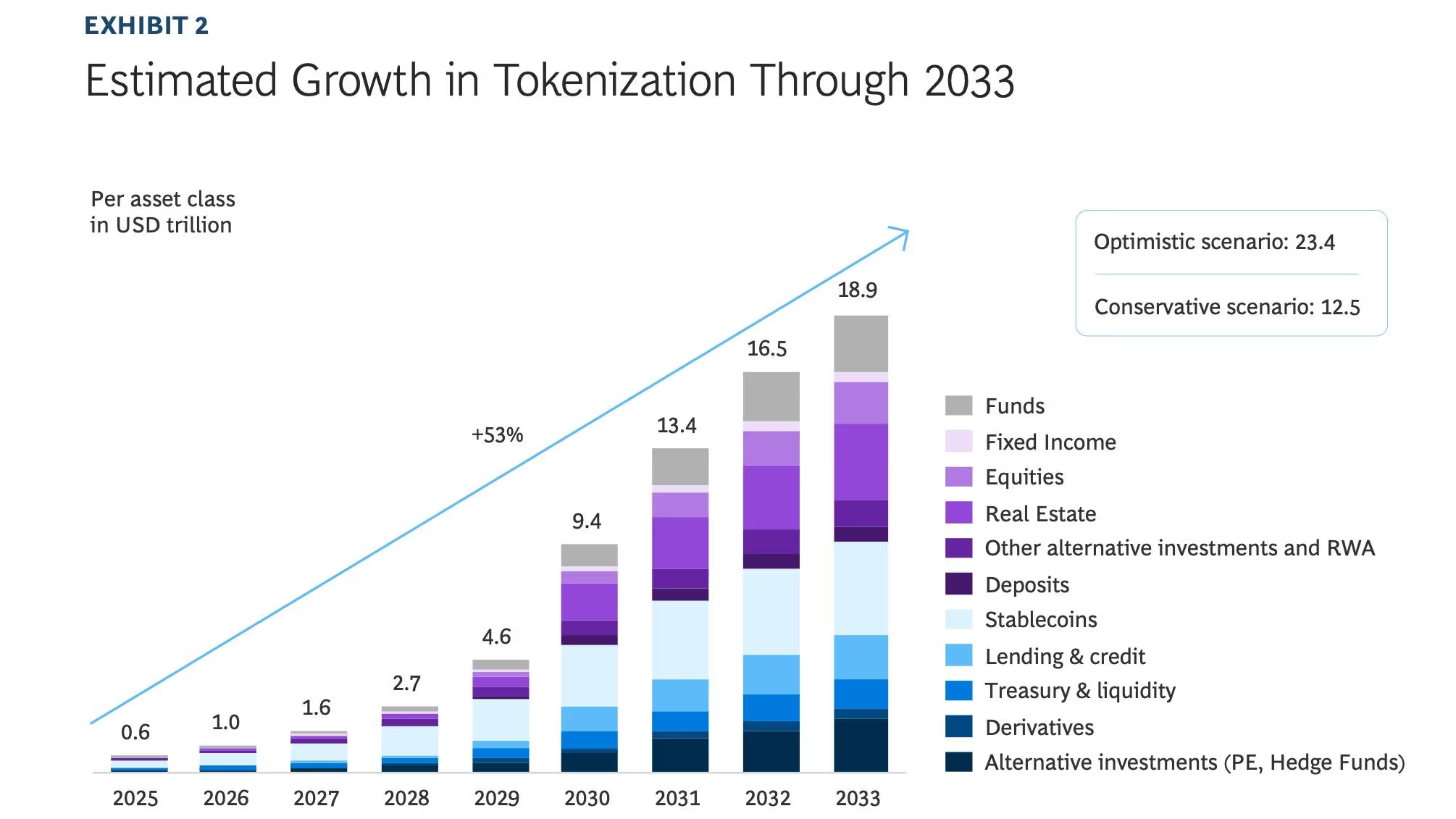 Tokenized asset market projection (BCG/Ripple)
The market for tokenized stocks has demonstrated even more rapid growth. The market value has tripled since mid-2025, according to RWA.xyz data, as Kraken, Ondo Finance, Robinhood, and several other exchanges and issuers have introduced tokenized equity versions.
The primary benefit of placing traditional equities on blockchains is the ability for continuous price discovery, explained Yuki Yuminaga, founder of tokenization startup Tenbin Labs. Unlike current traditional stock markets, which are bound by specific trading hours, blockchain-based assets can trade continuously. This is anticipated to unlock additional capital, enhance liquidity, and mitigate market volatility.
Furthermore, tokenizing stocks could facilitate more efficient lending and borrowing through decentralized finance (DeFi), Yuminaga noted. Tokenized shares might serve as collateral in lending markets, thereby increasing capital efficiency and creating new financing opportunities, according to him.
The entry of major players like Nasdaq and NYSE into the tokenized stocks sector could also address one of the most pressing issues at present: liquidity.
"Tokenized equities have faced liquidity challenges due to the separation of traditional and on-chain markets,” Yuminaga said. "If Nasdaq connects these two liquidity pools, it could significantly alter the situation.”
