Disclaimer: Information found on CryptoreNews is those of writers quoted. It does not represent the opinions of CryptoreNews on whether to sell, buy or hold any investments. You are advised to conduct your own research before making any investment decisions. Use provided information at your own risk.
CryptoreNews covers fintech, blockchain and Bitcoin bringing you the latest crypto news and analyses on the future of money.

Here’s how Bitcoin traders can navigate the uncertainty related to a U.S. government shutdown.

Bitcoin’s (BTC) price surge towards $28,000 on October 1 was partly driven by the uncertainty surrounding the United States debt ceiling. However, U.S. President Joe Biden signed the spending bill just hours before the September 30 deadline, preventing a government shutdown.
Investors are now questioning whether the momentum remains positive for cryptocurrencies, considering that the most severe political-economic scenario is no longer a concern. It is important to highlight that this bill only provides additional funding for the next 45 days, allowing more time for the House and Senate to finalize their funding strategies for 2024.
At first glance, investors might be tempted to utilize futures contracts to take a long position on Bitcoin. However, there is a considerable risk of liquidation if the price experiences a sudden decline, and it is impossible to foresee whether a successful budget negotiation in the future will be advantageous for cryptocurrencies.
With the current extension in effect, lawmakers must find a resolution before November 17. According to Margaret Spellings, the President and CEO of the Bipartisan Policy Center:
"We can't continue postponing our fiscal health and negotiating on the brink of government shutdowns and debt defaults."
There is no doubt that, despite narrowly averting a crisis, the overall risk of an economic recession persists. The U.S. Federal Reserve is contending with ongoing inflation and rising energy costs, factors that have driven the S&P 500 to its lowest level in 110 days and elevated the 10-year Treasury yield to heights not seen since October 2007.
Furthermore, oil prices have surged to $90, reflecting a 27.5% increase in just three months. This upward pressure on inflation is anticipated to further restrict economic activity.
On September 27, Minneapolis Fed President Neel Kashkari expressed uncertainty regarding whether interest rates have been sufficiently raised to counteract this price escalation.
Bitcoin’s initial response does not ensure bullish momentum
Amid this upheaval, Bitcoin has risen in value, surpassing the $28,000 resistance on October 2. This development has led investors to expect increased volatility for the cryptocurrency as the impending debt ceiling decision approaches.
Related Posts
Professional traders are likely to avoid directional risk due to the uncertain outcome of the political discussions and may opt for the reverse (short) iron butterfly, a limited-risk, limited-profit trading strategy.
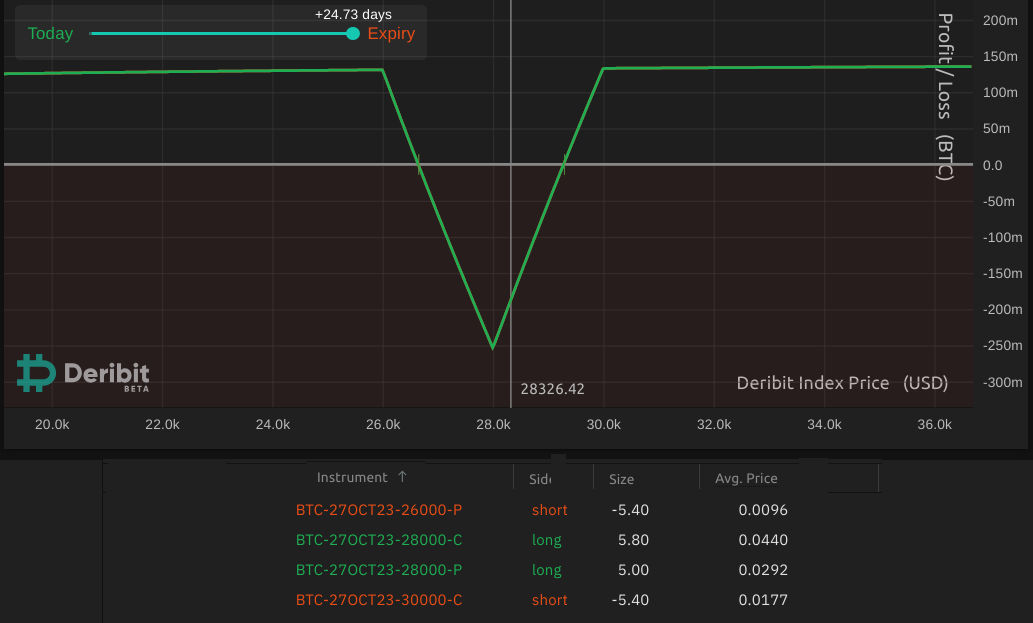 Profit/Loss estimate. Source: Deribit Position Builder
The prices referenced were accurate as of October 2, with Bitcoin trading at $28,326. All options listed expire on October 27, but this strategy can also be adjusted for different time frames. It is crucial to remember that options have a specified expiry date, meaning that the price increase must occur within the defined timeframe.
The suggested neutral-market strategy involves selling 5.4 contracts of $26,000 put options while concurrently selling 5.4 call options with a $30,000 strike. To finalize the trade, one should purchase 5.8 contracts of $28,000 call options and an additional 5 contracts of the $28,000 put options.
While a call option provides the buyer the right to acquire an asset, the contract seller faces potential negative exposure. To fully protect against market fluctuations, an investor must deposit 0.253 BTC (approximately $7,170), representing the maximum potential loss.
Confidence in volatility is crucial, as the risk-reward is inverted
For this investor to realize a profit, Bitcoin’s price must be below $26,630 on October 27 (a decrease of 6%) or above $29,280 (an increase of 3.4%). Essentially, the trade presents a potentially significant profit zone, but losses are 90% greater than potential gains if Bitcoin remains unchanged.
The maximum payout is 0.133 BTC (approximately $3,770). However, if a trader anticipates imminent volatility, a 6% movement within 24 days seems feasible.
It is important to note that investors have the option to reverse the operation before the options expire, preferably after a significant price movement in Bitcoin. To do this, they should repurchase the two options they initially sold and sell the two options they originally bought.
This article is for informational purposes only and is not intended to be and should not be construed as legal or investment advice. The views, thoughts, and opinions expressed herein are solely those of the author and do not necessarily reflect or represent the views and opinions of Cointelegraph.
