Disclaimer: Information found on CryptoreNews is those of writers quoted. It does not represent the opinions of CryptoreNews on whether to sell, buy or hold any investments. You are advised to conduct your own research before making any investment decisions. Use provided information at your own risk.
CryptoreNews covers fintech, blockchain and Bitcoin bringing you the latest crypto news and analyses on the future of money.

Grayscale’s research leader indicates that tokenization will occur in phases and outlines strategies for engagement.

Investors aiming to capitalize on tokenization should approach it in stages, with networks catering to institutions like Canton likely to achieve success first, followed by Avalanche and Ethereum capturing additional value later, stated Zach Pandl of Grayscale.
 Zach Pandl, head of research at Grayscale (Grayscale)
What to know:
- According to Grayscale’s research head Zach Pandl, tokenization should be perceived as a long-term strategy rather than a singular investment, with various winners emerging throughout different phases.
- Pandl anticipates initial advantages to stem from institutional-focused, permissioned frameworks like the Canton Network, which provides a “somewhat enhanced” version of contemporary finance.
- The subsequent phase may see a rise in hybrid frameworks such as Avalanche, eventually leading to more ambitious, globally decentralized systems like Ethereum.
Tokenization has emerged as a prominent term in crypto discussions, but Grayscale’s research lead Zach Pandl mentioned that investors ought to consider it as a long-term journey rather than a solitary investment with distinct winners at various points.
During his address at the EthCC conference held in Cannes, France, Pandl remarked that the trend remains in its early stages. The concept of tokenized assets—utilizing blockchain technology to facilitate, transfer, and document ownership of various financial assets such as bonds, funds, and equities—is rapidly expanding. However, with a current valuation of $27 billion, it constitutes approximately 0.01%, a minuscule portion, of the global capital markets. This figure is anticipated to grow to nearly $19 trillion by 2033, according to projections by BCG and Ripple.
Major financial institutions and asset managers are already recognizing this potential. “The two key areas that institutions are cognizant of are stablecoins and tokenization,” Pandl noted. Nevertheless, they are still determining how best to allocate capital to gain from these advancements.
Going forward, Pandl envisions the evolution of tokenization to occur in stages, with different categories of networks and models deriving value at each phase.
The initial successes, he suggested, may belong to initiatives that resemble traditional finance rather than diverge from it.
“In the early phases of the tokenization journey, successful implementations will likely mirror the current financial system,” he explained.
Related Posts
This indicates that institution-centric, permissioned networks will address practical concerns such as privacy, identity, and control.
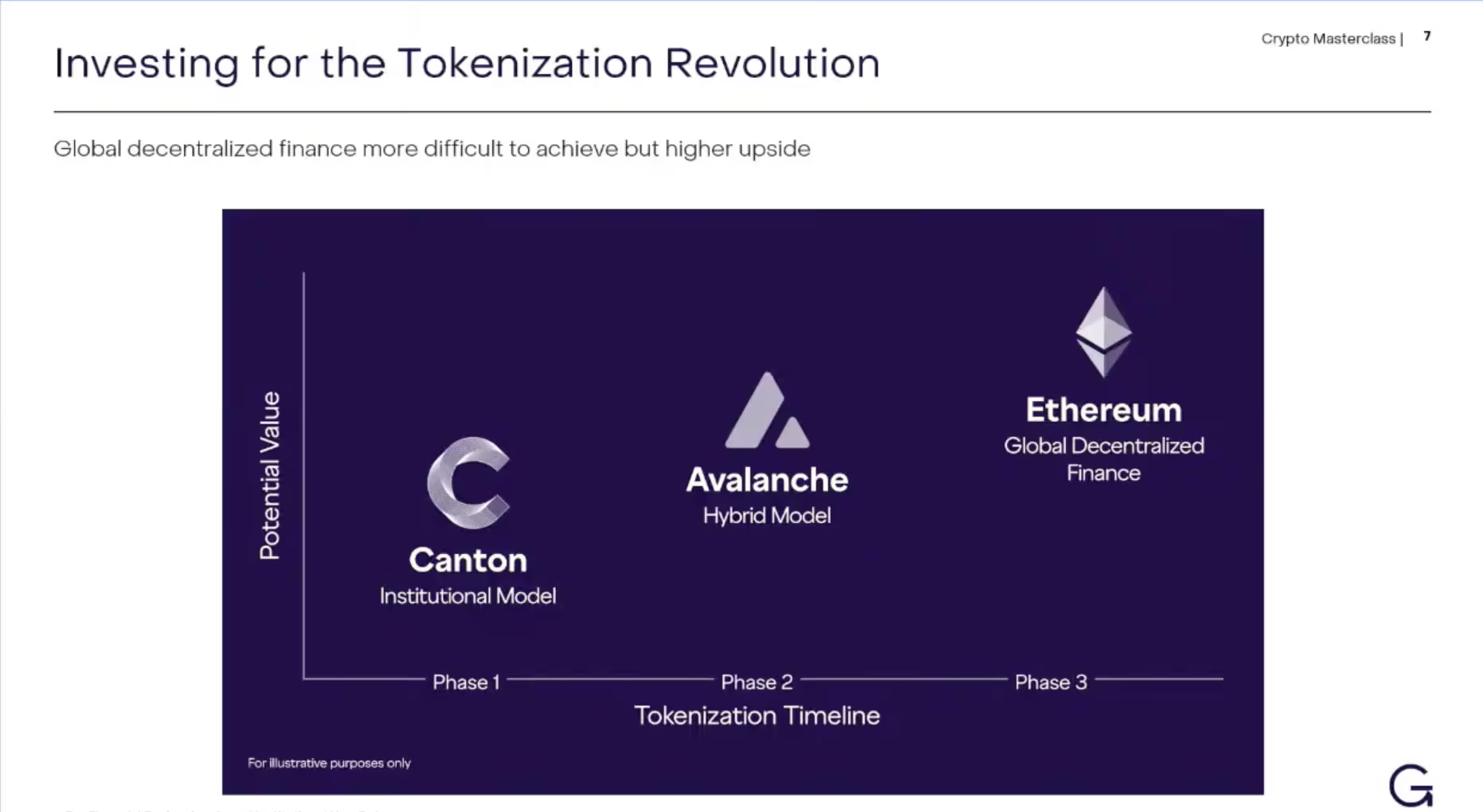 Canton, Avalanche and Ethereum as potential winners of tokenization phases (Zach Pandl presentation/Grayscale)
Pandl highlighted the Canton Network (CC), supported by major Wall Street firms such as DRW, TradeWeb, Goldman Sachs, and Nasdaq, as a likely frontrunner in the initial phase of tokenization.
He described it as “a perfectly reasonable investment” for those seeking shorter-term results, even though Canton’s method represents merely “a slightly different, slightly enhanced version” of the existing financial framework.
The second phase
The next phase of tokenization may involve a hybrid structure that incorporates both institution-controlled blockchains and a global shared infrastructure, where these networks are interconnected and communicate with one another. One illustration of this is Avalanche (AVAX), featuring numerous sovereign, corporate-owned chains (known as subnets) operating in conjunction with a primary layer-1 network.
Pandl regards Ethereum’s ether (ETH) as a larger yet slower prospect. He believes the market will ultimately gravitate toward “global decentralized finance,” but also noted that “the technology is not fully developed” and institutions are not yet prepared.
This positions ETH as a more ambitious option for those willing to wait for a long-term transition away from financial intermediaries.
There are also ancillary opportunities. Pandl emphasized chain-agnostic service providers like Chainlink as another means to gain exposure, suggesting they could be “even more appealing” than some blockchain platforms.
Read more: How tokenized assets could become a $400 billion market in 2026
