Disclaimer: Information found on CryptoreNews is those of writers quoted. It does not represent the opinions of CryptoreNews on whether to sell, buy or hold any investments. You are advised to conduct your own research before making any investment decisions. Use provided information at your own risk.
CryptoreNews covers fintech, blockchain and Bitcoin bringing you the latest crypto news and analyses on the future of money.

From ‘Ethereum’s companion’ to independent entities: Vitalik Buterin’s recent shift is compelling Layer 2 solutions to mature.

Leaders within the layer-2 sector do not perceive this moment as a critical threat; instead, they see Ethereum’s developments as a prompt to refine their objectives.
What to know:
- For several years, Ethereum’s layer-2 networks have promoted themselves as enhancements to Ethereum.
- However, in light of recent statements from Ethereum co-founder Vitalik Buterin questioning the necessity of a dedicated layer-2 roadmap, many of those teams are now highlighting a different perspective: that rollups are entirely separate from Ethereum.
- Instead of indicating an existential risk, layer-2 leaders contend that Ethereum’s advancement is prompting rollups to define their own roles and establish independence.
For several years, Ethereum’s layer-2 networks have promoted themselves as enhancements to Ethereum. “Arbitrum is Ethereum,” Offchain Labs co-founder Steven Goldfeder stated on X in March 2024. “Base is Ethereum,” Coinbase’s layer-2 team claimed in April 2025.
However, in light of recent statements from Ethereum co-founder Vitalik Buterin questioning the necessity of a dedicated layer-2 roadmap, many of those teams are now highlighting a different perspective: that rollups are entirely separate from Ethereum.
STORY CONTINUES BELOWDon’t miss another story.Subscribe to the Crypto Daybook Americas Newsletter today. See all newslettersSign me up
Goldfeder, in particular, adopted a markedly different stance following Buterin’s remarks, stating on X: “Arbitrum is not Ethereum.”
“It’s a core component of the ecosystem, a close partner, and has maintained a synergistic relationship for the past five years. However, it is not Ethereum,” he elaborated in his post.
Buterin’s comments, which implied that as Ethereum becomes faster and more cost-effective, the initial justification for layer-2s might be changing, rekindled discussions about whether rollups may become less essential as the base layer improves.
Layer-2 networks were previously integrated into Ethereum’s roadmap to enhance the network by processing transactions off the primary blockchain and settling them back to Ethereum, thereby alleviating congestion and fees.
This discussion is not merely theoretical. Numerous layer-2 networks currently secure billions of dollars in user assets, making them among the largest platforms in the crypto landscape. Coinbase-supported Base holds approximately $4 billion in total value locked, while Arbitrum secures over $2 billion, according to DefiLlama data.
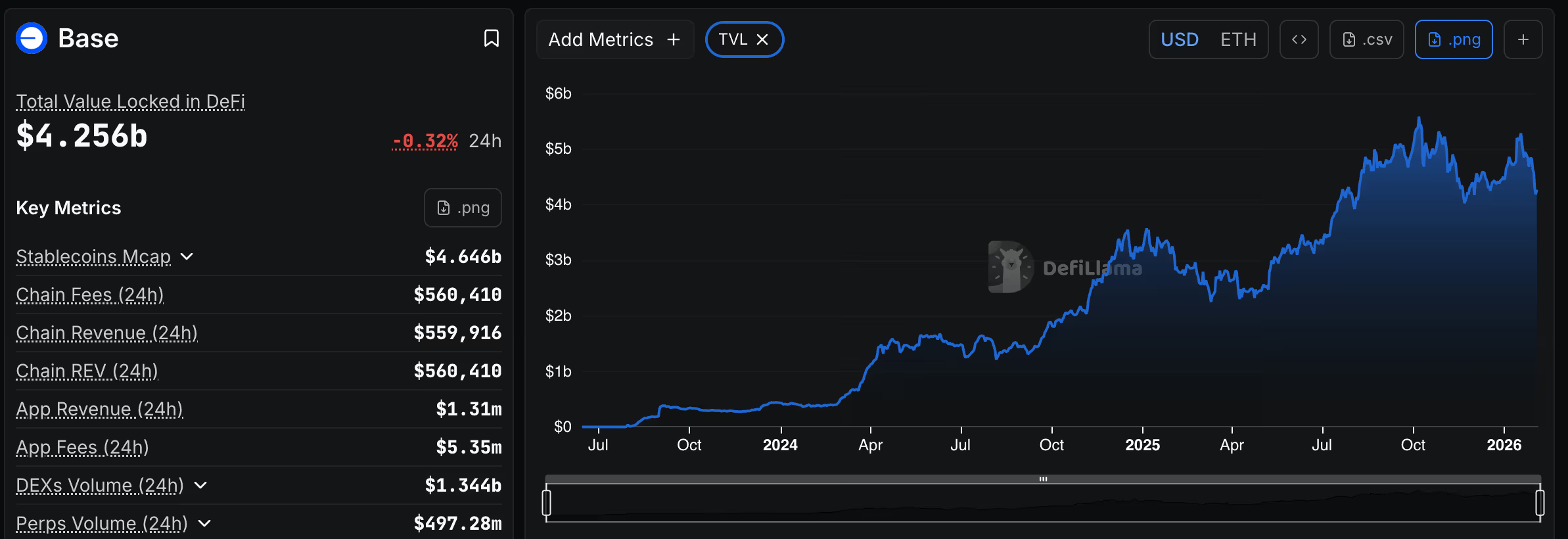 (Base TVL Feb 2026 / DefiLlama)
‘Less relevant’
Yet leaders across the layer-2 ecosystem assert that this moment is being misinterpreted.
Related Posts
Instead of indicating a critical threat, they argue, Ethereum’s advancements are prompting rollups to define their roles more clearly and to achieve independence.
Ben Fisch from the Espresso Foundation remarked that Buterin’s statements signify a logical progression in how Ethereum’s scaling strategy is perceived.
“I believe that Vitalik’s post aligns well with the notion that he’s indicating, ‘The primary purpose of layer-2s was initially to scale Ethereum. Now that we are enhancing Ethereum’s speed, they are becoming less relevant,” Fisch stated to CoinDesk during an interview.
Nevertheless, Fisch dismissed the notion that this renders rollups obsolete.
“I believe this marks the beginning of layer-2s thriving and evolving independently from Ethereum,” he mentioned.
“A layer-2 might utilize Ethereum as a service, but it is certainly not obligated to Ethereum or the views of its leaders.”
This viewpoint is increasingly being shared by layer-2 leaders themselves.
Base, Coinbase’s layer-2 network, welcomed enhancements at the base layer, with Jesse Pollak, the head of Base, referring to Ethereum scaling as “a win for the entire ecosystem,” while emphasizing that rollups must provide more than just reduced fees.
“Going forward, L2s can’t simply be ‘Ethereum but cheaper,’” Pollak remarked.
Polygon CEO Marc Boiron expressed a similar sentiment. Polygon recently announced a shift in its focus towards payments, and Boiron noted that Buterin’s comments were less about abandoning rollups and more about elevating expectations for them.
“Vitalik’s point was not that rollups are erroneous, but rather that scaling alone is not enough,” Boiron told CoinDesk. “The true challenge lies in creating a unique blockspace that caters to real-world applications such as payments, where cost, reliability, and consistency are crucial.”
Others have taken this further, suggesting that rollups should be seen as independent platforms rather than merely extensions of Ethereum. Jing Wang, co-founder of the Optimism Foundation and CEO of OP Labs, likened layer-2s to standalone web services.
“L2s are like websites. Each entity will have its own, customized to its requirements. Ethereum is an open settlement standard,” Wang stated to CoinDesk. “It’s vital for Ethereum to remain true to those foundational values to allow L2s the freedom to tailor their solutions.”
Collectively, these responses indicate that while Buterin’s remarks have sparked inquiries regarding the role of layer-2s, leaders within the ecosystem view it less as a threat and more as a transitional phase, one that is compelling rollups to align their branding with their evolving identities.
Read more: ‘You are not scaling Ethereum’: Vitalik Buterin issues a blunt reality check to the biggest crypto networks
