Disclaimer: Information found on CryptoreNews is those of writers quoted. It does not represent the opinions of CryptoreNews on whether to sell, buy or hold any investments. You are advised to conduct your own research before making any investment decisions. Use provided information at your own risk.
CryptoreNews covers fintech, blockchain and Bitcoin bringing you the latest crypto news and analyses on the future of money.

Ethereum experiences unprecedented activity levels, yet ether’s price and blockchain fees remain stagnant.

Capital outflows, occurring even as activity expands throughout Ethereum’s ecosystem, underscore the increasing disconnect between usage growth and ETH’s market performance, a report from CryptoQuant indicates.
 Ethereum experiences unprecedented activity across various measures.
What to know:
- Ethereum’s network activity has reached all-time highs in terms of active addresses and smart contract interactions, yet ether’s price has declined by approximately 30% in the last six months.
- Experts suggest that capital flows and increasing exchange deposits now provide a better explanation for ether’s price than on-chain usage, deviating from the strong correlation observed in earlier bull markets.
- Although Ethereum accounts for over half of the global stablecoin supply, its base layer is ceding fee and revenue share to competing networks.
The network activity of Ethereum has surged to unprecedented levels across numerous metrics, but this growth has not resulted in an increase in ether’s price or enhanced fee generation at the base layer.
A weekly analysis from the analytics firm CryptoQuant, published on March 10, reported that daily active addresses on Ethereum neared 2 million in February 2026, surpassing the peaks seen during the 2021 bull market. Active addresses refer to unique blockchain wallet addresses that have executed or received a transaction within a specific time frame, such as the past 24 hours.
Smart contract calls, which are commands on the blockchain that instruct it to perform specific actions, exceeded 40 million daily, and token transfers driven by internal contract interactions also reached record levels. These findings indicate widespread adoption across DeFi, stablecoins, and automated protocol activities, despite a decline in investment demand for ether.
Typically, record user activity in the network is indicative of positive market value for the blockchain’s native token. However, this is not true for Ethereum.
The native asset ether has dropped about 30% over the last six months, and the one-year change in Ethereum’s realized capitalization has turned negative, signaling net capital outflows from the market.
Exchange flow data from CryptoQuant reveals ether moving to trading platforms at a quicker rate compared to bitcoin, a trend consistent with heightened selling pressure.
Related Posts
Focus on capital flows
CryptoQuant contended that capital flows, rather than network activity, now more accurately account for ETH price dynamics.
In previous cycles, notably 2018 and 2021, increasing on-chain activity was aligned with price increases. That connection has diminished. The firm’s scatter analysis illustrated recent observations clustering at high activity levels but relatively low prices, indicating that incremental usage growth now has diminished influence on ether’s valuation.
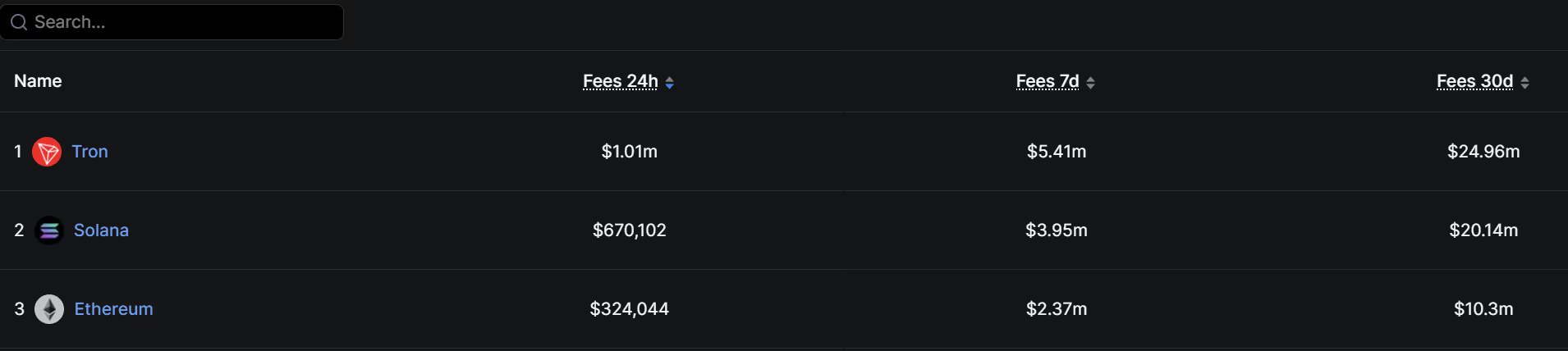
The fee landscape further emphasizes this disconnect. Data from DefiLlama indicates that Ethereum generated approximately $10.3 million in transaction fees over the past month, ranking it third after Tron with nearly $25 million and Solana with about $20 million.
On a revenue basis, the gap widens even further. Ethereum placed fifth in 30-day protocol revenue at $1.22 million, lagging behind Tron, Polygon, Base, and Solana. Base, an Ethereum layer-2 network developed by Coinbase, generated approximately three times Ethereum’s protocol revenue during the same timeframe.
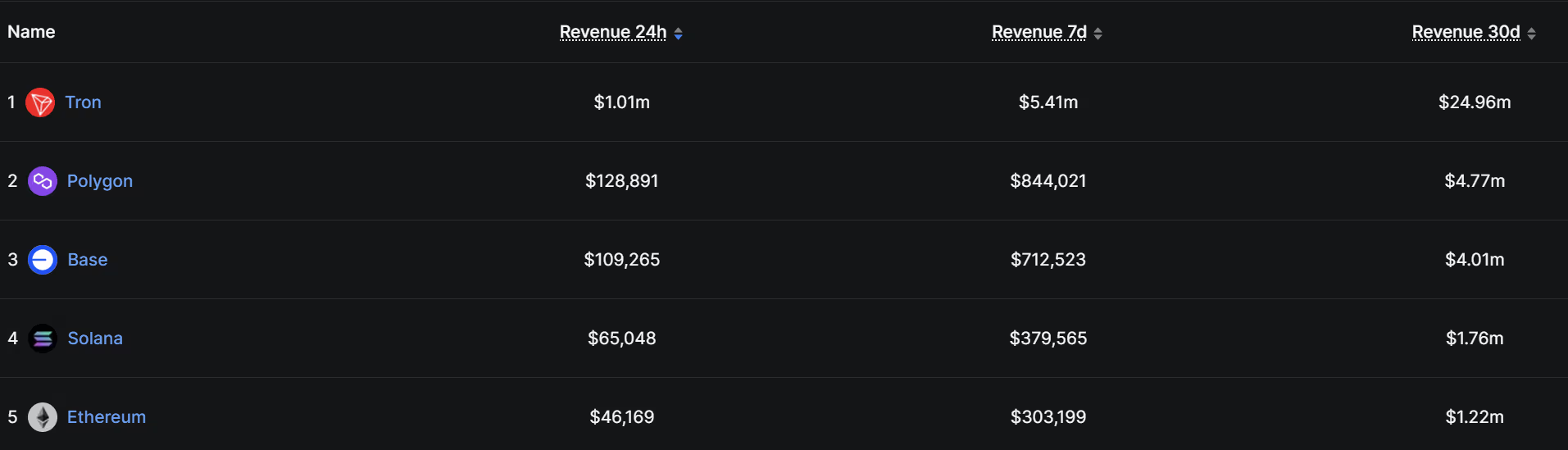
The discrepancy highlights the increasing significance of Ethereum’s layer-2 ecosystem. Networks like Base and Polygon handle substantial transaction volumes while incurring relatively minor settlement costs to the base chain, thereby distributing economic activity throughout the broader Ethereum ecosystem instead of concentrating it solely on the base layer.
Stablecoins continue to be a positive aspect for adoption. Ethereum supports approximately $162 billion in stablecoin supply, which accounts for about 52% of the global market, as per DefiLlama. However, this activity has not resulted in a corresponding value capture for ether itself.
While Ethereum may be more active than ever, the blockchain’s native asset is capturing a smaller portion of the value generated on it.
