Disclaimer: Information found on CryptoreNews is those of writers quoted. It does not represent the opinions of CryptoreNews on whether to sell, buy or hold any investments. You are advised to conduct your own research before making any investment decisions. Use provided information at your own risk.
CryptoreNews covers fintech, blockchain and Bitcoin bringing you the latest crypto news and analyses on the future of money.

DeFi risk management firm Gauntlet experiences $380 million withdrawal as OKX cryptocurrency initiative concludes.

Gauntlet observed that deposits have returned to levels seen prior to the campaign and has previously managed significant capital fluctuations due to the conclusion of incentive campaigns, airdrops, and changes in market conditions, which frequently result in brief fluctuations in either direction.

What to know:
- Gauntlet’s TVL decreased by 22.84% over a week, resulting in a loss of approximately $380 million in value, primarily due to the conclusion of OKX’s pre-deposit campaign on Katana rather than overall market pressures — the outflows are mainly stablecoins moving out of incentive-based vaults.
- Despite the significant figure, Gauntlet asserts that the fluctuation aligns with typical incentive cycle behaviors, citing a similar instance in October 2025 where a single deposit transaction of $775 million was fully regained within ten days as evidence of the firm’s capability to manage large capital shifts.
Gauntlet, a prominent provider of risk management solutions in decentralized finance (DeFi), has experienced a steep decline in its total value locked (TVL), which measures the assets deposited across its vaults, falling 22.84% to $1.325 billion.
This drop has erased approximately $380 million in dollar value from a peak of around $1.72 billion a week ago, based on data from DeFiLlama. The decline accelerated on Thursday, with a notable one-day decrease of 7.57%.
The primary factor, according to Gauntlet, was the ending of OKX’s pre-deposit campaign on the DeFi-oriented blockchain, Katana. Pre-deposit campaigns — where users are incentivized to allocate capital prior to a protocol launch — can create significant TVL increases that quickly reverse once the campaign concludes or a token airdrop occurs. The data supports this observation: Gauntlet’s TVL sharply increased around March 2 before declining just as quickly.
Related Posts
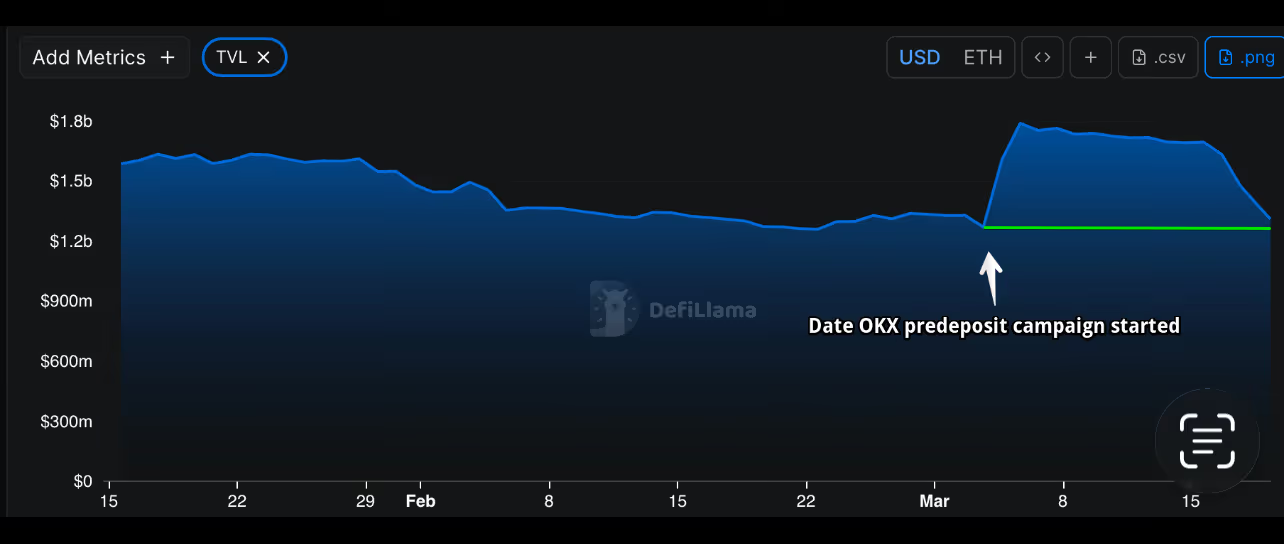 (DeFiLlama data provided by Gauntlet)
The outflows are primarily composed of stablecoins, as noted by Gauntlet.
The magnitude of this shift is significant considering Gauntlet’s core operations. The firm functions as a risk management consultant for DeFi, assisting protocols in understanding, for instance, the percentage of a borrower’s collateral that could be at risk of liquidation if ETH were to decline by 30% overnight. It does not hold funds directly; rather, it establishes the parameters that dictate how lending markets and vaults operate.
Its TVL serves as an indicator of the capital secured within systems that Gauntlet oversees. A sharp decline in this figure may indicate either market stress or, as is the case here, the mechanical conclusion of an incentive program.
Gauntlet, which achieved a $1 billion valuation in 2022, currently oversees three vaults — essentially pooled deposit accounts where users deposit capital in exchange for a yield. The vaults contain USDC, BTC, and WETH, respectively. The USDC vault is the most liquid, providing an APY of 4.86%, while the other vaults yield between 2% and 2.3%. The outflows might also signify DeFi traders reallocating funds to higher-yielding options — for instance, SOL-based protocols like Jito currently offer 5.69%.
Gauntlet has previously managed significant capital fluctuations. In October 2025, its USDT vaults recorded a $775 million single-transaction deposit — a 40x TVL increase — and returned to pre-deposit levels within ten days through active reallocation and new collateral market additions. The firm framed this week’s outflows similarly, emphasizing that the ends of incentive campaigns, token generation events, and shifts in market conditions frequently result in brief fluctuations in either direction.
"Institutional risk managers navigate through these events," the firm stated in a communication to CoinDesk. “They work to maintain rates, safeguard capital supplied to vaults, and adapt to market conditions.”
Oliver Knight contributed reporting to this story.
Read more: Tokenized Apollo Credit Fund Makes DeFi Debut With Levered-Yield Strategy by Securitize, Gauntlet
