Disclaimer: Information found on CryptoreNews is those of writers quoted. It does not represent the opinions of CryptoreNews on whether to sell, buy or hold any investments. You are advised to conduct your own research before making any investment decisions. Use provided information at your own risk.
CryptoreNews covers fintech, blockchain and Bitcoin bringing you the latest crypto news and analyses on the future of money.

Cryptocurrency advocates criticize Ray Dalio’s ‘outdated arguments’ while supporting bitcoin’s prospects.

Experts respond to billionaire hedge fund manager Ray Dalio’s caution regarding bitcoin’s absence of gold-like characteristics and concerns related to surveillance, quantum computing, and minimal central bank investment.
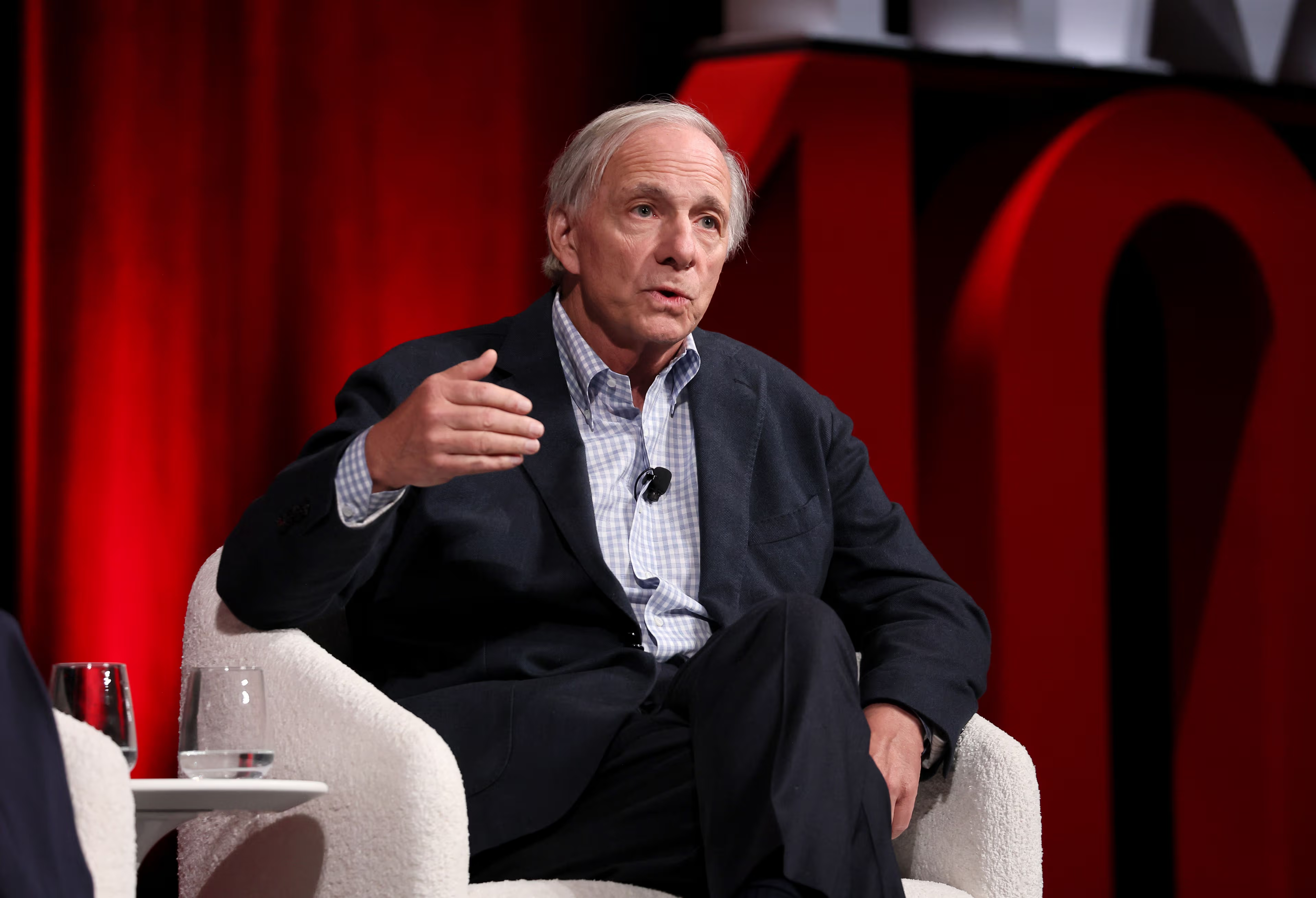 Ray Dalio (Jemal Countess/Getty Images for TIME)
What to know:
- Ray Dalio, the founder of Bridgewater Associates, expressed in a recent podcast that bitcoin does not possess the attributes of gold, mentioning transparency issues, absence of central bank support, and possible quantum computing threats.
- Bitwise CIO Matt Hougan noted that these concerns are precisely the reason bitcoin currently makes up only 4% of the gold market, with long-term investors anticipating that these issues will be resolved eventually.
- Galaxy’s Alex Thorn and VanEck’s Matthew Sigel countered Dalio’s assertions, stating that bitcoin’s adoption and practical use continue to expand while addressing quantum-related risks.
Crypto specialists are contesting billionaire hedge fund manager Ray Dalio’s recent skepticism regarding bitcoin , contending that the largest and most established cryptocurrency lacks the characteristics that render gold a dependable store of value.
While appearing on the All-In Podcast, the Bridgewater Associates founder remarked that bitcoin should not be likened to gold due to its lack of central bank support, limited privacy features, and potential existential risks from advancements in quantum computing. Dalio also indicated that the asset’s public ledger makes transactions susceptible to monitoring and possible control.
Dalio, who mentioned last year that his bitcoin allocation is approximately 1%, is no stranger to criticizing the digital currency. Previously, he stated that bitcoin’s traceability and possible weaknesses related to quantum computing pose challenges for it as a global reserve asset.
Nevertheless, industry experts argue that these criticisms mirror ongoing discussions surrounding bitcoin, and that the risks pointed out by Dalio are already reflected in bitcoin’s significantly lower market valuation compared to gold.
Bitcoin’s risks are also its upside
However, some analysts assert that these criticisms are precisely why bitcoin is a worthwhile investment.
"Dalio’s not ‘wrong’ in an absolute sense," Matt Hougan, chief investment officer at Bitwise, told CoinDesk. "There really is some risk with quantum and central banks really aren’t buying bitcoin yet."
However, Hougan emphasized that these issues are exactly why bitcoin’s market value is still significantly less, roughly 4%, compared to gold’s total market capitalization. Currently, bitcoin’s market cap is about $1.4 trillion, in contrast to gold’s estimated $35 trillion.
"These criticisms present a clear opportunity," he stated. "We invest in bitcoin because we believe these factors will evolve over time; developers will tackle quantum risk, and central banks will eventually embrace it."
Related Posts
"If these critiques did not exist, bitcoin would already be valued at $1 million per coin," he added.
‘Tired’ old narratives
Alex Thorn, head of research at Galaxy, remarked that Dalio’s arguments reflect outdated narratives from bitcoin’s earlier years.
"Ray Dalio’s Bitcoin critiques echo tired narratives from the pre-2017 era," Thorn stated in an email, noting that developers are already addressing quantum risks.
Read more: Here’s why the quantum threat for bitcoin may be smaller than people fear
He also pointed out that while comparing bitcoin to gold is reasonable, it overlooks the practical differences between the two assets. "Gold may be stored effectively in a bunker or at the New York Fed, but Bitcoin has real-world utility in ways that gold cannot replicate," he said, highlighting the asset’s increasing adoption by individuals and institutions over the past two decades.
Monetary shift
Matthew Sigel, head of digital assets research at VanEck, noted that both gold and bitcoin "have a role" as they signify hard assets from distinct monetary epochs.
"Ultimately, this is a discussion between the monetary frameworks of the previous century and the one emerging now," he stated in an email.
In his perspective, gold resolved the trust issue in an "analog" financial system reliant on reported reserves and custodians. In contrast, bitcoin addresses that challenge within a digital environment through open-source development and verifiable transactions.
He further mentioned that central banks, such as the Czech National Bank, are already starting to explore digital asset exposure, and privacy enhancements are progressing through improved wallet practices and second-layer networks.
Sigel also countered the quantum computing concern, asserting that this issue impacts the entire financial system rather than bitcoin exclusively. "Quantum risk is a broader cryptography challenge facing the entire financial system, not a flaw unique to bitcoin," he stated.
Investor surveys indicate that younger investors are increasingly leaning toward bitcoin, suggesting a gradual transition in the "monetary center."
Read more: ‘Big Short’ Micheal Burry spots 2022 vibes in bitcoin crash
