Disclaimer: Information found on CryptoreNews is those of writers quoted. It does not represent the opinions of CryptoreNews on whether to sell, buy or hold any investments. You are advised to conduct your own research before making any investment decisions. Use provided information at your own risk.
CryptoreNews covers fintech, blockchain and Bitcoin bringing you the latest crypto news and analyses on the future of money.


The SEC is shifting from its former regulatory approach.
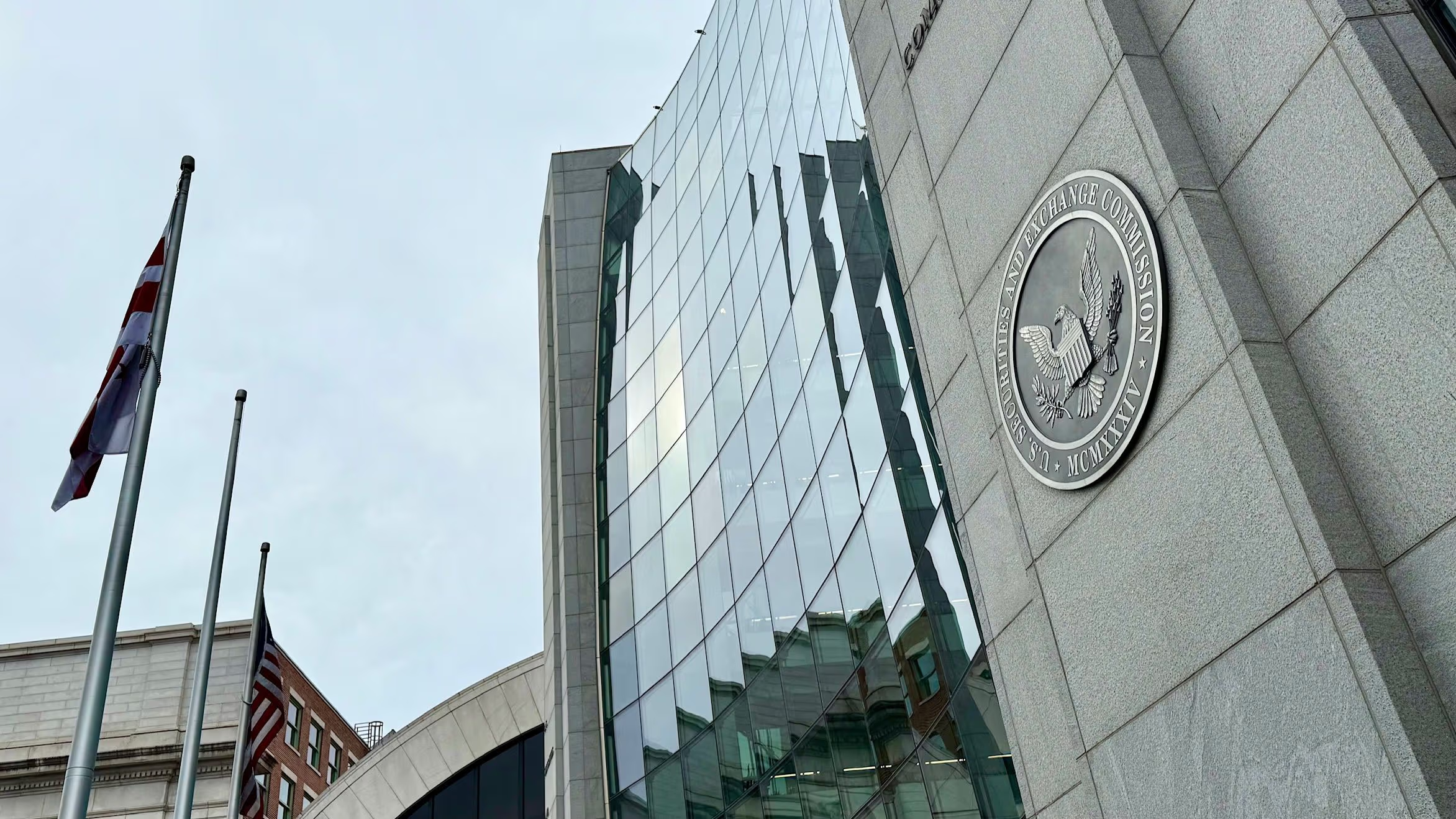 U.S. Securities and Exchange Commission (Jesse Hamilton/CoinDesk)
For over a decade, U.S. investors and innovators have navigated a landscape marked by uncertainty regarding when crypto assets fall under federal securities laws. Effective markets rely on clear understanding of regulations. However, financial regulators have, for an extended period, responded to legitimate regulatory inquiries with silence, imposed higher entry barriers, and executed ad-hoc enforcement actions that further exacerbated the industry’s confusion.
The Securities and Exchange Commission is making a significant move to change that previous methodology.
The Commission has announced a pivotal interpretation that ultimately presents clear guidelines. It establishes a simple classification of crypto assets — the majority of which are not considered securities — and elucidates how the Supreme Court’s Howey test pertains when a crypto asset is associated with an investment contract.
This initiative creates a pathway to the essential bipartisan market structure legislation currently progressing through Congress. Only Congress has the authority to amend the law, and we are prepared to collaborate with CFTC Chairman Michael Selig to implement the CLARITY Act. Meanwhile, we are offering the responsible regulatory framework that the markets require.
Our interpretation — based on existing legislation and shaped by extensive public feedback — identifies four categories of crypto assets that do not qualify as securities: digital commodities, digital collectibles, digital tools, and payment stablecoins as outlined by the GENIUS Act.
Only one category remains within the federal securities framework: digital securities, which are tokenized forms of traditional securities such as stocks and bonds. This differentiation reaffirms the Commission’s primary objective — and its legal authority — by safeguarding investors engaged in securities transactions.
A viable framework, however, necessitates more than mere classification. It also needs to clarify the application of the Howey test to crypto. While the definition of a stock is well established, “investment contract” is not defined in the statute, making its interpretation reliant on a Supreme Court test.
Related Posts
Essentially, the Howey test defines an investment contract as an investment of funds in a common venture with a legitimate expectation of profits generated from the key managerial or entrepreneurial efforts of others. Early-stage blockchain projects often issue tokens in a funding transaction linked to the development of software, a protocol, or a network. When teams make explicit commitments that lead buyers to depend on the team’s ongoing efforts with an anticipation of profit, the transaction is regarded as an investment contract.
Equally significant, our interpretation clarifies how and when an investment contract concludes, releasing the crypto asset from obligations under securities law. The critical factor is transparent disclosure: project teams must clearly articulate the representations or promises they are making so that investors comprehend the rights they are acquiring.
As a project progresses, once the team’s promised activities have been fulfilled or resolved, purchasers no longer anticipate profits from those essential managerial efforts, resulting in the termination of the investment contract. In essence, reliance on Howey must derive from clear and definitive assurances the project team intends to fulfill.
The SEC’s function is to provide impartial clarity, not to dictate how teams should structure their projects.
By offering this guidance as Congress completes legislation, we ensure that crypto asset innovation can develop and flourish domestically without delay. Clear regulations also enable regulators to concentrate enforcement efforts where they are most needed: combating fraud and maintaining market integrity within the bounds of our legal authority.
For generations, the capital markets of the United States have been recognized as the most vibrant and trusted globally. A vital element of that achievement is our regulatory framework’s capacity to adopt new technologies while ensuring robust investor protections.
The rise of blockchain networks and crypto assets presents yet another opportunity to achieve that equilibrium.
Crypto markets — along with the millions of Americans who engage with them — merit the clarity that has been long overdue. Under President Trump’s administration, we are making significant progress.
