Disclaimer: Information found on CryptoreNews is those of writers quoted. It does not represent the opinions of CryptoreNews on whether to sell, buy or hold any investments. You are advised to conduct your own research before making any investment decisions. Use provided information at your own risk.
CryptoreNews covers fintech, blockchain and Bitcoin bringing you the latest crypto news and analyses on the future of money.


In this week’s Crypto Long & Short Newsletter, Gregory Mall of Lionsoul Global discusses how ETFs have redirected a significant portion of bitcoin volatility into U.S. equity options markets.
 (Giulia Squillace/ Unsplash+)
What to know:
You’re reading Crypto Long & Short, our weekly newsletter that provides insights, news, and analysis for professional investors. Sign up here to receive it in your inbox every Wednesday.
Hi readers,
Welcome to our institutional newsletter, Crypto Long & Short. This week:
STORY CONTINUES BELOWDon’t miss another story.Subscribe to the Crypto Long & Short Newsletter today. See all newslettersSign me up
- Gregory Mall on how ETFs have redirected a growing portion of bitcoin volatility into U.S. equity options markets
- Key headlines institutions should monitor by Francisco Rodrigues
- Mid-caps exhibit surprising strength in Chart of the Week
Thank you for being with us!
-Alexandra Levis
Expert Insights
When ETF options begin influencing bitcoin
– By Gregory Mall, chief investment officer, Lionsoul Global
Related Posts
The introduction of U.S. spot bitcoin ETFs marked a significant structural change. The iShares Bitcoin Trust ETF (IBIT) quickly became one of the most rapidly growing ETFs in history, attracting tens of billions into a regulated structure. Less frequently discussed, but equally significant, is the subsequent rapid growth of IBIT options.
In the past year, open interest in IBIT options has surged into the multi-billion-dollar range. During certain high-volume sessions, trade activity has approached levels historically linked with Deribit, the cryptocurrency futures and options exchange. A substantial portion of bitcoin’s convexity is now located within U.S. equity options markets rather than in offshore crypto platforms.
This transition is crucial as it alters the manner in which volatility is transmitted.
From offshore leverage to onshore gamma
For most of its existence, bitcoin volatility has been influenced by offshore perpetual futures. Funding discrepancies, leverage buildups, and liquidation cascades have driven price movements.
ETF options introduce an alternative mechanism.
When investors purchase calls or puts on IBIT, dealers generally sell that optionality and hedge delta exposure. If dealers are short gamma, a frequent scenario when investors are net long options, they must buy as prices rise and sell as prices drop. These hedging flows tend to be procyclical and can amplify underlying fluctuations.
Since IBIT holds actual bitcoin, hedging is not limited to the wrapper. Arbitrage and creation and redemption flows carry ETF positioning into the underlying market. Bitcoin is increasingly subject to the same positioning mechanics that affect equity indices.
The structure of ETF options markets, where investors are typically net long optionality, indicates that dealers often hold short gamma during times of heightened demand. This dynamic likely intensified during the February episode, when volatility was relatively low and crypto-native participants accumulated downside puts. Ongoing option purchasing in a low-volatility environment leaves market makers with short convexity across both ETF and offshore venues. When spot prices decline, hedging flows can reinforce the feedback loop. The graph below illustrates the relationship between IBIT option volume and BTC U.S.-hours realized volatility, showing that the correlation has strengthened in recent weeks.
Chart 1 illustrates the co-movement between IBIT option volume and BTC U.S.-hours realized volatility, indicating that their relationship has strengthened over the past weeks. To formally assess this relationship, we regress bitcoin realized volatility on lagged IBIT options volume while controlling for BTC funding rates, equity returns (Nasdaq Composite), implied volatility (CBOE Volatility Index, or VIX), short-term interest rate fluctuations, and U.S. dollar movements. The findings show that IBIT options trading activity is significantly linked with BTC volatility even after considering broader macroeconomic factors.
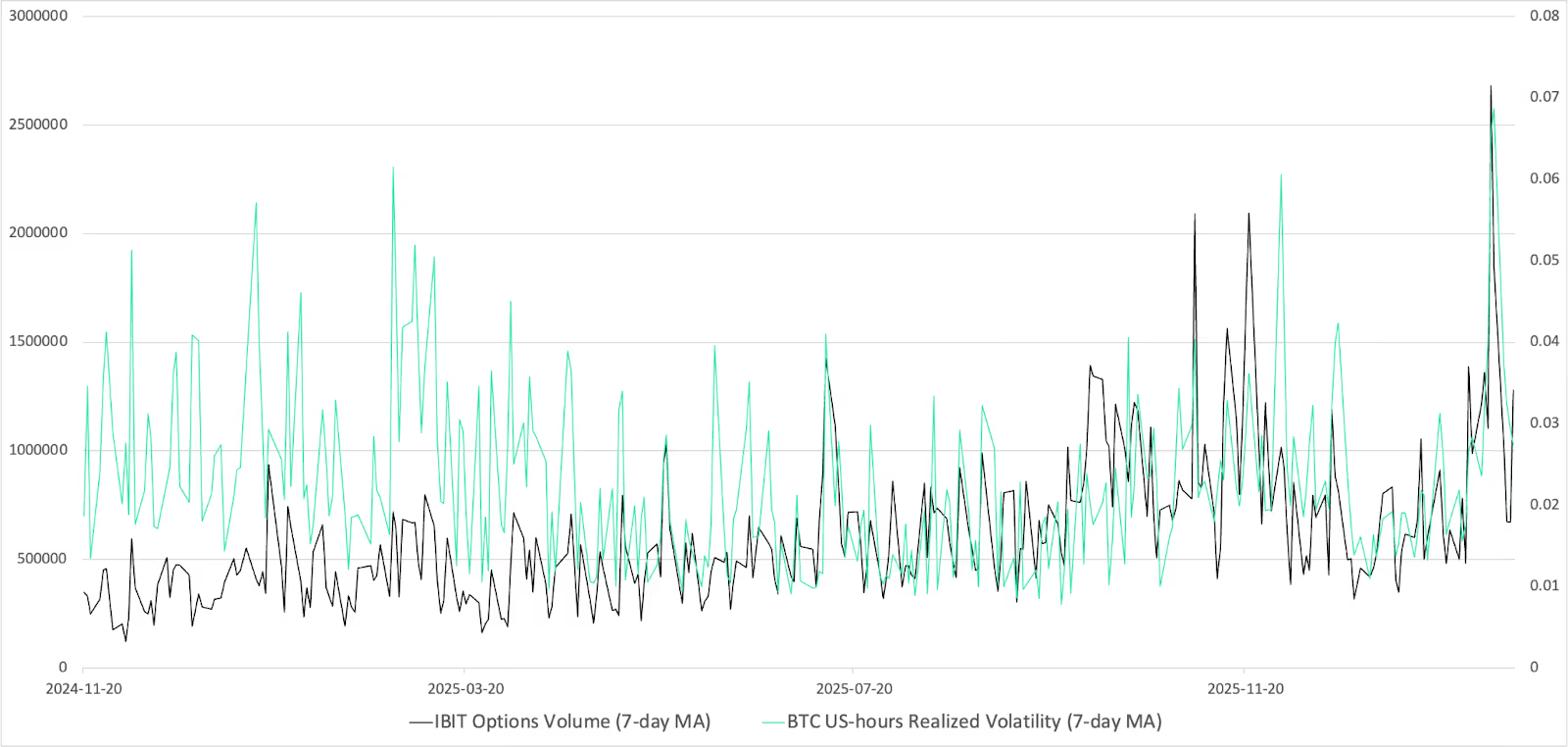
Chart 1: Movement of IBIT option volume and BTC U.S.-hours realized volatility
