Disclaimer: Information found on CryptoreNews is those of writers quoted. It does not represent the opinions of CryptoreNews on whether to sell, buy or hold any investments. You are advised to conduct your own research before making any investment decisions. Use provided information at your own risk.
CryptoreNews covers fintech, blockchain and Bitcoin bringing you the latest crypto news and analyses on the future of money.

Coinbase survey reveals that more than 50% of users lack comprehension of cryptocurrency taxation.

The 2026 Crypto Tax Readiness Report, conducted in collaboration with Cointracker, revealed that merely 49% of participants accurately recognize that cryptocurrency is taxable whenever it is sold.
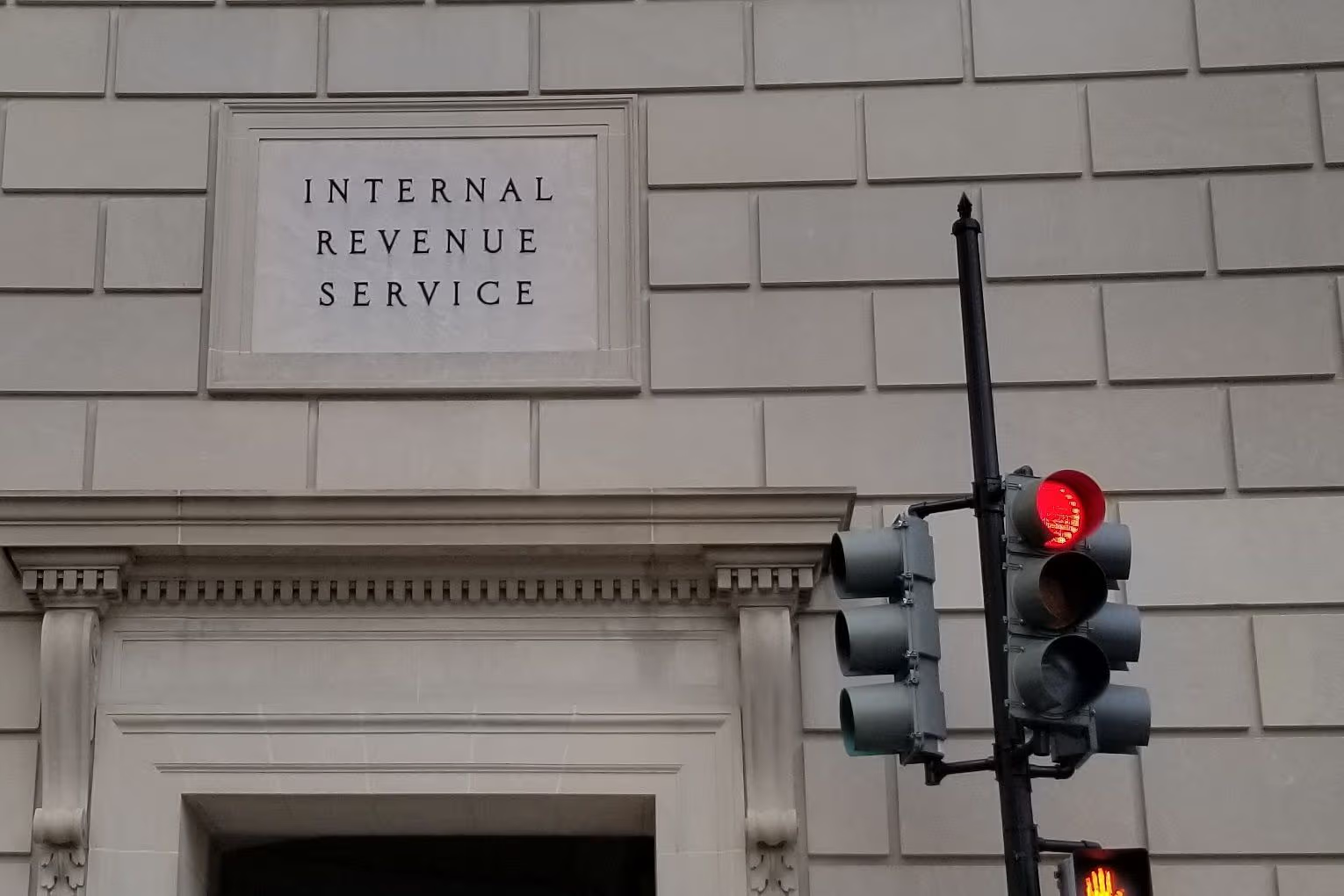 IRS building (Coindesk archives)
Key points:
- Nearly a quarter of users incorrectly believe that simple transfers result in taxable events.
- Participants reported an average of 2.5 platforms/wallets, with 83% utilizing self-custodial wallets.
- Only 35% indicated that they had modified their cost basis previously.
According to a survey conducted by Coinbase (COIN), a cryptocurrency exchange listed in the U.S., and Cointracker, a platform for crypto tax and portfolio management, over half of cryptocurrency investors lack an understanding of the essential principle of taxability concerning their digital asset holdings.
The 2026 Crypto Tax Readiness Report determined that only 49% of respondents accurately comprehend that cryptocurrency is subject to taxation whenever sold, while almost a quarter mistakenly think that simple transfers constitute tax events.
Although most users intend to comply with crypto tax regulations, the reality of multi-platform ownership complicates the cost basis issue, which involves deducting the initial purchase price of an asset to report capital gains.
The research revealed that users averaged 2.5 platforms/wallets, with 83% employing self-custodial wallets, and merely 35% reported that they had adjusted their cost basis previously. The survey, carried out in late 2025, included responses from 3,000 U.S. crypto users.
Related Posts
The confusion surrounding cost basis in the new 1099-DA forms is further complicated by a level of overreporting inherent in the new system, according to Coinbase. This occurs because routine actions such as stablecoin payments and Ethereum gas fees trigger taxable events, generating minimal significant tax revenue.
Coinbase anticipates issuing more than four million 1099-DA Forms to clients with proceeds under $600, compounded by the fact that over 60% of its customers lack complete cost basis data due to the manner in which digital assets are transferred across wallets and platforms.
“At present, this means every stablecoin payment, every minor DeFi [decentralized finance] transaction, every gas fee is technically a taxable event,” Coinbase stated. “The compliance burden this creates for ordinary Americans is not just inconvenient – it poses a direct threat to the adoption and innovation that the GENIUS Act aimed to facilitate.”
Despite some challenges, the shift toward standardized reporting of cryptocurrency taxes is expected to promote adoption in the long term, according to Matt Price, director of investigations at blockchain analytics firm Elliptic. Price, a former IRS special agent focused on criminal investigations, views this as a move toward targeted enforcement rather than the broad, manual investigations of the past.
Also a former head of investigations at Binance, Price recognizes the intricacies involved in handling crypto taxes, having been compensated partly in cryptocurrency by Binance and needing to account for a volatile asset in his payments.
“How do you even report it?” Price questioned in an interview. “I didn’t even receive a 1099 to report that, so I essentially had to conduct all my own accounting to file accurate taxes that reflected that information.”
Consequently, the introduction of 1099-DA forms signifies a welcome standardization that aligns cryptocurrency with the reporting practices that other financial products have employed for years, paralleling the approach of the 1099-B for brokerages.
“There’s definitely nuance, and it’s a valid point that calculating the basis is trickier given the high frequency of trading,” Price noted. “However, there are parallels in traditional investments as well; I’m not sure how many retail traders are executing algorithmic trades on Schwab, for instance, but that also represents a similar type of transaction. If they can manage it, then the industry can likely navigate these complexities as well.”
