Disclaimer: Information found on CryptoreNews is those of writers quoted. It does not represent the opinions of CryptoreNews on whether to sell, buy or hold any investments. You are advised to conduct your own research before making any investment decisions. Use provided information at your own risk.
CryptoreNews covers fintech, blockchain and Bitcoin bringing you the latest crypto news and analyses on the future of money.

Coinbase-supported AI payments system aims to address micropayment challenges, but demand remains insufficient at this time.

Agentic commerce presents potential, yet data indicates that x402 remains in a testing phase

Key points:
- The x402 protocol is designed to facilitate “agentic payments” by integrating stablecoin micropayments directly into the communication layer of the internet, allowing AI agents and software to transact automatically with each other.
- Despite an ecosystem valuation of approximately $7 billion, on-chain data reveals that x402 is currently handling around $28,000 in daily volume, primarily arising from testing and “gamed” transactions rather than genuine commercial activity.
- Proponents believe that the real utility of x402 will surface as more AI-driven, pay-per-use services become available, yet at present, the discourse surrounding agentic commerce is outpacing actual adoption.
Following the rise of ChatGPT and chatbots, the excitement around artificial intelligence (AI) has shifted towards “agentic payments,” touted as the next phase of online commerce in which human involvement is absent.
It will involve AI agents transacting with one another: The concept is straightforward: create automated payment systems utilizing AI agents that traditional companies like credit card firms find challenging to manage.
The narrative surrounding agentic payments continues to expand, with cryptocurrency leaders such as Brian Armstrong and CZ promoting AI agents, while McKinsey claims that AI agents could facilitate between $3 trillion to $5 trillion in global consumer commerce by 2030.
This is where x402, an agentic payments protocol supported by a coalition that includes Coinbase, becomes relevant. The vision is ambitious: to embed payments via stablecoins directly into the internet’s communication layer, allowing software to charge other software automatically.
Advocates of x402 assert that the protocol could pave the way for a new category of internet businesses centered around minute automated payments. Conventional payment systems, like credit card networks, were designed for human transactions, not for countless sub-cent payments among software services.
“Current payment processors will encounter difficulties onboarding these merchants. This is not due to a lack of technology, but because when a processor agrees to take on a merchant, it assumes that merchant’s risk,” stated Noah Levine, a partner at a16z crypto.
Consider the scenario Levine described: an AI agent assigned by a human to conduct research may call a specific API tens of thousands of times. Each request could incur a minimal cost.
Throughout a week, those requests could yield $40 in revenue for the developer managing the service. Credit card companies struggle with these small payments and merchants, as they are unable to verify them.
“Processors decline applicants they cannot underwrite. A tool without a website, entity, or established track record is exceedingly challenging to underwrite,” Levine added.
Additionally, processing fees can surpass these micro payments, and payment processors generally require an intermediary and operational history before approving a merchant account.
X402 could address this challenge through agentic payments utilizing stablecoins.
The name x402 itself alludes to the project’s aspirations. It refers to HTTP 402 — “Payment Required” — a status code initially set aside in the internet’s early days for a future where payments could be integrated directly into web requests. That vision never materialized in the conventional web, and supporters of x402 believe that crypto rails could finally enable it.
Nonetheless, the issue remains that the technology is still in its infancy and has not yet translated into on-chain usage.
‘Largely an illusion’
On-chain analysis from Artemis indicates that approximately half of the x402 transactions observed are attributed to artificial activity, describing them as “gamified” actions rather than authentic commerce.
“The x402 ‘agent payments’ surge is still largely an illusion,” an Artemis analyst remarked on X in February.
Related Posts
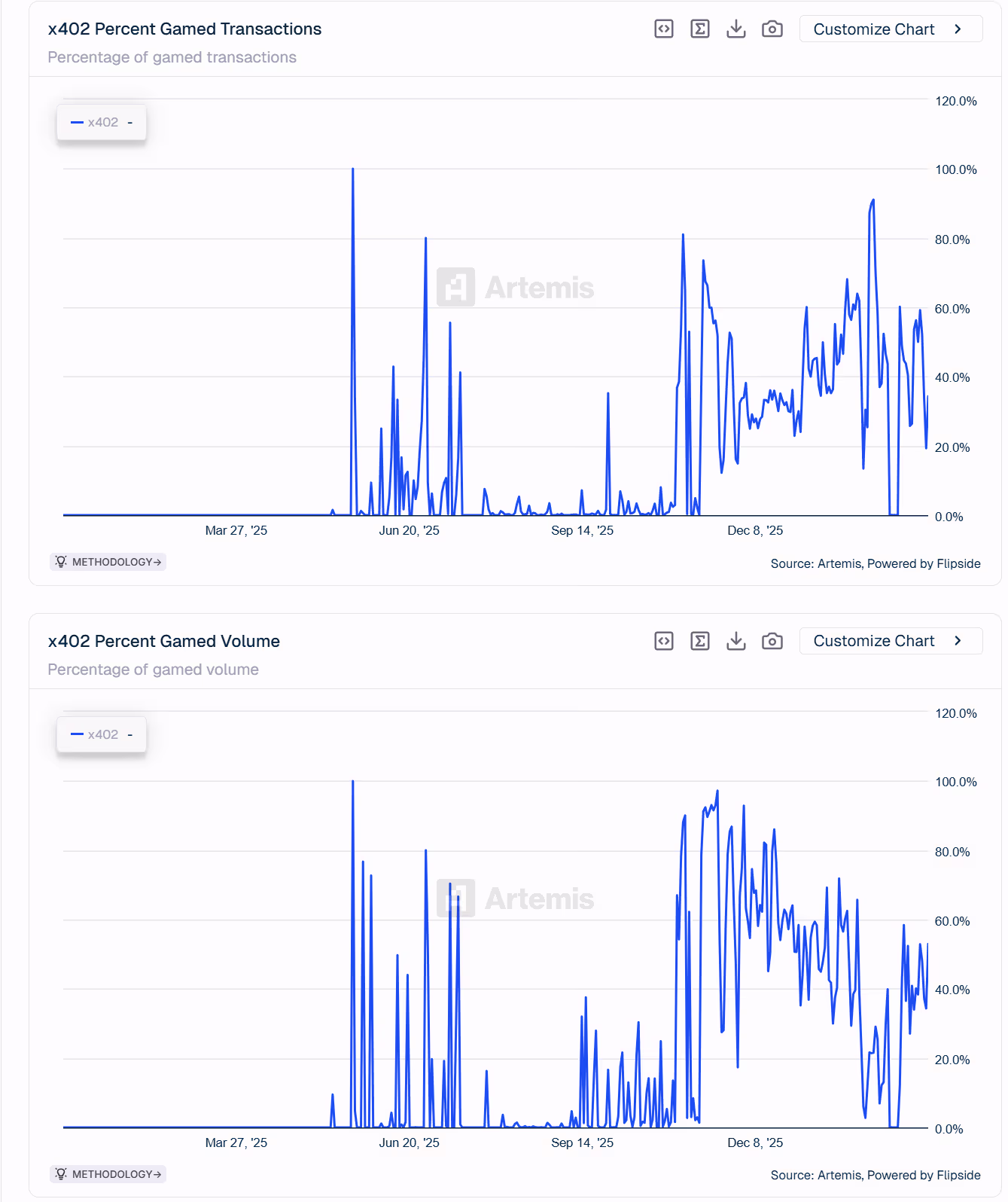
Recent daily data indicates approximately 131,000 transactions yielding around $28,000 in volume, with the average payment amounting to roughly $0.20.
The network has experienced spikes in activity, including a day in February that recorded 3.8 million transactions and about $2 million in volume. However, on-chain analysts at Artemis attribute much of that surge to infrastructure testing and experimental use.
Artemis classifies these “gamed” transactions into two categories: self-dealing, where the same wallet functions as both buyer and seller, and wash trading, where the seller finances the buyer’s wallet, which then returns the funds immediately after the transaction.
In essence, a significant portion of the traffic utilizing the protocol currently does not resemble actual commerce.
Nonetheless, in the initial phases of network testing, such transaction types are to be anticipated. “As teams transition from testing to production and begin catering to real users, these percentages should naturally decrease,” Artemis noted.
“Open standards like x402 are intended to be permissionless and open, meaning no single entity governs every interaction – similar to how no one ‘controls’ every computer utilizing HTTP. Naturally, this implies that individuals will experiment with the system in sometimes unintended manners,” Erik Reppel, Head of Engineering for Coinbase Developer Platform and Founder of x402, stated to CoinDesk.
A $7 billion ecosystem?
This divergence between what is genuine and what constitutes “gamed” transactions can render the ecosystem seemingly less impressive at first glance.
Examining the total market capitalization of the ecosystem (the cumulative value of all tokens and projects within a network, distinct from the overall market cap of the network’s token, as there is currently no token for x402), which stands at around $7 billion, appears misaligned with approximately $28,000 in daily payment volume.
Given this disparity, some may be inclined to dismiss the premise as unrealistic, akin to past crypto gaming ventures that boasted substantial valuations but attracted few users.
However, CoinGecko’s categorization should not be interpreted literally, as it includes Chainlink’s LINK token, which boasts a market cap of $6.3 billion. LINK does not serve as a dedicated x402 asset.
While Chainlink supports the protocol through integrations like its Chainlink Runtime Environment, LINK predates x402 and has a far broader role across various crypto infrastructures. Its presence in the category artificially inflates it, raising expectations excessively for such a nascent protocol.
Still early?
Adjusting for the significant contribution from the LINK token’s market cap, the ecosystem may appear more in line with the reality of the transactions, yet the primary challenge persists: the merchants that x402 is intended to support are still uncommon.
The x402 protocol is not designed to replace traditional cards or payment systems. Rather, it targets a new segment of digital commerce — small automated services utilized by AI agents and software systems.
As AI tools simplify the process of building and launching software, an increasing number of developers are creating small, single-purpose services — data feeds, image processors, code-testing tools — intended to be used not by humans, but by other software.
And this development requires time.
“At its essence, it’s a micropayments rail,” an Artemis analyst stated. “Its true value becomes apparent at small transaction sizes, facilitating pay-per-use APIs, content generation, and agent coordination.
For the moment, however, those merchants remain scarce at this stage of this emerging agentic commerce
