Disclaimer: Information found on CryptoreNews is those of writers quoted. It does not represent the opinions of CryptoreNews on whether to sell, buy or hold any investments. You are advised to conduct your own research before making any investment decisions. Use provided information at your own risk.
CryptoreNews covers fintech, blockchain and Bitcoin bringing you the latest crypto news and analyses on the future of money.

Coinbase confronts a multibillion-dollar challenge from Washington, D.C., yet a ‘rewards’ loophole may safeguard its stablecoin earnings.

The suggested regulations could prohibit yield on stablecoins such as USDC, although analysts indicate that the exchange might adjust accordingly.
 Coinbase CEO Brian Armstrong (David Dee Delgado/Getty Images)
Key points:
- A proposed CLARITY Act in Congress may prevent stablecoin issuers from offering interest directly to holders, potentially affecting one of the methods Coinbase uses to encourage customers to retain digital dollars on its platform.
- Existing loopholes in the bill’s language may still permit exchanges like Coinbase to provide yield-like rewards through marketing incentives, payments based on user activity, or partnerships with issuers, creating ambiguity between interest and rewards.
- Analysts suggest that while stablecoin incentives are strategically significant, they are not critical for Coinbase, whose primary revenue remains transaction-based, and they anticipate that the company and the wider industry will adjust even if stringent yield restrictions are implemented.
If legislators ultimately prohibit stablecoin rewards under the proposed CLARITY Act, Coinbase (COIN) may lose a tactic it utilizes to entice users to maintain digital dollars on its platform, although analysts believe the effect on the exchange’s operations may be minimal.
As lawmakers deliberate the future of stablecoin regulation in Washington, an unresolved aspect of the proposed CLARITY Act could have major ramifications for Coinbase and other stablecoin associates’ business models: whether companies will be permitted to distribute yield to stablecoin holders.
The bill, which has been stalled in Congress since January, aims to create a regulatory framework for stablecoins — digital tokens usually tied to the U.S. dollar. A key point of dispute is whether cryptocurrency firms should be allowed to pass on the yield earned from the reserves that back those tokens. Banks and some legislators have advocated for a ban on interest payments, while crypto firms, including Coinbase, have contended that restricting rewards would diminish the utility and competitiveness of stablecoins.
However, this week brought some signs of optimism from D.C. One potential agreement could involve stablecoin issuers and their partners adjusting the wording of their offerings to distinguish them from bank deposits, Senator Cynthia Lummis remarked on Wednesday.
Read more: Key U.S. senator on crypto market structure bill negotiation: ‘We think we’ve got it’
Nonetheless, for Coinbase, the issue is significant because stablecoins, especially USD Coin (USDC), have become a crucial source of revenue and user interaction.
According to the current draft of the CLARITY Act, stablecoin issuers would be prohibited from paying interest directly to holders. However, a source from the industry familiar with the legislation, who requested anonymity, indicated that the language allows for alternative structures that might still enable rewards to reach users.
“There are numerous loopholes in the CLARITY Act regarding stablecoin yields that suggest the situation is already somewhat established,” the source told CoinDesk. While the bill forbids issuers from providing interest, it does not explicitly prevent exchanges or platforms from distributing incentives such as rebates, credits, or other rewards.
The distinction between “interest” and “rewards” is subtle, the source noted. Marketing incentives or loyalty programs could effectively replicate the economic benefits of yield while technically adhering to regulations. This aligns with ongoing discussions regarding guidance related to the GENIUS Act, where the boundary between restricting yield and determining how it can be allocated through partners remains ambiguous.
Another clause in the bill might further complicate enforcement. The legislation includes an exception for payments linked to activity — suggesting that yield could potentially be allocated if a stablecoin is utilized in transactions, lending, or other financial activities. In practice, this could enable structures where stablecoins are funneled through decentralized finance protocols to generate returns before those rewards are distributed to users.
Even collaborations between issuers and exchanges could potentially yield a similar outcome. For instance, an issuer might earn yield on Treasury reserves, share part of that income with an exchange partner, and have the exchange distribute rewards to users — a setup that regulators have cautioned might be seen as evasion but is not explicitly prohibited in the current version of the bill.
“It appears that even a moderately skilled marketing professional could devise several innovative structures that would remain compliant,” the source stated.
Related Posts
Not ‘existential’
Wall Street analysts indicate that the ongoing discussion has ramifications for Coinbase but is unlikely to jeopardize the company’s overall business model.
Owen Lau, an analyst at Clear Street, mentioned that the capacity to share stablecoin yield is merely one of many avenues the company employs to draw users to its platform.
“It’s important, but it’s not at all existential,” Lau stated. Coinbase already generates income from trading, derivatives, and its Base blockchain ecosystem, and numerous users are attracted to the platform for services beyond stablecoin rewards.
In 2025, transaction revenue continued to be the exchange’s primary source of income, although stablecoin revenue had surged significantly from the previous year, totaling $1.35 billion in 2025 compared to $910 million in 2024, making it the second-largest revenue contributor, as per a recent filing.
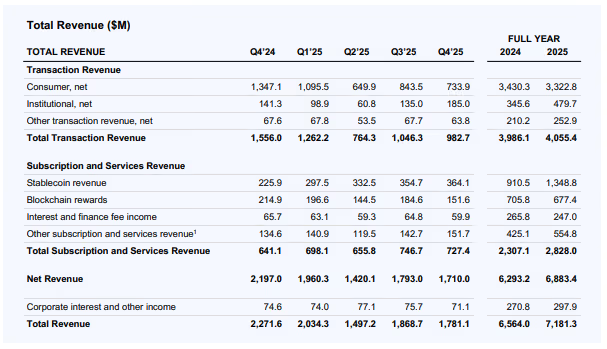 Coinbase’s 2025 revenue (Coinbase)
Coinbase, however, has a somewhat different perspective on this matter.
"Ironically, if a ban on crypto rewards were to become law, it would enhance our profitability since we currently pay out substantial amounts in rewards to our customers holding USDC," Coinbase CEO Brian Armstrong mentioned in a post on X in February. "However, we do not wish for this to occur; it is more beneficial for customers to receive rewards, and it is advantageous for the U.S. to maintain competitive regulated stablecoins on a global scale."
Stablecoin incentives do serve a strategic purpose, however.
Clear Street’s Lau noted that Coinbase gains when customers retain USDC on its platform since the company can capture the entirety of the yield generated by the reserves supporting the token. Should users transfer those assets to external wallets or decentralized platforms, Coinbase may only receive a fraction of that revenue.
“If they fail to provide sufficient incentives for customers, these individuals may relocate USDC away from Coinbase wallets,” Lau stated, which could diminish the company’s share of stablecoin-related earnings.
Simultaneously, the immediate financial impact may be limited. Lau observed that Coinbase largely transmits stablecoin yield to users, meaning the revenue is frequently balanced out by costs.
“From an earnings standpoint, it actually doesn’t alter much,” he said, adding that the more significant concern is whether restrictions might hinder the long-term growth of USDC adoption.
If the final regulations permit activity-based rewards or loyalty-style incentives, Lau indicated that Coinbase could still leverage those initiatives to motivate customers to hold and utilize USDC on its platform, potentially boosting the stablecoin’s market capitalization and increasing the revenue Coinbase shares with Circle.
For now, the outcome is uncertain as lawmakers continue to negotiate the bill’s provisions.
Nonetheless, even if stringent yield limits are upheld, analysts and industry stakeholders believe that crypto firms are likely to adapt, ensuring that stablecoins continue to be a competitive aspect of the digital payments landscape.
Coinbase shares have declined by approximately 12% year-to-date, while bitcoin has dropped 19%.
