Disclaimer: Information found on CryptoreNews is those of writers quoted. It does not represent the opinions of CryptoreNews on whether to sell, buy or hold any investments. You are advised to conduct your own research before making any investment decisions. Use provided information at your own risk.
CryptoreNews covers fintech, blockchain and Bitcoin bringing you the latest crypto news and analyses on the future of money.


Billionaire Venture capitalist raises issues regarding privacy and fungibility, as discussions intensify over corporate bitcoin strategies including Strategy’s substantial holdings.
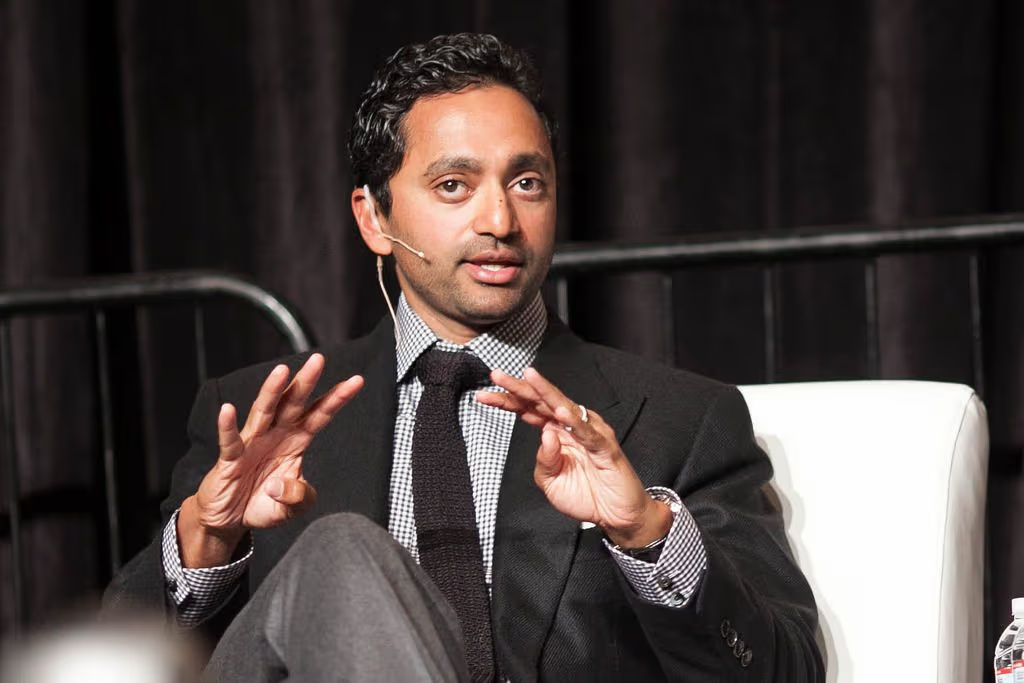 Chamath Palihapitiya questions bitcoin’s potential (JD Lasica/Flickr Creative Commons)
What to know:
- Chamath Palihapitiya contends that bitcoin does not possess the privacy and fungibility necessary for central banks to retain it as a structural reserve asset, asserting that gold better fulfills those requirements.
- In a separate podcast conversation, Erik Voorhees defended Strategy’s method of accumulating bitcoin, while investor Jason Calacanis expressed concerns regarding intricate financial metrics and transparency.
Billionaire investor Chamath Palihapitiya, a venture capitalist and former Facebook executive, recently claimed that bitcoin has a “structural failing” that may hinder its long-term acceptance by governments and central banks.
During an appearance on the People by WTF podcast at the World Government Summit, Palihapitiya stated that for a digital asset to gain widespread acknowledgment at the sovereign level, it must embody characteristics that qualify it for central bank reserves.
Palihapitiya indicated that bitcoin is inadequate in two critical aspects: privacy and fungibility. Fungibility pertains to the principle that each unit of an asset is interchangeable and indistinguishable from another. With physical currency or gold, one unit is practically identical to another.
In contrast, bitcoin functions on a transparent blockchain where transaction records are permanently stored. As coins can be traced back through previous transactions, some units may become linked to illicit activities, leading to certain coins being treated differently from others.
Related Posts
Palihapitiya asserts that this traceability diminishes bitcoin’s fungibility and undermines its viability as a reserve asset for central banks.
So far, only one central bank, the Czech National Bank, has publicly acknowledged acquiring bitcoin.
In comparison, he notes that gold meets both privacy and fungibility standards for sovereign entities, which is why central banks maintain significant gold reserves.
Consequently, Palihapitiya suggested that bitcoin may find it challenging to achieve another tenfold increase in market capitalization driven by central bank interest. Instead, he hinted that alternative crypto projects or smaller tokens could eventually overcome these obstacles.
Palihapitiya remains positive about advancements in digital finance, particularly stablecoins, which are cryptocurrencies intended to maintain a stable value by being linked to assets such as the US dollar or commodities.
He highlighted the potential for gold-backed stablecoins as an instance of financial innovation that could minimize friction in payments and settlements.
Meanwhile, Jason Calacanis, another venture investor and co-host of the All In podcast, engaged in discussions about bitcoin-related corporate strategies with crypto entrepreneur Erik Voorhees on the This Week in Startups podcast. Calacanis inquired about Strategy (MSTR), formerly MicroStrategy, the public company recognized for holding the largest corporate treasury of bitcoin.
Voorhees, a long-time Bitcoin supporter and founder of the crypto exchange ShapeShift, stated that the approach of acquiring as much bitcoin as possible makes sense if the company firmly believes in bitcoin’s long-term value. Calacanis expressed more skepticism, noting that when financial structures become difficult to articulate or depend on new metrics, such as “community EBITDA,” it raises concerns for him as an investor.
This follows hedge fund billionaire Ray Dalio’s recent assertion that “there is only one gold.”
