Disclaimer: Information found on CryptoreNews is those of writers quoted. It does not represent the opinions of CryptoreNews on whether to sell, buy or hold any investments. You are advised to conduct your own research before making any investment decisions. Use provided information at your own risk.
CryptoreNews covers fintech, blockchain and Bitcoin bringing you the latest crypto news and analyses on the future of money.


Russia, Iran, and North Korea have increased their utilization of stablecoins, hacked assets, and state-affiliated exchanges to transfer over $100 billion on-chain in an effort to circumvent international sanctions.
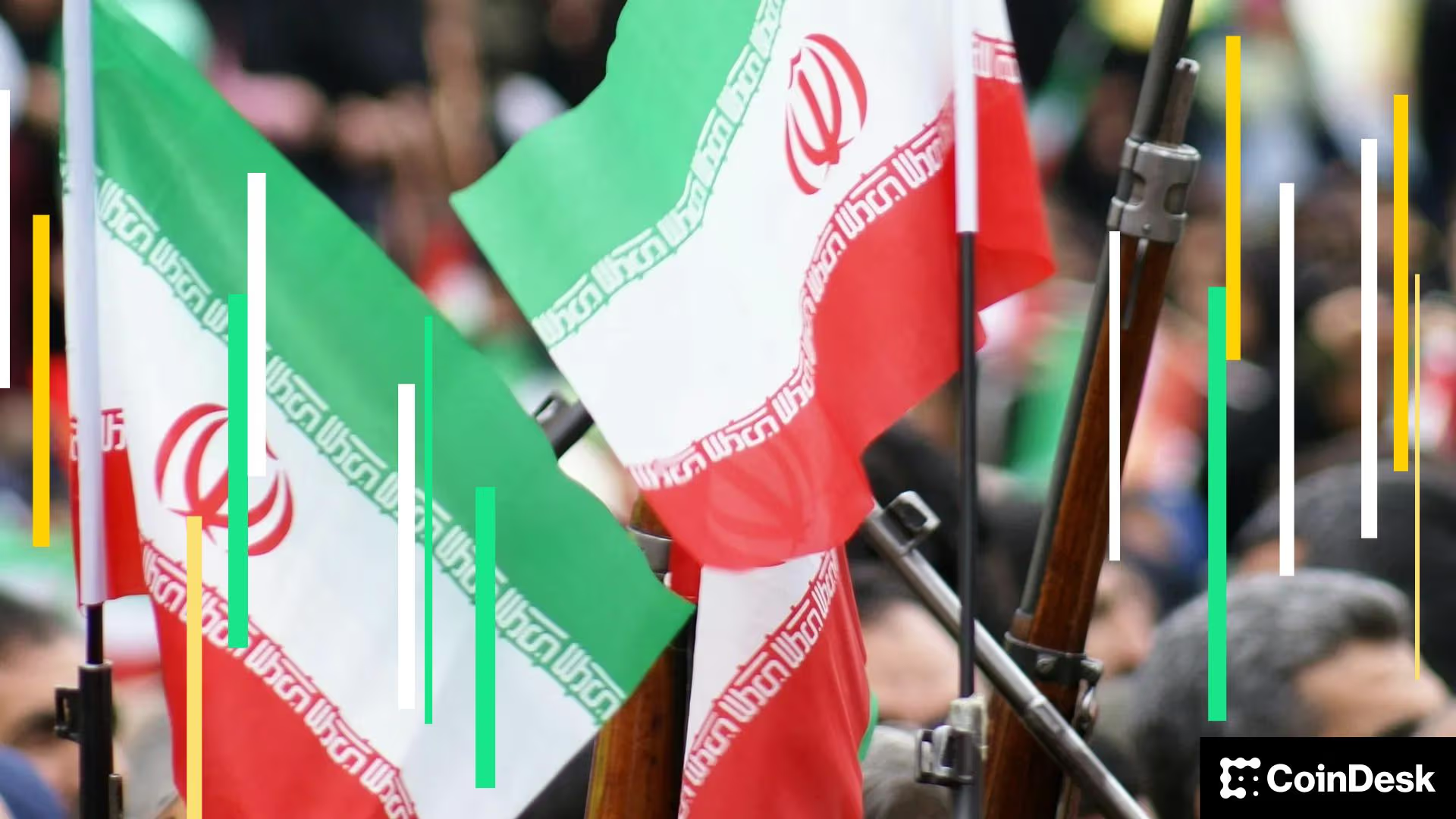 Chainalysis has published a recent report on how states under Western sanctions are using cryptocurrency for evasion. (Seyed Gholamreza Nematpour-Unsplash/Modified by Coindesk)
What to know:
- According to Chainalysis, the evasion of sanctions by state actors such as Russia, Iran, and North Korea has led to unprecedented levels of illicit finance associated with cryptocurrency in 2025.
- The ruble-pegged stablecoin A7A5 serves as a key channel for sanctioned Russian companies, facilitating over $93 billion in transactions, the report stated.
- Stablecoins represent approximately 84% of the total volume of illicit cryptocurrency transactions, as entities like Iran’s Islamic Revolutionary Guard Corps and hackers from North Korea increasingly depend on these assets to transfer billions.
According to Chainalysis, sanctions evasion was a significant factor in the rise of crypto-related illicit finance last year, with state actors including Russia, Iran, and North Korea contributing to increased activity, as detailed in a report released on Thursday.
Sanctioned groups received a minimum of $104 billion in cryptocurrency, marking an almost eightfold rise from 2024, thereby elevating the overall illicit on-chain volume to an all-time high of $154 billion. The results illustrate how heavily sanctioned nations are incorporating cryptocurrency into their national financial frameworks to sidestep conventional banking systems.
Chainalysis’ report follows a related analysis by TRM Labs, which noted in February that illicit entities acquired $141 billion in stablecoins, the highest amount recorded in five years. TRM indicated that sanctions-related transactions comprised 86% of these flows, mainly in stablecoins, with approximately 50% of the total, or $72 billion, associated with the A7A5 token registered in Kyrgyzstan, a ruble-pegged stablecoin.
Related Posts
Chainalysis’ 88-page report identified A7A5 as a significant player, stating that it managed $93.3 billion in transactions within less than a year, acting as a settlement mechanism for sanctioned Russian businesses to engage in cross-border trade. The token is linked to exchanges Grinex and Meer, which processed billions in transactions before facing sanctions from the U.S. and EU.
Chainalysis pointed out an “A7A5 Instant Swapper” service that exchanges the token for mainstream dollar-pegged stablecoins with minimal or no know-your-customer (KYC) verification. This service has handled over $2.2 billion thus far, effectively allowing sanctioned entities to connect with the broader crypto market, according to the report.
“These Chainalysis statements are not new for us. They are politically motivated by Western countries,” stated Oleg Ogienko, A7A5’s director for regulatory and overseas affairs, in a communication with Coindesk via Telegram. “We primarily provide payment solutions extensively for Russian export and import activities. It is fully legal and adheres to the laws of Russia, Kyrgyzstan, and the regulations of other nations that are trade partners with Russia.”
Ogienko also highlighted that A7A5 has advanced KYC and anti-money laundering (AML) measures and adheres to regulatory standards. Additionally, he noted that the ruble-pegged stablecoin is not referenced in any global Financial Action Task Force (FATF) reports.
Iran has also increased its engagement with cryptocurrency. By late 2025, addresses associated with the Islamic Revolutionary Guard Corps (IRGC), which has been designated a terrorist organization by the U.S., EU, and other jurisdictions, accounted for over 50% of the value received by Iranian services, moving more than $3 billion linked to regional proxy financing, oil trade, and procurement networks.
North Korea continued to be the most active actor in cyber theft, according to Chainalysis, having stolen over $2 billion in cryptocurrency in 2025, including $1.5 billion from a breach of Bybit, marking the largest digital asset theft ever recorded.
The report further emphasizes a fundamental change in crypto crime dynamics. Stablecoins now constitute roughly 84% of illicit transaction volume, indicating that sanctioned actors are increasingly depending on liquid, dollar-pegged assets to transfer funds across borders.
