Disclaimer: Information found on CryptoreNews is those of writers quoted. It does not represent the opinions of CryptoreNews on whether to sell, buy or hold any investments. You are advised to conduct your own research before making any investment decisions. Use provided information at your own risk.
CryptoreNews covers fintech, blockchain and Bitcoin bringing you the latest crypto news and analyses on the future of money.


Warren Buffett and Bill Ackman are among the most prominent investors globally, yet they have adopted contrasting perspectives on the bond market in recent months.
Only one can be correct. Billionaire investor Bill Ackman has stated that he is shorting US Treasuries. If long-term inflation is 3% instead of 2%, the 30-year Treasury yield could increase to 5.5%. Conversely, Warren Buffett has revealed that he is purchasing 10-year US Treasuries. Shorting US 10-year bonds appears… pic.twitter.com/X2zSPzJ91Y
— Holger Zschaepitz (@Schuldensuehner) August 5, 2023
Buffett has been acquiring short-term Treasury bills, while Ackman has been shorting long-term Treasury bonds. Is it possible for both investors to be correct?
Buffett serves as the chairman and CEO of Berkshire Hathaway, one of the largest investment holding firms in the world. His net worth is estimated to exceed $100 billion. Ackman is an American hedge fund manager, activist investor, and the founder and CEO of Pershing Square Capital Management, a hedge fund managing over $20 billion in assets.
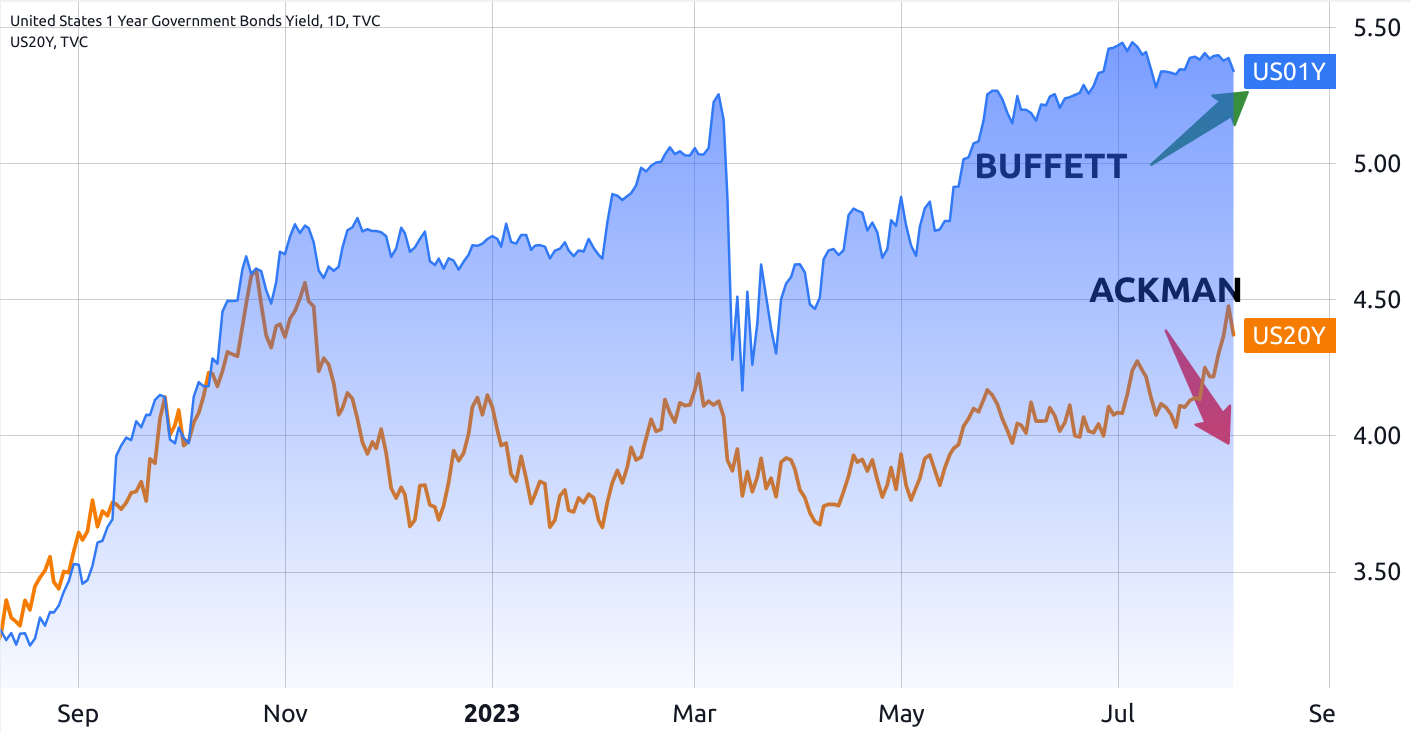 U.S. Treasury 1-year yield vs. 20-year yield. Source: TradingView and Cointelegraph
There exists the potential for short-term and long-term interest rates to diverge. For instance, if the Federal Reserve increases short-term rates to tackle inflation, long-term rates might decrease. This scenario would favor Buffett, who is investing in short-term bonds, but would be disadvantageous for Ackman, who is shorting long-term bonds.
Another possibility is that Buffett and Ackman are simply interpreting the risk of inflation differently. Buffett posits that inflation is not a significant threat and views short-term Treasury bills as a safe refuge from market fluctuations. In contrast, Ackman contends that inflation poses a serious risk and that long-term Treasury bonds are overvalued.
Buffett and Ackman may both achieve their objectives
It is conceivable that both Buffett and Ackman could be correct, at least in the short term, suggesting that both short-term and long-term rates might rise. This could occur if the Federal Reserve raises interest rates to combat inflation, yet the market doubts the Fed’s ability to sufficiently curb inflation.
In this scenario, Buffett would gain from his short-term Treasury bill investments, while Ackman would benefit from his short position on long-term Treasury bonds. This possibility is reinforced by the fact that the correlation between bond and stock prices has approached a record high in recent months.
Related Posts
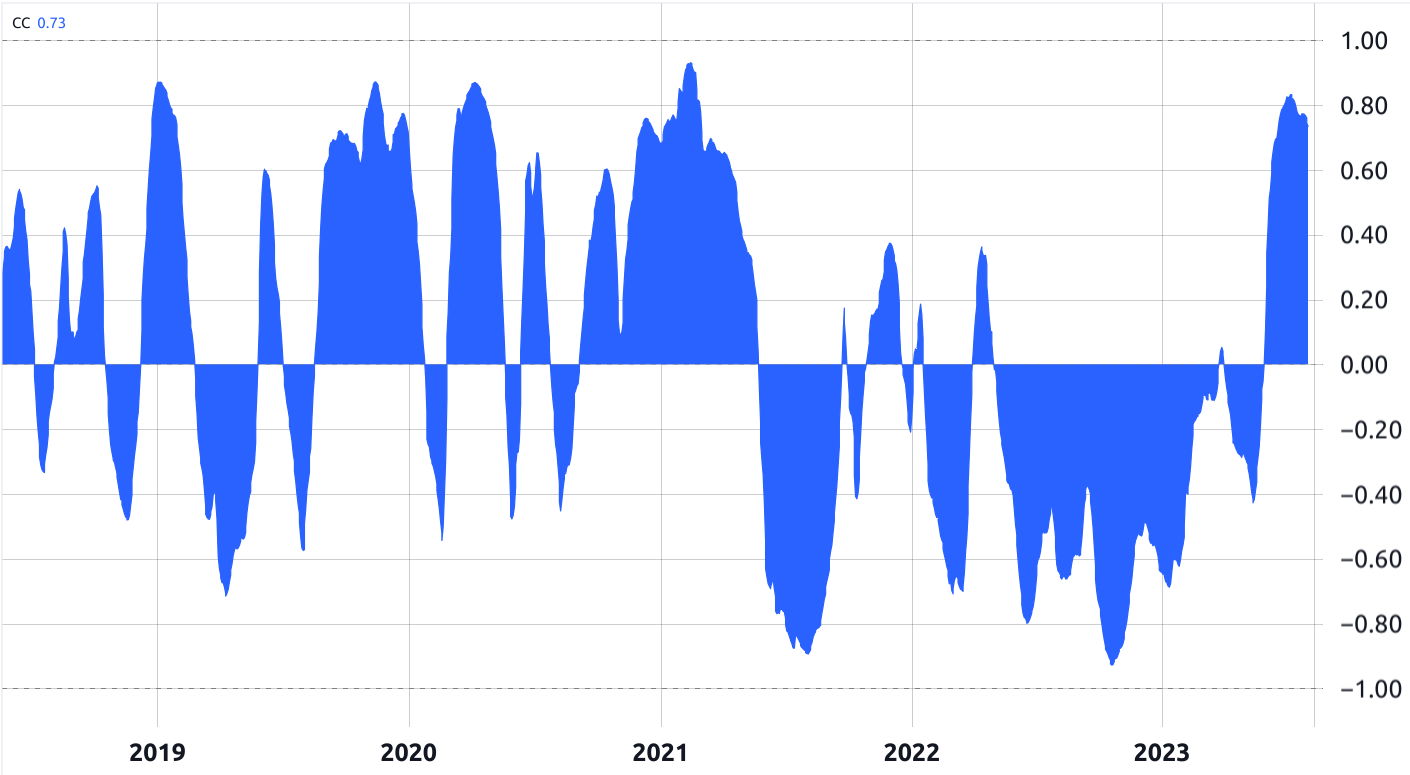 S&P 500 correlation to the U.S. 10-year Treasury yield (50 days). Source: TradingView
This indicates that as bond prices decline, stock prices are likely to rise, likely due to investors selling bonds and purchasing stocks in anticipation of higher interest rates.
When geniuses falter — Could both investors be mistaken?
It is also possible that both Buffett and Ackman could be incorrect. This scenario would occur if short-term and long-term rates move in the same direction. This would happen if the market believes that the Fed can raise rates sufficiently to significantly reduce inflation. In this case, both Buffett and Ackman would likely incur losses on their respective investments.
Only time will reveal how this discussion unfolds, and there is no straightforward answer to the question of who is correct. Investors should consider the differing investment strategies employed by Buffett and Ackman. Buffett is a value investor, while Ackman is a short-seller. These distinct strategies could significantly influence the performance of their respective investments.
What about the effects on crypto markets?
The U.S. Treasury curve, particularly the spread between the one-year and 20-year notes, has substantial implications for the wider financial ecosystem, which can indirectly affect the sentiment of Bitcoin (BTC) investors.
A steepening curve, where long-term rates increase more rapidly than short-term rates, often indicates expectations of future economic growth and the potential for rising inflation. In such an environment — if both Buffett and Ackman are incorrect — Bitcoin could be viewed as a hedge against inflation, enhancing its appeal.
For Bitcoin investors, a flattening curve — suggesting that both Buffett and Ackman are correct — reflects concerns regarding future economic growth and heightened uncertainty and volatility in traditional markets. This would lead investors to decrease their exposure to cryptocurrencies, as many consider it a speculative asset.
This article is for informational purposes only and is not intended to be and should not be construed as legal or investment advice. The views, thoughts, and opinions expressed herein are solely those of the author and do not necessarily reflect or represent the views and opinions of Cointelegraph.
