Disclaimer: Information found on CryptoreNews is those of writers quoted. It does not represent the opinions of CryptoreNews on whether to sell, buy or hold any investments. You are advised to conduct your own research before making any investment decisions. Use provided information at your own risk.
CryptoreNews covers fintech, blockchain and Bitcoin bringing you the latest crypto news and analyses on the future of money.

BlackRock is investing billions in the belief that tokenized funds will transform Wall Street similarly to how the internet revolutionized mail.

In his yearly correspondence, BlackRock CEO Larry Fink asserts that digital wallets and tokenized assets have the potential to modernize markets and enhance investor access.
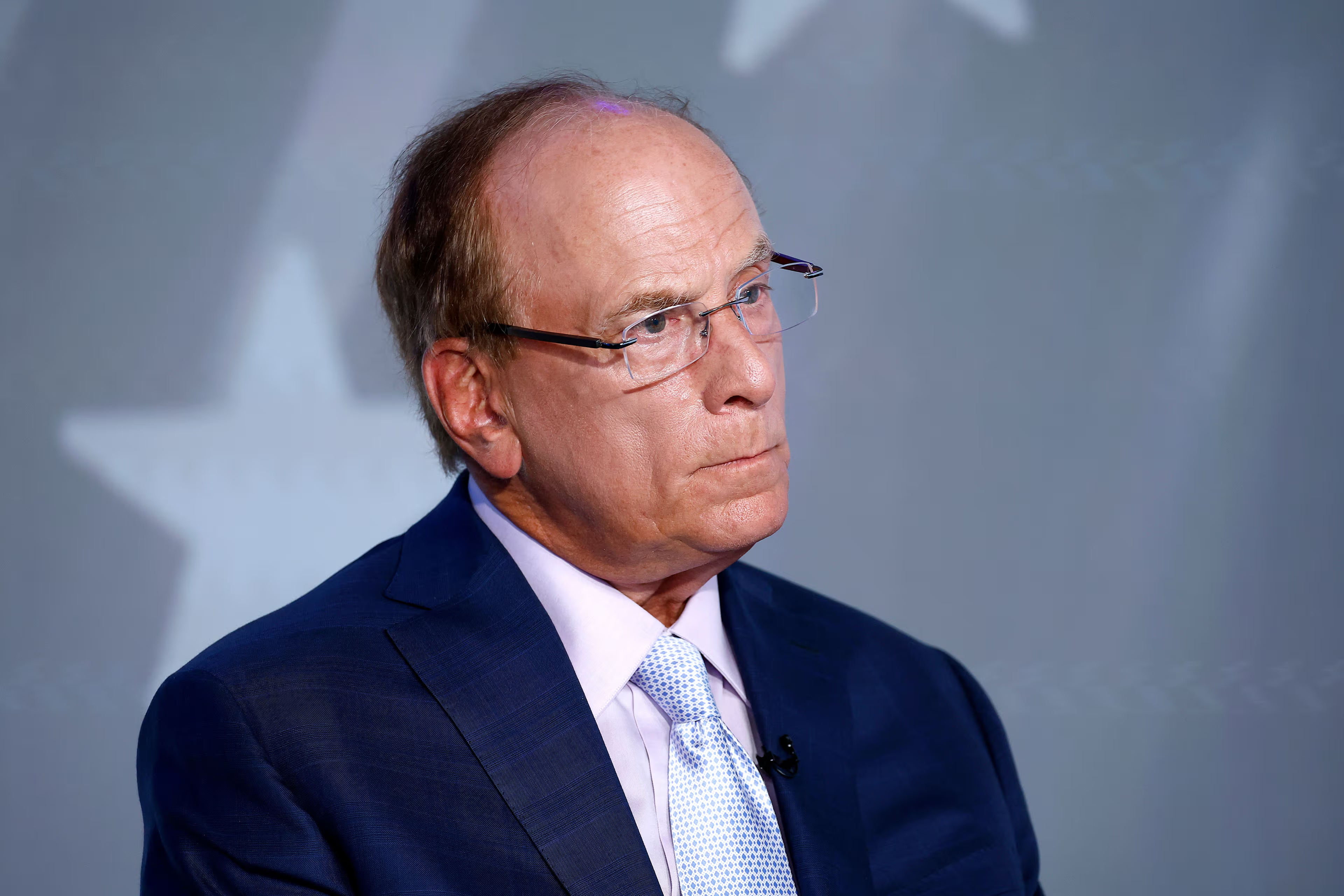 BlackRock CEO Larry Fink (Paul Morigi/Getty Images)
What to know:
- BlackRock chief Larry Fink utilized his annual letter to shareholders to assert that tokenization and digital assets have the capacity to modernize the financial system, while cautioning that U.S. capitalism is failing numerous workers.
- Fink stated that documenting asset ownership on digital ledgers and employing regulated digital wallets could facilitate the issuance, trading, and accessibility of investments more swiftly, cost-effectively, and broadly.
- He positioned tokenization as part of a larger initiative to tackle inequality and strained public finances, highlighting BlackRock’s expanding digital asset business and advocating for clear regulations on investor protections, counterparty risk, and digital identity.
BlackRock Chairman and CEO Larry Fink leveraged his annual letter to shareholders to propose that digital assets and tokenization could assist in modernizing the financial system, despite expressing concerns that the U.S. economic framework is leaving a significant number of individuals behind.
In the correspondence, Fink remarked that the existing system has predominantly benefited those who already possess assets, while many workers have been excluded from market growth. He linked this disparity to a broader issue in the U.S., where increasing inequality, substantial government debt, and limited participation in capital markets are exerting pressure on the traditional financial model.
“Capitalism is functioning—just not for enough individuals,” Fink stated.
His suggested solution revolved around tokenization and digital distribution as means to broaden investment access and enhance market efficiency.
Tokenization, according to Fink, could “modernize the infrastructure of the financial system” by simplifying the processes of issuing, trading, and accessing investments.
Related Posts
The concept is straightforward: If asset ownership is recorded on digital ledgers, transferring a fund share, bond, or another security could become more rapid and less expensive. In practice, this would enable a regulated digital wallet to not only manage payments but also hold tokenized bonds, ETFs, and fractional interests in assets such as infrastructure or private credit.
“Half the world’s population carries a digital wallet on their phone,” Fink mentioned. “Envision if that same digital wallet could also allow you to invest in a diverse array of companies for the long term—as easily as sending a payment.”
Fink likened the current state of tokenization to the internet in 1996, suggesting that it will not instantly replace traditional finance but could gradually link established and new systems. He urged policymakers to concentrate on constructing that connection “as swiftly and securely as possible” and advocated for clear buyer protections, counterparty-risk standards, and digital identity verification to mitigate risks associated with illicit finance.
These remarks contribute to BlackRock’s broader initiative in digital assets. In the same letter, Fink indicated that the firm has established “early leadership” in this domain, citing almost $150 billion in assets related to digital markets.
BlackRock’s USD Institutional Digital Liquidity Fund (BUIDL) is recognized as the largest tokenized fund globally, and the firm also oversees $65 billion in stablecoin reserves and nearly $80 billion in digital asset exchange-traded products.
However, much of the letter emphasized deeper challenges facing the U.S. financial system. Fink cautioned that banks, corporations, and governments can no longer independently finance significant economic transitions, especially as the nation seeks to rebuild manufacturing capabilities, broaden energy supply, and compete in the field of artificial intelligence.
He also contended that Social Security serves as a vital safety net but may require structural reform, including exposure to long-term market returns, to ensure sustainability.
For Fink, tokenization is part of that larger vision. It represents not a gamble on hype, but a belief that improved infrastructure could enable a greater number of individuals to become investors rather than mere observers.
His overarching message was that finance requires modernization, and that digital assets could play a key role in that transformation.
