Disclaimer: Information found on CryptoreNews is those of writers quoted. It does not represent the opinions of CryptoreNews on whether to sell, buy or hold any investments. You are advised to conduct your own research before making any investment decisions. Use provided information at your own risk.
CryptoreNews covers fintech, blockchain and Bitcoin bringing you the latest crypto news and analyses on the future of money.

Bitcoin’s inflation-hedging hypothesis examined as increasing interest rates create market volatility.

The U.S. economy has been undergoing challenging conditions recently, with the U.S. personal consumption expenditure (PCE) inflation index increasing by a notable 3.5% over the last year. Even when the volatile food and energy sectors are excluded, it is clear that the U.S. Federal Reserve’s attempts to control inflation have not achieved their 2% target rate.
U.S. Treasuries have seen a dramatic loss of $1.5 trillion in value, largely attributed to these interest rate hikes. This situation has led investors to speculate whether Bitcoin (BTC) and risk-sensitive assets, such as the stock market, will be adversely affected by rising interest rates and a monetary policy designed to temper economic growth.
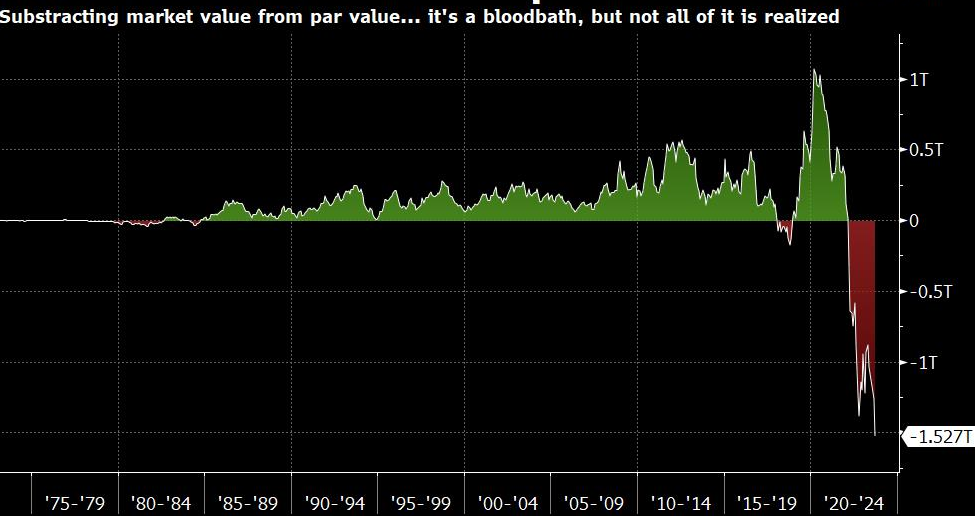 Theoretical losses of U.S. Treasury holders, USD. Source: @JoeConsorti
As the U.S. Treasury continues to inundate the market with debt, there is a genuine risk that rates could escalate further, intensifying the losses for fixed-income investors. An additional $8 trillion in government debt is anticipated to mature within the next year, further heightening financial instability.
As Daniel Porto, the head of Deaglo London, noted in comments to Reuters:
"(The Fed) is going to play a game where inflation is going to lead, but the real question is can we sustain this course without doing a lot of damage?"
Porto’s remarks reflect a growing apprehension in financial circles—a concern that the central bank might tighten its policies to such an extent that it triggers significant disruptions within the financial system.
High interest rates eventually have devastating consequences
A key factor contributing to the recent upheaval in financial markets is the increase in interest rates. As rates rise, the values of existing bonds decline, a phenomenon referred to as interest rate risk or duration. This risk is not confined to specific entities; it impacts nations, banks, corporations, individuals, and anyone holding fixed-income securities.
Related Posts
The Dow Jones Industrial Index has recorded a 6.6% decline in September alone. Furthermore, the yield on U.S. 10-year bonds reached 4.7% on Sept. 28, the highest level since August 2007. This rise in yields indicates that investors are becoming more reluctant to assume the risk of holding long-term bonds, including those issued by the government.
Banks, which typically borrow through short-term instruments and lend over the long term, are particularly susceptible in this climate. They depend on deposits and often maintain Treasuries as reserve assets.
When Treasuries depreciate, banks may find themselves lacking sufficient funds to fulfill withdrawal demands. This situation forces them to liquidate U.S. Treasuries and other assets, bringing them perilously close to insolvency and necessitating intervention from entities like the FDIC or larger banks. The failures of Silicon Valley Bank (SVB), First Republic Bank, and Signature Bank highlight the instability within the financial system.
Federal Reserve shadow intervention could near exhaustion
While emergency measures such as the Federal Reserve’s BTFP emergency loan program can offer some assistance by permitting banks to use impaired Treasuries as collateral, these actions do not eliminate the losses.
Banks are increasingly transferring their holdings to private credit and hedge funds, inundating these sectors with rate-sensitive assets. This trend is likely to escalate if the debt ceiling is raised to prevent a government shutdown, further increasing yields and exacerbating losses in the fixed-income markets.
As long as interest rates remain elevated, the potential for financial instability increases, prompting the Federal Reserve to bolster the financial system through emergency credit lines. This situation is particularly advantageous for scarce assets like Bitcoin, given the rising inflation and the deteriorating profile of the Federal Reserve’s balance sheet as indicated by the $1.5 trillion in paper losses in U.S. Treasuries.
Timing this occurrence is nearly impossible, not to mention the implications if larger banks consolidate the financial system or if the Federal Reserve effectively guarantees liquidity for distressed financial institutions. Nonetheless, there is hardly a scenario where one would view Bitcoin unfavorably under such conditions.
This article is for informational purposes only and is not intended to be and should not be construed as legal or investment advice. The views, thoughts, and opinions expressed herein are solely those of the author and do not necessarily reflect or represent the views and opinions of Cointelegraph.
