Disclaimer: Information found on CryptoreNews is those of writers quoted. It does not represent the opinions of CryptoreNews on whether to sell, buy or hold any investments. You are advised to conduct your own research before making any investment decisions. Use provided information at your own risk.
CryptoreNews covers fintech, blockchain and Bitcoin bringing you the latest crypto news and analyses on the future of money.

Bitcoin’s hashrate experiences a decline in the first quarter for the first time in six years as miners shift focus to artificial intelligence.

The decline in the first quarter interrupts a prolonged trend of growth, but may ultimately foster decentralization as publicly traded U.S. miners risk losing their leading position.
 The bitcoin mining hashrate experienced a decline in the first quarter. (Mark Agnor/Shutterstock)
Key points:
- Bitcoin’s hashrate has decreased by approximately 4% this year, marking the first decline in the first quarter since 2020, after a continuous period of five years with double-digit growth.
- As the economics of mining worsen, companies are shifting investments toward AI infrastructure, a transition that may lessen the concentration among major U.S. miners and enhance network decentralization.
In this article
 SUSHI$0.1957◢3.59%
 COMP$18.17◢0.55%
 AAVE$98.96◢3.73%
For the first time in six years, the bitcoin hashrate, which signifies the overall computational capacity securing the network, decreased during the first quarter. It is currently down about 4% year to date, remaining around 1 zettahash per second (ZH/s).
Related Posts
Over the last five years, this rate has escalated from about 100 exahashes per second (EH/s), representing a tenfold increase, according to Glassnode data. Each year, this metric saw an increase during the first quarter and concluded with robust annual growth exceeding 10%. In 2022, it nearly doubled.
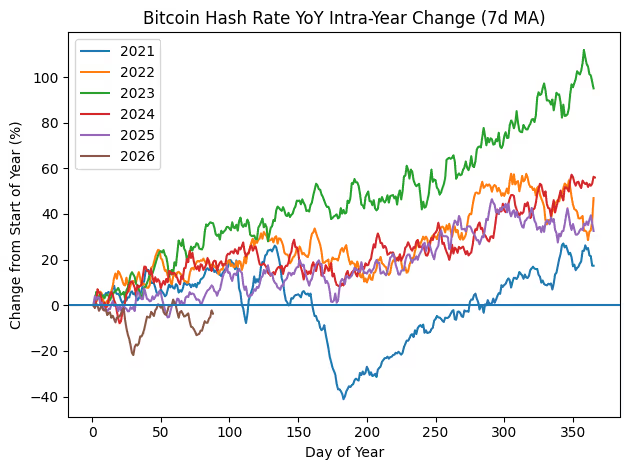 BTC Hashrate YoY (Glassnode)
The AI Pivot
The transition in 2026 indicates shifting economic conditions within the bitcoin mining industry. With production costs nearing $90,000 per bitcoin and the spot price approaching $67,000, profit margins are negative. Consequently, numerous publicly traded miners are transitioning to artificial intelligence and high-performance computing setups, which offer higher and more stable returns.
This change is being financed through debt issuance and bitcoin divestments, leading to decreased reinvestment in bitcoin mining. As a result, hashrate expansion is increasingly influenced by the cryptocurrency’s market price, with lower prices potentially prompting further reductions as smaller miners withdraw.
While a declining hashrate might raise questions about network security, the importance of decentralization may surpass that of sheer size. Publicly traded U.S. miners have represented over 40% of the global hash rate, and a decrease in their dominance could result in a more geographically diverse network. In this regard, the current transition may ultimately enhance decentralization.
Despite the slowdown, CoinShares continues to project hashrate growth to approximately 1.8 ZH/s by the close of 2026, contingent on bitcoin recovering toward $100,000.
Read More: End of bitcoin ‘HODL’: public miners going all-in on AI, signaling more BTC selling
