Disclaimer: Information found on CryptoreNews is those of writers quoted. It does not represent the opinions of CryptoreNews on whether to sell, buy or hold any investments. You are advised to conduct your own research before making any investment decisions. Use provided information at your own risk.
CryptoreNews covers fintech, blockchain and Bitcoin bringing you the latest crypto news and analyses on the future of money.


Although the Bitcoin network has progressively grown over the years, the Bitcoin mining sector has not experienced a similar rise in carbon emissions — a feat that a Bloomberg analyst suggests “few industries can assert.”
This development could potentially stimulate the next wave of institutional investment.
On September 20, Bloomberg crypto market analyst Jamie Coutts referenced data indicating that the sustainable energy composition for Bitcoin has been on the rise since 2021, now exceeding 50%. This trend has resulted in a deceleration of emissions growth in relation to the network’s ongoing expansion.
“Bitcoin as a global monetary network is scaling while its carbon impact declines. Few industries can claim this achievement”
He noted that the changing dynamics between Bitcoin network growth and the worldwide initiative to shift away from fossil fuels could “trigger a wave of institutional and even sovereign investment capital.”
The analyst further stated that since energy accounts for more than 50% of mining’s operational expenses:
“The motivation to secure the most affordable energy sources is aiding the network’s increasing hash rate while concurrently lowering the industry’s emissions or carbon intensity.”
Bottom Line: If the network expands to hundreds of millions of users, the effect on global carbon emissions will be negligible, and the technology itself is expected to play a crucial role in the transition from fossil fuels
— Jamie Coutts CMT (@Jamie1Coutts) September 20, 2023
Energy emissions pertain to the greenhouse gases and air pollutants released as byproducts from various energy sources and activities, while carbon intensity assesses the cleanliness of the electricity.
On September 18, Cointelegraph reported that the upcoming generation of Bitcoin miners is concentrating on alternative energy sources for improved efficiency.
Related Posts
Nonetheless, the proportion of sustainable energy utilized in Bitcoin mining has been a subject of contention, as Cambridge University’s model (which has not been updated since January 2022) claims that mining from sustainable energy sources is merely 37.6%.
Climate technology venture investor and activist Daniel Batten, however, contends that this figure is actually above 50%.
Google is learning pic.twitter.com/xt8flWKN63
— Daniel Batten (@DSBatten) September 19, 2023
He mentioned that the Cambridge statistics are inaccurate because off-grid mining and methane mitigation are currently excluded from its assessments.
Related: Bitcoin mining is becoming more environmentally friendly
Earlier this year, Batten reported that Bitcoin mining emissions intensity had reached its lowest level ever.
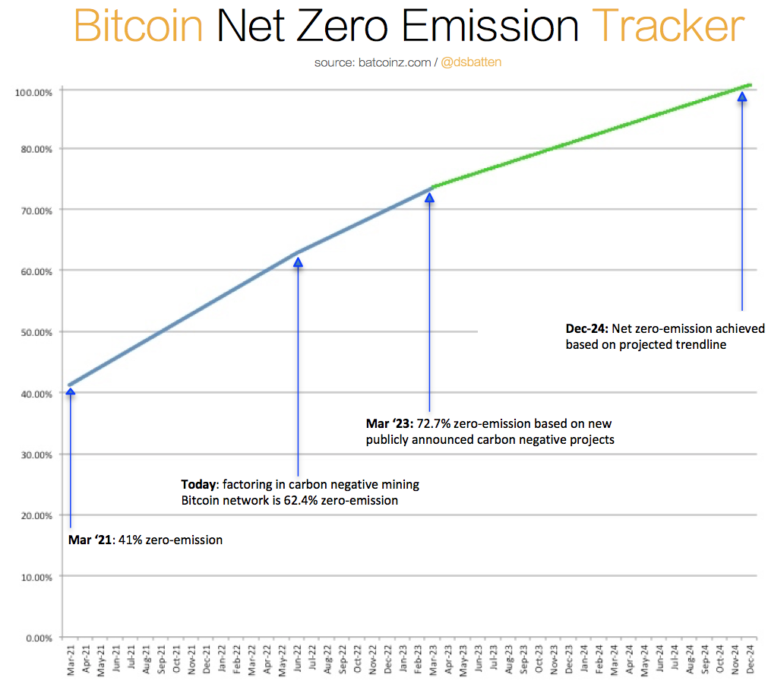 Bitcoin Net Zero Emission Tracker. Source: batcoinz.com/@dsbatten
Additionally, he forecasted that the Bitcoin network will achieve carbon neutrality by December 2024.
“By 2030, the Bitcoin network is anticipated to mitigate 10 times more emissions from the atmosphere than it generates, an extraordinary accomplishment,” asserted Batten.
Magazine: Bitcoin is on a collision course with ‘Net Zero’ promises
