Disclaimer: Information found on CryptoreNews is those of writers quoted. It does not represent the opinions of CryptoreNews on whether to sell, buy or hold any investments. You are advised to conduct your own research before making any investment decisions. Use provided information at your own risk.
CryptoreNews covers fintech, blockchain and Bitcoin bringing you the latest crypto news and analyses on the future of money.


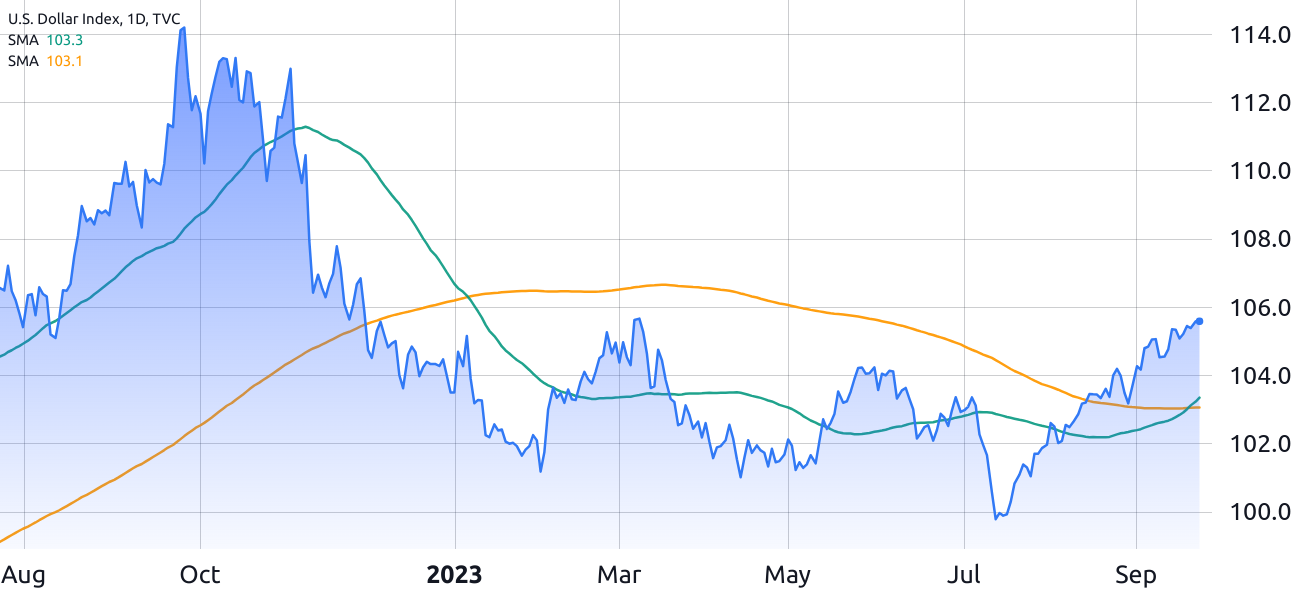
The Dollar Strength Index (DXY) reached its peak in almost 10 months on Sept. 22, reflecting an increasing confidence in the United States dollar relative to other fiat currencies such as the British pound, euro, Japanese yen, and Swiss franc.
DXY “golden cross” confirmed
Additionally, there are concerns among investors that this rise in demand for the U.S. dollar could create challenges for Bitcoin (BTC) and other cryptocurrencies, although these worries are not inherently linked.
 U.S. Dollar Index (DXY). Source: TradingView
The DXY confirmed a golden cross pattern when the 50-day moving average exceeded the longer 200-day moving average, a signal often interpreted as an indicator of a bull market by technical analysts.
Impacts of the recession and inflation risks
While some investors maintain that historical trends are dictated solely by price movements, it is crucial to recognize that in September, the U.S. dollar demonstrated strength, even amid concerns regarding inflation and economic growth in the largest economy globally.
Market projections for U.S. gross domestic product growth in 2024 stand at 1.3%, which is below the 2.4% average rate observed over the previous four years. This deceleration is attributed to factors such as stricter monetary policy, increasing interest rates, and reduced fiscal stimulus.
However, not every rise in the DXY signifies increased confidence in the economic strategies of the U.S. Federal Reserve. For instance, if investors choose to sell U.S. Treasurys and retain cash, it indicates a potential recession or a considerable rise in inflation as the most probable scenarios.
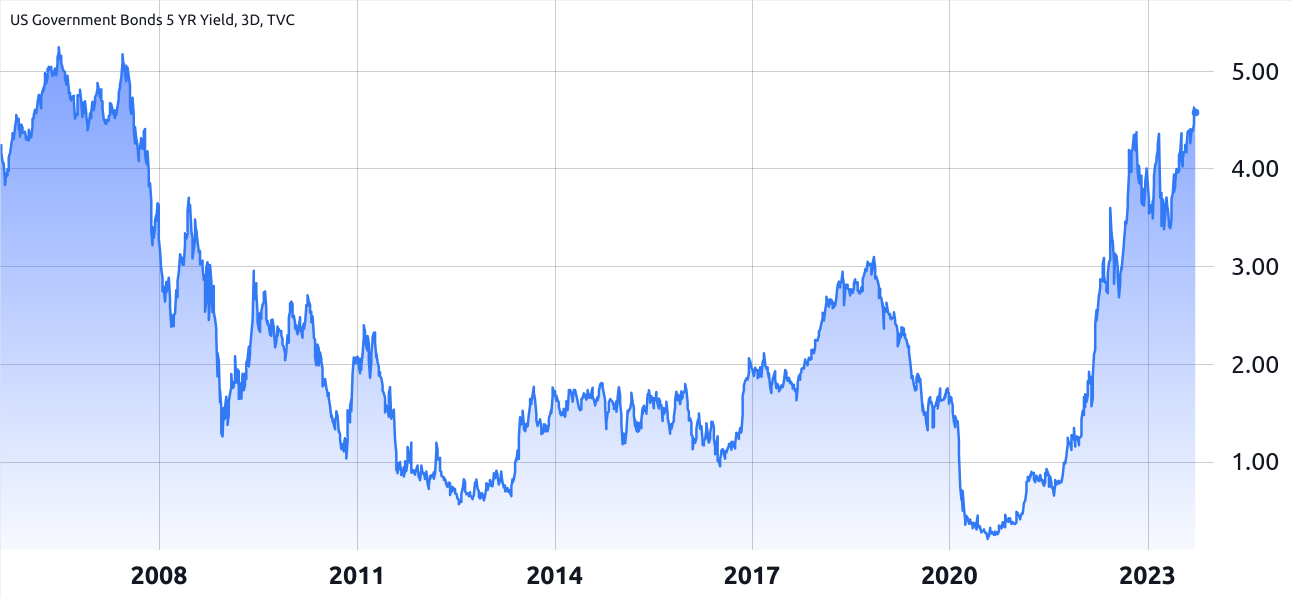
With the current inflation rate at 3.7% and trending upward, there is minimal incentive to secure a 4.4% yield, leading investors to demand a 4.62% annual return on five-year U.S. Treasurys as of Sept. 19, the highest level in 12 years.
 U.S. 5-year Treasury yield. Source: TradingView
Related Posts
This information clearly indicates that investors are steering clear of government bonds in favor of the safety of cash positions. While this may initially appear counterintuitive, it aligns with the approach of waiting for a more advantageous entry point.
Investors expect that the Fed will persist in raising interest rates, enabling them to secure higher yields in the future.
If investors lack faith in the Fed’s capacity to manage inflation without inflicting significant economic damage, a direct correlation between a stronger DXY and diminished demand for Bitcoin may not be present. On one hand, there is indeed a reduced appetite for risk-on assets, as evidenced by the S&P 500’s decline of 4.3% in September. However, investors understand that accumulating cash, even in money market funds, does not guarantee stable purchasing power.
More money in circulation is positive for Bitcoin’s price
As the government continues to raise the debt ceiling, investors encounter dilution, making nominal returns less impactful due to the expanded money supply. This clarifies why scarce assets, such as Bitcoin, and certain leading tech firms may perform well even during an economic downturn.
Related: How much is Bitcoin worth today?
If the S&P 500 maintains its downward trend, investors may exit risk markets regardless of their scarcity or growth potential, at least in the short term. In such a scenario, Bitcoin could indeed experience negative performance.
Nonetheless, it is essential to recognize that this analysis overlooks the reality that the same pressures from inflation and recession will likely lead to an increase in the money supply, either through further Treasury debt issuance or the Fed’s bond purchases in exchange for U.S. dollars.
In any case, heightened liquidity in the markets generally favors Bitcoin, as investors may seek refuge in alternative assets to safeguard against “stagflation” — a condition characterized by stagnant economic growth alongside rampant inflation.
Consequently, the DXY golden cross may not necessarily represent a net negative for Bitcoin, especially over longer timeframes.
This article is for general information purposes and is not intended to be and should not be taken as legal or investment advice. The views, thoughts, and opinions expressed here are the author’s alone and do not necessarily reflect or represent the views and opinions of Cointelegraph.
